Saturday, December 31, 2011

Packaged drinking snacks #2 出来合の酒のつまみ パート2

This is the last post of 2011. It will be the year of the dragon next year. Although this may not be a worthy ending of 2011,  this is  the second installment of the series on prepackaged drinking snacks from Japan. These three items are vacuum packed but not individually packaged. So, once you open up the bag, you have to finish them relatively quickly.

The left is miso flavored squid from Tsunami ravaged Iwate prefecture, the center is squid cheese rolls, the right is "toba" which is "cut" and "soft" accoding to the label.
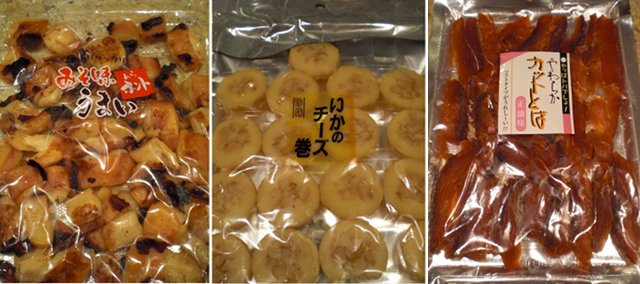
I am not sure how the squid was prepared but it is semi-dry and slightly chewy with good miso flavor. The item shown in the center picture is cut-up squid encased in mild cheese (Japanese "processed" cheese). This is rather mild and soft with a very agreeable taste. The right is "soft and cut" toba. Toba とば, written in kanji ideograms as 冬葉 which means "winter leaves". This is a famous item on my home island of Hokkaido. The name, I suppose, comes from the way the strips of salted salmon drying in the cold winter wind on the bare branches of trees resembles brown leaves. Traditonal toba is usually very chewy, or sometimes hard like a strip of leather, and very salty. It is sort of the Hokkaido version of beef jerky. This version is considerably "tamed". The skin has been removed and it is cut into smaller pieces. In addition, somehow it has been made much softer, although it is still quite salty.
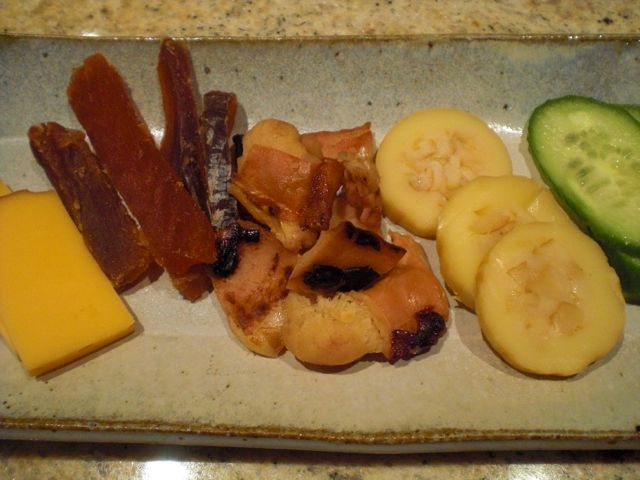
(from left to right; smoked cheddar, toba, miso flavored squid, cheese-encased squid and cucmer slices)

I served these three items with slices of smoked sharp cheddar cheese and slices of cucumber. Somehow, these drinking snacks called for scotch and water. Although we only rarely drink hard liquor now-a-days, I made a very small and weak scotch and water. Since we had not drunk scotch for such a long time, I had to hunt around to find a bottle and eventually came up with "Chivas Regal". Somehow toba goes well with scotch. Is it possible that I used to have toba with scotch in my drinking days in Susukino 薄野?

Thursday, December 29, 2011

Packaged drinking snacks #1 出来合の酒のつまみ パート1

Like mixed nuts, mini pretzels and goldfish crackers in American bars, the Japanese have a much wider array of prepackaged drinking snacks. So, when you are in Japan, in a pinch, even in your hotel room, you could have a small party without spending a fortune on room service. Drinks (beer, whiskey, chochu, sake or premixed alcoholic drinks in a can) and drinking snacks of many different kinds are available from vending machines or near-by convenience stores (you have a better choice in the latter). We received a care package from my mother. This year, for some reason, she sent different kinds of packaged drinking snacks. The four I am showing here came in a large bag but were individually wrapped. (Such double wrapping is very common for Japanese food items).
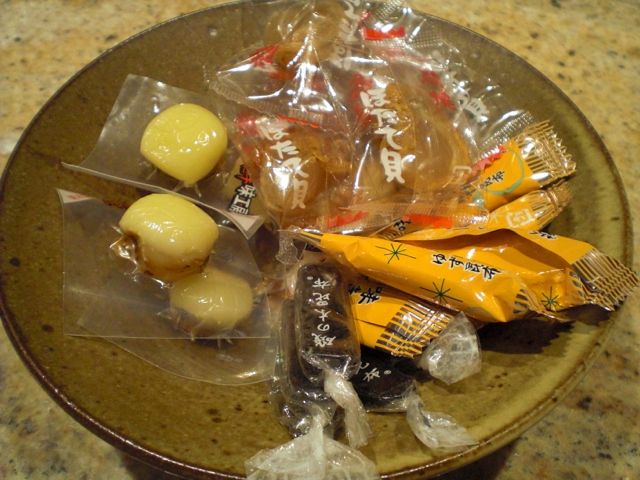
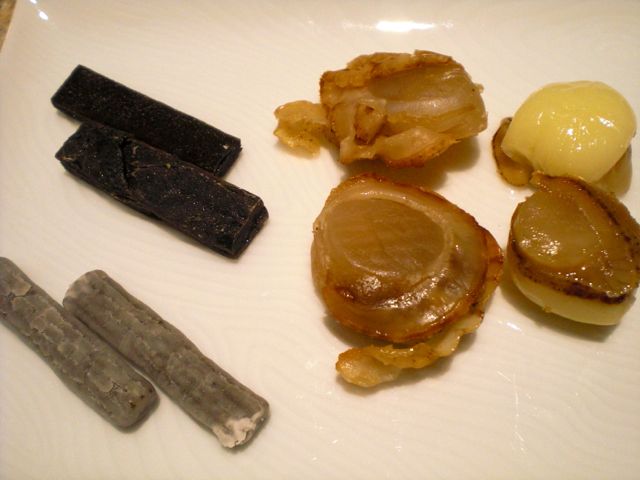
Here are the individually packaged items which can be stored at room temperature for quite some time. The below are what they look like after removing the wrappers.
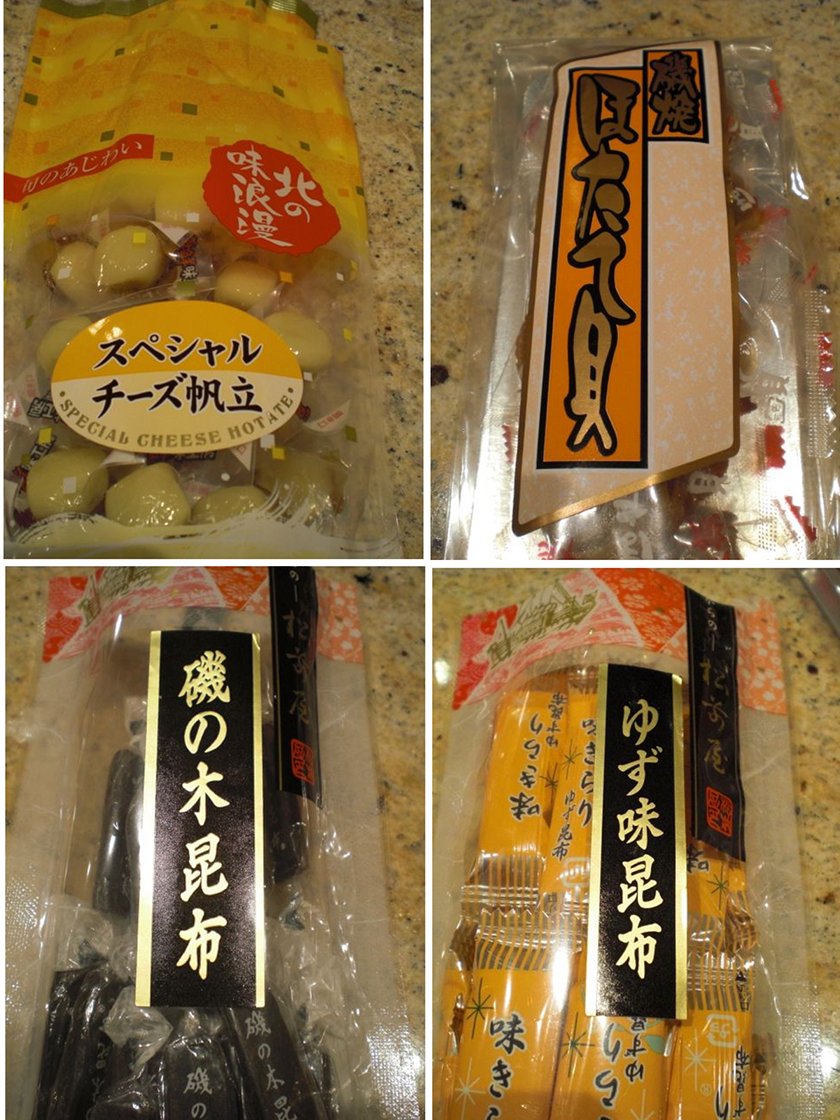
The left upper is "Iso-noki konbu" 磯の木昆布, a small layered kelp stick, which is a bit chewy but has a slight sweetness and kelp flavor (lower left in the picture below). The lower left is another kelp snack called "Yuzu-aji konbu" or yuzu-flavored kelp ゆず味昆布, a similar small kelp stick but less chewy with a nice yuzu citrus flavor (lower right in the picture below). In the center is "Iso-yaki hotate-gai" shore-grilled scallop 磯焼き帆立貝, which is a semi dried and cooked (the name implies grilled-on-the-shore) scallops. They have a nice scallop flavor but do not appear to be smoked but seasoned instead - soy sauce, mirin?? (Upper right in the picture below). Finally, on the right in the above picture is "Specail cheese hotate" スペシャル チーズ帆立, the muscle of scollop with mild cheese covering one side (Left upper in the picture below). This one is not as strongly flavored as the shore-grilled scallop.
These snacks are much more interesting and tasty (and sometimes chewy) than their American counterparts. It is very convenient as a drinking snack while you are making something else for your drink. My wife liked the yu-zu flavored kelp stick the best followed by the cheese covered scallop. I was more partial to the two scallop snacks. Whichever snacks we preferred, we both ended up drinking quantities of water--because although individually they are pleasingly seasoned cumulatively we felt we had eaten a lot of salt.

Tuesday, December 27, 2011

Omelet rice オムライス

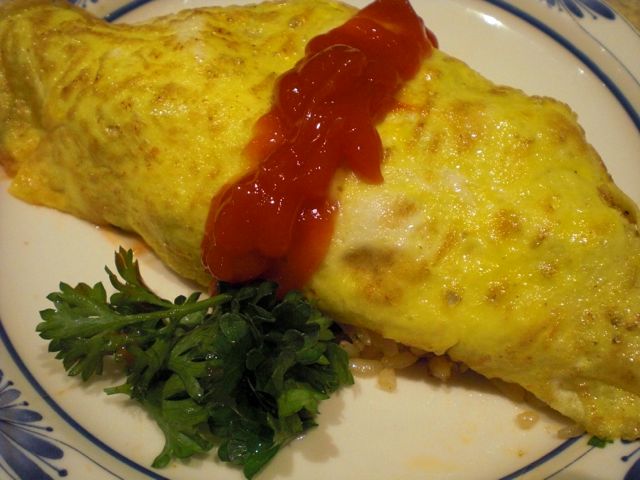
One evening, this was what we had as a shime 〆 or ending dish. I thought about what we had in the fridge and suggested to my wife "chicken omelet rice" or "omuraisu" オムライス. Omuraisu, "omu" is short for "omelet" and "raisu" i.e. rice in Japanese. It is a quintessential Japanese style Western "Yoshoku" 洋食 dish and also one "kids" like. I am not sure about the history of omuraisu but the movie "Tampopo" たんぽぽ made a version of omuraisu famous. Please see this link for the details and the actual movie footage.

The basic omurice is fried rice flavored with ketchup and covered with an omelet. I do remember my mother making it for us when we were kids. She had a special rice mold just for omurice.
You cannot really appreciate the size of this omurice seen above but this is a miniature version and probably less than 1/3 of the usual size. As such it is a perfect shime or ending dish for us.

Rice: As ususal I used previously frozen rice (about 1/2 cup) which was briefly microwaved; not warm but the grains could be separated (in my case about 30-40 seconds).

I used finely chopped shallot (1 medium or onion), leftover barbecued chicken (meat from one leg, cut into small cubes), and parsley (several sprigs, finely chopped). The more authentic recipe calls for canned green peas for greenery.

I added light olive oil (1 tbs) to a non-stick frying pan on medium heat. I first sautéed the shallot for 1 minute or until it became semi transparent, I then added the chicken meat and the rice and fried them for 1-2 minutes. I seasoned it with salt and pepper. I then moved the rice mixture to one side making an empty area in the frying pan. I added about 2 tbs of ketchup and stirred using a silicon spatula without mixing it with the rice for 1 minutes until the color darkened (which makes the flavor of ketchup a bit more complex).  I then mixed the ketchup with the rice mixture and added the parsley. I tasted (adjust the seasonings if needed) but did not need more seasonings.

After I divided the fried rice into two portions, I cleaned the frying pan and added a pat of butter and one egg (beaten) to make a thin omelet. I devided the omelet in half and draped it over the mound of rice and adjusted the shape to make it presentable. I squirted the ketchup on the top and added parsely springs as a garnish. If you have, you could erect a small Japanese flag or any national flag of your choice on the omuraisu but that is for kids. I have no idea  why a flag is used to decorate a "lunch" for kids or "Okosama ranchi" お子様ランチ in which "omuraisu" is one of the most popular items.

My wife is not crazy about "ketchup" flavored rice but I think this is a perfectly fine dish for adults to end the evening as long as you do not erect a national flag on it.

Sunday, December 25, 2011

Edible chrysanthemum with black sesame sauce 春菊の黒ごま和え

Edible chrysanthemum or "shungiku" 春菊 is one of my wife's favorite Japanese vegetables. We even grew some from the seeds for few years.  The harvest, however was was quite meager and the plants frequently got leggy consisting mostly of stalks with few leaves so we stopped growing it. Only sporadically, do I see fresh shungiku at the Japanese grocery store. This green is usually used in "Sukiyaki". My wife, however, gets quite creative with it, claiming that "shungiku in not just for sukiyaki any more." She shocked several of my Japanese friends by using it as lettuce in a salad..."but it is never eaten this way in Japan", they exclaimed. My wife asked, "why not?"

I bought shungiku last weekend but did not have a chance to prepare it. Rather than let them go waste, I decided to make this simple dish.
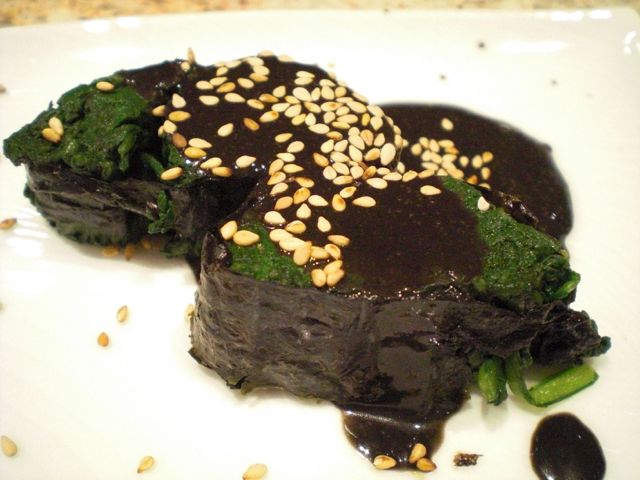
Shungiku: This started out as a good sized bunch but once cooked, like spinach, it reduced tremendously. I first cut off the largest stalks on the bottom and blanched the bunch in salted boiling water for about 1 minute and immediately shocked it in ice water. Using paper towels, I wrapped the shungiku and squeezed out any excess moisture as much as I could. I then wrapped the shungiku in nori sheet to make a cylindar. I sliced the cylindar into 4 pieces (2 pieces per serving as you can see above).

Black sesame sauce: This is exactly as I posted before. I used black sesame paste from the pouch (2 tbs), sugar (1 tsp), soy sauce (1-2 tbs), if needed, sake or mirin to adjust the consistency.

The flavor of shungiku is very unique. It is not spinach and really taste like "chrysanthemum". This is rather healthy but quick good dish. Next time, when I get fresh shungiku, I have to make sukiyaki--unless my wife comes up with something else first.

Friday, December 23, 2011

Drunken tomatoes and its "marinade" Martini 酔っ払いトマトとマーティニ

This is certainly not post-worthy but I noted it anyway just in case I have a lean time for recipes (such as now). I have previously mentioned our favorite way of preserving and enjoying Campari or cherry tomatoes; we make them into a drunken tomato or Martini-on-a-stick.
I first blanch the tomatoes (Campari or cherry or even grape tomatoes), shock them in ice water to stop the cooking and then remove the skin. For marinade, I use either straight Vodka or more often,  Vodka or Gin Martini (I prefer Gin and used Tanqueray this time, the proportion of dry vermouth is up to your taste) and soak these skinned tomatoes. After overnight soaking in a refrigerator, they are ready to be enjoyed. The most proper way is to put tooth picks and serve several on a plate with a small mound of salt on the side and call it "Martini or Bloody Mary-on-the-stick". Another way is to use it as a garnish or as a salad. 

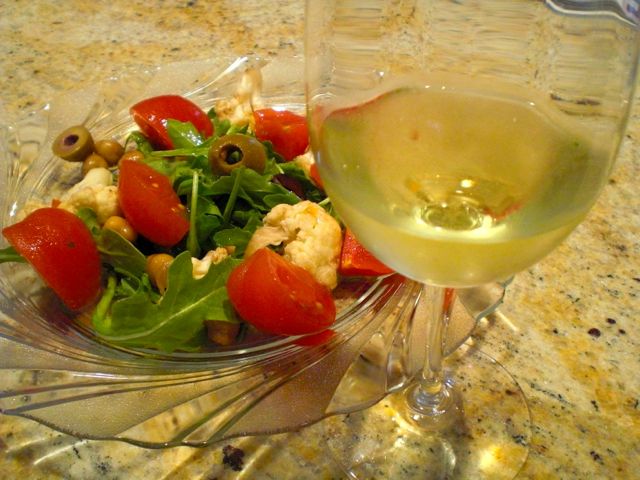
Soaking tomatoes in alcohol keep them fresh tasting for long time in the refrigerator but after one week, it is time to finish up. So I made a salad from the drunken tomatoes, leftover baked cauliflower, chick peas and olive and baby arugula.  For dressing, I simply splashed Champagne  vinegar, good fruity olive oil, a few grinds of black pepper, and sprinkling of salt.

And now, the piece de resistance is the marinade. It is essentially gin martini but has nice sweet tomato flavors and is much easier to drink than straight gin martini. It serves as a perfect aperitif, and with the salad, a promising start of the evening.