We had this with Louis M. Martini Cabernet Sauvignon Napa Valley 2012, this is a very reliable California Cab and got 90 from Wine Advocate. This winery was bought out by the Gallo some years ago but appears to be maintaining their quality. It may not be a spectacular wine but it has all the good qualities of a Napa cab. One should be careful when buying this brand, however, since they make three different versions with near-identical labels but different prices; they are from Napa, Alexander and Sonoma valleys. We tried all three in different vintages but we liked the Napa version best. This wine went rather well with the carpaccio, although the addition of fish roe resulted in a somewhat less than perfect match for red wine. The roe were in small enough amounts so as not to be objectionable and they did add a nice saltiness. The balsamic vinegar was more sweet than vinegary and did not compete with this red. The olive oil was again great, adding nice fruity, grassy tastes with a peppery finish. The octopus itself had a very neutral flavor (an euphemism for not much taste) but added great texture. We had the octopus slices with layers of the onion, cucumber which made it very nice. I made one more dish which we had with this red wine before changing to cold sake with tuna tartar (both dishes are subjects of future posts). Saturday, June 11, 2016
Octopus carpaccio variation タコのカルパッチョ
We had this with Louis M. Martini Cabernet Sauvignon Napa Valley 2012, this is a very reliable California Cab and got 90 from Wine Advocate. This winery was bought out by the Gallo some years ago but appears to be maintaining their quality. It may not be a spectacular wine but it has all the good qualities of a Napa cab. One should be careful when buying this brand, however, since they make three different versions with near-identical labels but different prices; they are from Napa, Alexander and Sonoma valleys. We tried all three in different vintages but we liked the Napa version best. This wine went rather well with the carpaccio, although the addition of fish roe resulted in a somewhat less than perfect match for red wine. The roe were in small enough amounts so as not to be objectionable and they did add a nice saltiness. The balsamic vinegar was more sweet than vinegary and did not compete with this red. The olive oil was again great, adding nice fruity, grassy tastes with a peppery finish. The octopus itself had a very neutral flavor (an euphemism for not much taste) but added great texture. We had the octopus slices with layers of the onion, cucumber which made it very nice. I made one more dish which we had with this red wine before changing to cold sake with tuna tartar (both dishes are subjects of future posts). Saturday, October 3, 2026
Octopus Carpaccio 蛸のカルパッチョ
Ingredients: (2 servings)
One octopus leg thinly sliced (The one we got was boiled and frozen).
1/4 sweet onion, very thinly sliced,
1/4 small jalapeño pepper, seeded and deveined, thinly sliced
thinly sliced parmigiano reggiano, amount arbitrary
dabs of roaster red pepper sauce (or pesto)
Ikura salmon roe, not too much
Extra- virgin olive oil, balsamic glaze
Salt and pepper
Directions:
Sprinkle some salt and pepper on the bottom of the plate, drizzle on some thin lines of the balsamic glaze and olive oil. Spread the onion and Jalapeño pepper slices over the drizzle. Spread on the octopus slices. Add thin lines of the glaze and olive oil on top. Sprinkle on the ikura and dabs of the red pepper sauce. Top everything with thin slices of Parmesan cheese
This is a really good appetizer. I also tried it with pesto instead of red pepper sauce and we like the red pepper sauce better. Although we like to have octopus in Japanese style with either wasabi and soy sauce or with sumiso sauce, this type of carpaccio really works with wine but do not over do the ikura.
Wednesday, August 5, 2015
Octopus 2 ways たこのお通し2種類
The first one is sort of octopus carpaccio (Carpaccio de pulpo). I posted a similar item in the past. I first made zigzag lines of good fruity olive oil on the plate and then criss-crossed with lines of syrupy aged balsamic vinegar. I scattered Kosher salt and freshly ground black pepper. Since I had a leftover fennel bulb which was used for making chicken paillard, I first thinly sliced fennel using a Japanese mandolin Benriner and placed them as a base. I thinly sliced boiled octopus leg and placed in one layer on the top. I added a few slices of fennel, thin slices of cucumber and scattered oil cured back olives (after removing the stone). I finished with lines of olive oil and balsamic vinegar, Kosher salt and black pepper. Fennel added anis-like flavor and oil cured olive gave a burst of saltiness. This combination was quite good.
Using the tips of the octopus leg, I also made a small Japanese style salad with karashi-su-miso 芥子酢味噌 dressing. I just cut the tips into small bite size chunks. I sliced cucumber, salted it and squeezed out the moisture. I then took salt preserved (not dry) Wakame sea weed, washed it to remove the salt and soaked in water for a few minutes then cut into small pieces. The dressing is a mixture of white (sweet "Saikyo" 西京味噌) miso, rice vinegar, Japanese mustard and sugar.
Because of the acidity in the dishes, sake was the best choice although the first Carpaccio dish could go with wine. These were good starters with cold sake.
Wednesday, February 11, 2015
Carpaccio of octopus タコのカルパチオ
When I made salmon gravlax, I bought navel oranges which turned out to be very sweet and juicy—the best oranges we have had for some time. So I decided to use the orange fruit as well as a bit of it's juice.
Ingredients (for 4 servings):
Sweet onion: one medium, thinly sliced in rings using a Japanese Mandoline (Benriner)
Boiled octopus legs: 2 thinly sliced on bias.
Navel orange: one large, fruit separated from membrane and cut into small chunks
Watercress: remove thick stalks
Olive oil: Good fruity extra-virgin olive oil
Balsamic vinegar: Aged sweet syrupy one
Salt and pepper (I used smoked sea salt).
In a small serving dish, I freshly cracked some smoked sea salt. Then, I drizzled on lines of olive oil. I repeated the process this time with balsamic vinegar which I drizzled in lines perpendicular to the ones I made with the olive oil to form an olive oil, balsamic vinegar grid on the plate. I then scattered thinly sliced onion. I placed the slices of the octopus to cover the entire center portion of the plate. I added the orange chunks, more slices of onion, and then the watercress. I drizzled lines of olive oil and balsamic vinegar on the top, and sprinkled on the juice of the orange, salt and pepper.
This was a great hit. Our guests had never had octopus before. They guessed that the octopus was a “protein” but did not know what it was. We had this with champagne.
Friday, May 13, 2022
Beef tongue carppaccio 牛タンのカルパッチョ
My wife loves beef tongue but not the way it’s usually prepared in Japan (thinly sliced and grilled). As a result I usually prepare the tongue by boiling it in water with some aromatics which is how the beef tongue she ate as a child was prepared. (She refers to it as the Pennsylvania Dutch rather than Japanese method of preparation. The Pa Dutch method results in a meat that is extremely tender and melts in the mouth. The Japanese method in contrast results is a fairly tough and chewy meat. As my wife would say, “Which is the best method of preparation? What was the question?”) After removing the skin, I thinly slice it and make sandwiches using pumpernickel bread with mayo and mustard. (Again made to the exacting specifications of the tongue sandwiches my wife used to eat as a child.) Portions are further cooked as a Japanese-Western style beef tongue stew. (Which by-the-way was not something my wife used to eat as a child but likes non-the-less.)
We have not able to get beef tongue for a while. Although we know one of the grocery stores usually carries it, we have not been there recently since we are getting grocery home delivery. But an unexpected event led us to be at this particular grocery store and since we were there we snagged a rather large beef tongue. We enjoyed the tongue over several days as sandwiches and stew with spaetzle. I finally used the last portion of the tongue to make carpaccio (left in the picture below) and a small salad in Japanese-style (made using the PA. Dutch style prepared tongue, of course) with ponzu, yuzu-kosho, onion, cucumber topped with sesame seeds (right)
For the other salad, I just used the cucumber and onion left over from the previous salad. I arranged it with the onion on the bottom, the tongue (thinly sliced) next and topped with the cucumber. I dressed it with ponzu ポン酢 mixed with Yuzu-kosho 柚子胡椒 and topped with sesame. (The dressing is what made it Japanese style.) We liked the carpaccio better.
Tuesday, June 14, 2016
Tuna, asparagus and poached egg 鮪漬けの炙りとアスパラガスの温玉添え
- I thawed the frozen block of tuna overnight in the refrigerator. I sliced half of the block into half inch thick slices.
- This time I made "Goma-dare" for marinade. I first dry roasted white sesame seeds in a dry frying pan (1 tsp) until slightly darkened and fragrant (the sesame was already roasted but re-roasting it add much more flavor). I ground the seeds in a Japanese Suribachi すり鉢 mortar. I then added mirin, sake and soy sauce in a ratio of 1:1:2.
- I placed the tuna and the marinade in a Ziploc bag to make sure all the surface of the tuna was covered with marinade and removed as much air from the bag as I could. I sealed the bag and kept it in the refrigerator overnight.
- The next evening, I took out the tuna slices, blotted the excess marinade from the surface (picture below) and cut one slice into two.
Monday, April 26, 2010
Morimoto, Philadelphia, April 23, 2010. レストラン森本、フィラデルフィア
(from http://www.top-hotels-restaurants.com/files/morimoto-restaurant/5.jpg)
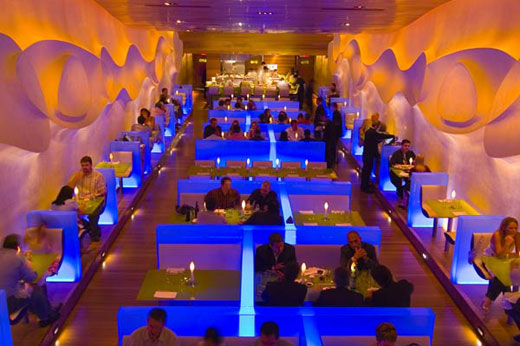
We finally made an excursion over the weekend to dine "omakase おまかせ menu" at Morimoto in Philadelphia. From the hotel, we walked to Morimoto down Chestnut street. The walk was an interesting mix of inner city decay amid the former splendor of old Philadelphia and the inspiration of new businesses taking root. The block on which "Moriomoto" is located may need more time to fully recover its former glory. Opening the semi-transparent door, the inner decor is certainly not Japanese in any way. The space is deep and narrow with a tall undulating ceiling. In the back, there is a large square counter and the open kitchen and further back the closed main kitchen. Both sides of the main floor are slightly elevated and it is one step up to the tables for two. The center booths are divided by semitransparent Plexiglas low partitions back lit by blue and red neon in the bottom of the partition. The color of the neon changes every-now-and-then but mostly stays blue giving an impression of the bottom of the sea. We were seated at a table for two on the elevated portion. For us, "midgets", the chairs were too tall--for the first time since childhood, our feet did not touch the ground, and it was not really comfortable. We weren't entirely sure about this interior decor but it does indicate things to come in term of the cuisine.
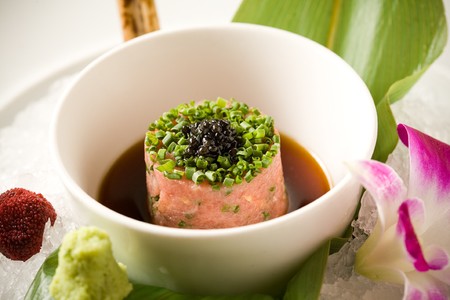
The first course was a rather mundane "Toro tartar" with crisp fried shallot, chive topped with caviar and a small amount of broth in the bottom made of dashi, mirin, and soy sauce. The wasabi that accompanied it appears to be from a real wasabi daikon 山葵大根. The toro was too finely mashed and we would have preferred finely diced instead. The crispy fried shallot was very nice. The sauce was too sweet. The caviar must have been North American (may have been even Paddle fish caviar) and did not add much. They gave us a small stainless steal spoon but we would have preferred non metal spoon for this dish.