Saturday, February 7, 2026
Appetizers; one with Shad Roe 酒のつまみ
Nothing particulary new but two may deserve some notes:
1. Nagaimo-shad roe gelee:
Japanese tarako is slat marinated but not cooked. I used tarako without further cooking for this dish.
Since Shad roe is not slated or cooked, i modified my recipe. I first removed the roe from the sacs and marinated in the equal mixture of x4 concentrated Japanese noodle soup and mirin for several hours in the refrigerator (good amount of the marinade get absorbed).
After draining the excess marinade, I cooked the roe in the frying pan with melted butter in low heat until the color changes (or cooked). Let it cooled down and use it like tarako.
I used 1 cup of Japanese broth with 3/4 envelope of unflavored gelatin. Seasoned with splashes of dark sesame oil and tabasco or sriracha. For the nagaimo layer, I seasoned with small amount of sushi vinegar.
2. Daikon Kimpira:
I had the last of a good daikon from Suzuki Farm. I peeled (a bit thickly) and cooked with a pinch of raw rice grains (which can be used in simmered dishes such as oden. I cut the peels with skin in match stick and made kimpira with daikon green (from daikon from Weee we just got) and fried “abura-age” tofu.
In the picture #2, i served the nagaimo-shad roe gelee (top center), kelp salmon roll 鮭の昆布巻き (left lower) and salmon nanban 鮭の南蛮漬け (right lower).
Monday, January 10, 2022
New Year 2022 Jan 3 Salmon three ways 一月三日鮭尽し
We have been enjoying the items from the Sushi Taro osechi box. After indulging in a serving of wonderful dishes from the box which go perfectly with sake, I served this plate as the “second course”. The red and white fish cake or "kouhaku kamaboko" 紅白蒲鉾 (upper left in the picture) came from the osechi box (they were the last four slices). I made a deep pocket in each and stuffed the pink one with the leftover Maruhide sea urchin shutou 丸秀雲丹の酒盗 topped with a dab of wasabi. I topped the white one with Ikura marinated in soy sauce イクラの醤油ずけ topped with strips of nori.
The remaining items were all different salmon dishes which I prepared for New Year. Starting from right upper, clock wise, is salmon nanban 鮭の南蛮漬け、Russian marinated salmon 鮭のロシア漬け, and finally salmon kelp roll 鮭の昆布巻き. These three salmon dishes all have different textures and flavors. For the salmon nanban, the salmon was dredged in flour and fried before being marinaded in sweet vinegar which gave it a bit firmer texture. The Russian marinated salmon started out as thin strips of raw salmon marinated in sake, vinegar and oil without any sweetness. This year I something different. I added dijon mustard to the marinade and emulsified it with the “motor boat” emersion blender. As a result the oil didn’t separate or solidify. Also, the salmon did not “over cook” and had a lovely soft texture. Finally the salmon kelp roll was simmered for sometime in seasoning broth, producing a yet different soft and moist texture. These are wonderful to enjoy with sips of sake.
Saturday, August 21, 2021
Simmered eggplant and shime-saba with grated daikon 茄子の忘れ煮としめ鯖のおろし和え
Ingredients:
One package of shime-saba, thawed, lightly washed with sake, patted dry, thin skin removed, and then cut into thin (1/4 inch) slices.
2 tbs ponzu shoyu ポン酢醤油 (from the bottle, or equal mixture of rice vinegar or citrus juice and soy sauce)
2 inch long daikon, peeled and grated and excess moisture drained*
Rehydrate dried seaweed mixture, arbitrary amount (optional)
Chiffonade of perilla and lemon wedge for garnish
Directions:
In a bowl, add the shime-saba, grated diakon, seaweed and ponzu and mix, I also added additional yuzu juice (from the bottle) for a good measure. I let it marinate for several hours to overnight, then topped it with the perilla and lemon.
I made the eggplant dish since I got 2 Japanese eggplants at the Japanese grocery store a week ago and did not immediately use them. (My wife was kind enough to reminded me that eggplant, even the Japanese kind, does not improve with age.) The dish is also from the same web site I got the recipe for the mackerel dish. I decided to make this since it does not use any oil and looked healthy and simple. The Japanese name is "Wasure-ni" 忘れ煮 meaning "forgot that it was still simmering" indicating involving long simmering. The original recipe calls for "hoshi-ebi" 干しエビ, small dried shrimp, which is used to add "umami" flavor and fresh "myouga" 茗荷 but I did not have either one so I skipped the shrimp and substituted fresh myouga with vinegard myouga 茗荷の甘酢漬け we made almost one year ago as a garnish. I added slices of ginger in the simmering liquid whihc was not part of the original recipe. I served this with blanched broccoli rabe which is the closest we can get to "Nanohana" 菜の花.
Ingredients:
One Japanese eggplant (this one was on the larger side), remove the stem end, cut in quarters lengthwise, multiple thin slice cuts on the bias through the skin into the flesh but not all the way through and immediately soak in salted cold water for 10-20 minutes.
2 slices of ginger
Threads of ginger root for garnish (skin, slice thinly and then cut into thin threads).
For broth
1 cup Bonito broth (I made it from a dashi pack)
1/3 cup of concentrated Japanese noodle sauce (or mirin and soy sauce in equal amount).
two slices of ginger (original recipe calls for 1 tbs dried shrimp)
Directions:
Heat up the simmering broth until boiling
Put the prepared egg plant, the ginger slices and cover with a inner "otoshi" buta 落とし蓋 (I used a silicon "otoshi-buta" or cover it with an aluminum foil made it to a round, slight smaller than the pot opening, place the lid and simmer for 20-30 minutes.
Friday, May 7, 2021
Three appetizers with two new ones 新しいお通し2種
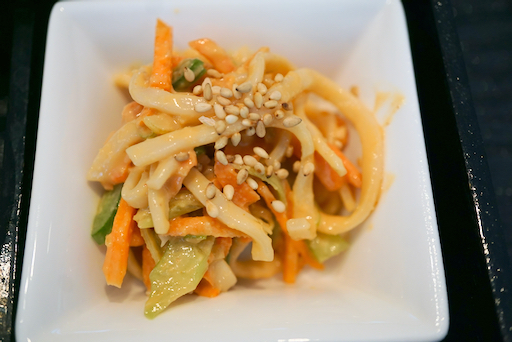
I served these three appetizers one evening. The dish shown on the left in the first picture is my stand-by fried salmon in sweet vinegar or “salmon nanban” 鮭の南蛮漬け. The new ones are the one in the center “dried persimmon and daikon in sweet vinegar” 干し柿の大根なます and the one on the right, “udon noodle salad with peanut butter dressing” うどんのピーナッツバター和え.
2 dried persimmon, stem end and seeds removed and cut into strips.
1 inch segment of daikon, peeled, and cut into buttons then julienned.
Carrot and/or celery julienned (optional)
1/2 cup sweet vinegar (1/2 rice vinegar, 1/4 cup sugar or 2:1 ratio, pinch of salt, heat until dissolved. Then let it cool)
1 Tbs roasted white sesame seeds, fine ground (I used a Japanese mortar and pestle or suribachi.
1/2 tsp dark sesame oil
Directions:
Salt the daikon pieces and knead, then let it stand for 5-10 minutes.
Add all the ingredients and the sweet vinegar.
Let it marinate for at least 30 minutes in the refrigerator.
Ingredients: (amount is all arbitrary)
Cooked thin udon noodle
Carrot, julienned
Scallion, sliced thinly diagonally
Sesame seeds for garnish (or crushed peanuts)
For Dressing:
Peanut butter, soy sauce, and rice vinegar in 2:1:1 ratio
Dash of dark peanut oil
Sugar and sriracha to taste
Minced ginger and garlic to taste
Add warm water if the consistency is too thick
Directions:
Cut the noodles into 1-2 inch lengths (optional but for ease of eating)
Dress with the peanut dressing.
Garnish with sesame seeds or crush peanuts.
Sunday, April 25, 2021
Four appetizers in new small bowls 御通し4種類と新しい小鉢
We have a good number of small Japanese-style bowls and plates but for some reason my relationship with breakable dishes ends up with them getting broken every-now-and-then. So I am always on the look out for potential replacement small Japanese style dishes/bowls. (Also, since enjoyment of food is visual in addition to taste, I just like different bowls in which to present what I make to complete the entire experience). I found these small bowls on Amazon. They came in four different patterns/colors in a set of four (i.e. total of 16 bowls) . I ended up getting all 4 sets. So, this is the first time I used this set to serve 4 appetizers. The first picture, from left to right, are "salmon nanban" 鮭の南蛮漬け, "hijiki seaweed stir-fry" ひじきと油揚げの炒めのも and Japanese "dashi-maki" だし巻き卵 omelet, "Wood ear"* mushroom, cucumber and wakame seaweed sunomono" キクラゲ、ワカメ、胡瓜の酢の物, and "shredded chicken tenderloin and asparagus in sesame dressing" 鳥のささみとアスパラの胡麻和え.
*Wood ear mushroom is so-called because it grows out of the surface of wood like an ear sticking out. Japanese call it "ki-kurage" meaning "jelly fish of the wood" because the crunchy texture is similar to dried and salted edible jelly fish. It is interesting, however, when it is written in "kanji" ideograms, it is 木耳 which means wood 木 ear 耳. There is no way you can pronounce 木耳 as "ki-kurage" but the meaning of these two ideograms indeed mean "wood ear".
Saturday, February 27, 2021
One spoonful appetizers and more
Saturday, December 19, 2020
Appetizers 4 kinds お通し4種類
Ingredients:
3 Japanese eggplant
2 tbs neutral vegetable oil
two small pieces of ginger, crushed with the side of the knife.
250ml Japanese dashi broth (I made this with my usual bonito and kelp dashi pack)
3 tbs soy sauce
3 tbs mirin
(Instead of soy sauce, I am using "shirodashi" 白だしand light colored soy sauce).
Directions:
Cut the eggplants in half lengthwise. Shallowly cut the skin in crosshatching pattern and then cut lengthwise again to make 1/4 eggplant.
Add the oil to a frying pan on medium flame and add the ginger for a few minutes until fragrant.
Add the eggplants skin-side down and fry for 3-4 minutes and turn over to fry both of the fresh sides for 2-3 minutes each,
Add the seasonings and broth (below), put on the lid and simmer for 3-4 minutes.
This is good eaten hot right after it is cooked but it can also be stored in the broth in a sealable container in the refrigerator. The stored eggplant can be eaten cold or heated up in the microwave.
This is usual salmon nanban. This one was really good since the quality of the salmon (from Whole foods) was good and I did not over cook it. I served this with sugar snap in salt broth スナップ豌豆の塩びたし.
Mr. and Mrs. Segawa of Tako Grill kindly gave us "kazunoko" herring roe 数の子. I prepared it as I described in my New Year dish tab. The half serving shown below was soaked in dashi broth with soy sauce and mirin seasoning. I marinated the other half serving in sake-lee and miso mixture or "kasu-miso" 粕味噌. Since this preparation will last longer than the one soaked in dashi broth we will eat it closer to the holidays.
I also served Spanish mackerel in miso sauce 鯖の味噌煮. (The red dots surrounding the mackerel are part to the decoration of the bowel not part of the preparation.)
This was a quite a good starter line up for the evening.
Wednesday, December 16, 2020
Cuttlefish legs with simmered vegetables イカの足いり根菜の煮付け
Saturday, July 25, 2020
Horse mackerel wrapped in perilla leaves 鯵の大葉バター焼き
4 raw jack mackerel or "aji" filets (thawed if frozen)
1 tbs miso
1 scallion, finely chopped
1/2 ginger, finely chopped
1/4 tsp soy sauce (optional)
1/4 tsp sugar
10 perilla leaves, washed and dried with stem end removed
Butter for frying
Directions
I first made "namerou" by chopping and pounding the aji with a sharp knife until the aji became a bit pastey. I mixed in the scallion, ginger, miso and sugar and kept pounding until well mixed. You could add a bit of soy sauce to adjust the seasoning and consistency. I placed a small amount of namerou on a perilla leave and folded it into half-moon shape (below)
Sunday, July 19, 2020
Salmon appetizer 4 kinds 鮭のお通し4種
This is the usual salmon salad. Instead of crackers, I served it with slices of cucumber so that we would not get filled up too quickly.
Below is "salmon nanban" 鮭の南蛮漬け. This is a variation of nanban 南蛮. I made it with chicken, jack mackerel 鯵, "shishamo" ししゃも or capelin fish previously.
Monday, October 21, 2019
Capelin "nanban" シシャモの南蛮漬け
Along with this dish, I served store-bought "satsuma-age" fish cake 薩摩揚げ, "dashimaki" omelet だし巻き卵, sugar snap スナップ豌豆の塩びたし, simmered kabocha かぼちゃの煮物(center square plate) and boiled octopus leg with rapini. This was quite a big starter.
Ingredients:
One package (10) "shishamo" capelin thawed
2-3 Tbs potato starch "katakuriko" 片栗粉 for dredging
One sweet onion, halved and cut into thin strips
One medium carrot, peeled and cut into small julienne
Few dried Japanese "nanban" togarashi 南蛮唐辛子 red pepper, cut into small rings
One cup sweet vinegar (one cut rice vinegar, 1/2 cup sugar and 1tsp Kosher salt, boiled to dissolve)
1/2 vegetable or peanut oil for "shallow" frying
Direction:
Dredge shishamo with the potato starch (#1)
Add the onion and carrot in a sealable container and pour the hot sweet vinegar and let it cool to the room temperature (#2)
Shallow fry (or deep fry if you so prefer) in 1/4 inch deep oil (#3) for a few minutes and then turn over and cook another minute or two (#4)
Remove half of the vegetables from #2 and add the fried shishamo (#5)
Add back the vegetables to cover the fish (#6)
Put the lid on and refrigerate for a few hours or overnight.
As a rescue dish for old frozen shishamo, this was quite good. Frying and marinating in sweet vinegar really made it more than edible. Because of the preservative nature of the marinade, we kept enjoying this dish for a week (one small fish at a time). This dish is perfect for cold sake but not great with red wine because of the acidity.
Friday, January 5, 2018
Sushi taro Osechi and New Year's day evening 2018 元旦の夕べ
Although we were ready to dig into our Sushi-taro osechi box 寿司太郎御節箱, I started with what I made, which, to my surprise, mostly filled the boxes. I only added shiitake-umani 椎茸旨煮 and "fu" gluten cake 梅麩 from the Sushi-taro osechi box. For the occasion, I used "Hagoita 羽子板*"-shaped chopstick pillows or "hashi oki" 箸置き.
*Hagoita is a racket for Japanese badminton-like game which was traditionally played in New Year. Now, almost nobody plays the game and "hagoita" rackets are a purely decorative item for New Year, there are special "ichi" or markets before the New Year which specialize in decorative "hagoita".
Recipes for most of the dishes I made are posted in the "Norio's New Year's Dishes" tab in this blog. #1=Salmon kelp roll 鮭の昆布巻, #2= salmon "Nanban" 鮭の南蛮, #3=Russian marinaded salmon 鮭のロシア漬, #4=Date-maki omelet roll 伊達巻き, #5=chicken patty with dried fig and Gorgonzola cheese いちじくとガルゴンゾラチーズの松風焼き (I garnished with my figgy cranberry sauce), #6="Matsukaze-yaki" chicken patty with pine nuts, 松風焼き#7=simmered shiitake mushroom 椎茸旨煮 and "fu" gluten cake 梅麩 (these are from the osechi box), #8=blanched green asparagus with mayo-sesame paste-soy sauce アスパラの胡麻マヨ, #9=Thinly sliced rib roast with wasabi/horseradish Greek yogurt sauceローストビーフ, and #10=spicy tofu cubes ぴり辛豆腐.
After watching the sun set, we came back downstairs and hit the osechi box. The picture below is the top layer. We were excited to find "Karasumi 唐墨" Japanese bottarga. As usual, the box is packed with goodies.
Here is the close up of sun-dried karasumi 天日干し唐墨.
The picture below is the bottom layer.
This is the plate I prepared from the osechi box. I served the karasumi slightly heated in a toaster oven and sandwiched between thinly sliced daikon. The other items are ginko nuts 炒り銀杏, pickled flower-cut lotus root 花輪蓮根, steamed "uni" sea urchin 蒸し雲丹, caramelized small shrimp "Tsuyani" 小海老艶煮 and grilled Japanese "Madai" snapper with Japanese pepper tree leave/miso or "kinome" sauce 真鯛木の芽焼き. I also heated up the fish in the toaster oven. Some items especially grilled fish are best enjoyed heated up slightly to take off the chill of cold. Karasumi is, of course, our favorite and we started with cold sake we brought from Japan on the last trip there.
Here is the close up of all the items which go so superbly with sake.

The sake we opened was the limited edition, "extra premium Jurakudai" daiginjou from Sasaki-shuzou in Kyoto 聚楽第大吟醸エキストラプレミアム, 佐々木酒造、京都. It was brewed from Yamada Nishiki 山田錦 milled to 40% and a special artesian well water from the ruin of "Jurakudai" castle 聚楽第跡, hence the name of the sake. All sounded very promising but it was not as impressive as we had hoped. It has all the characteristics of daiginjou sake. Very fruity and it almost tasted slightly sweet which may not have been our favorite type of sake. Since this was bought at the duty-free shop in Narita airport, we did not have a large selection and we did not have any foreknowledge of the sake we were buying. Still, this was an excellent sake, especially with karasumi, uni and grilled fish with kinome sauce. Kinome has such a distinctive flavor you cannot miss. So we were warming up for more goodies and proceeded to make a second plate from the osechi box.
The below are the second plate which included "tarako" cod roe kelp roll 鱈の子昆布巻, flower-cut simmered carrot 梅人参, sweet simmered chestnut with inner skin 栗渋皮煮, pickled myouga 酢取茗荷 (new this year), Kumquat in syrup 金柑, simmered sweet fish with roe 子持鮎甘露煮, herring roe marinaded in miso 数の子味噌漬. I am not sure if snow pea 絹サヤ came from my own or from the osechi box.
Herring roe was very nice with very subtle sweetness.
Japanese sweet fish "ayu" with it's roe was also perfect.
At this point, we were quite full. As a ending dish, we had my fuccacia bread with Spanish olive oil for dipping.
This was a pretty auspicious way to start the New Year but it's not over yet. There are many more goodies in the osechi box.