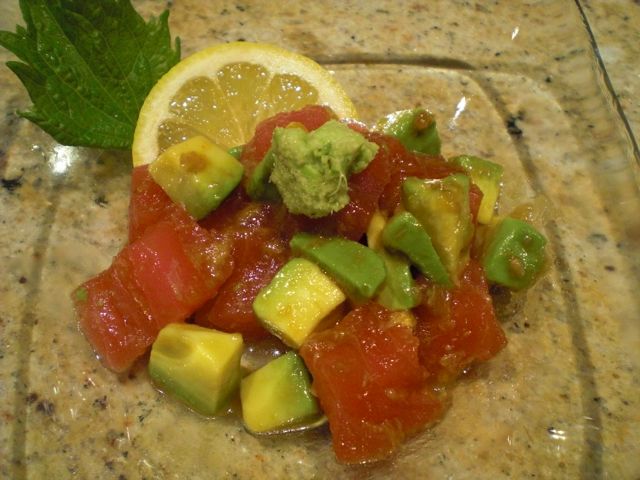
Friday, June 19, 2026
Grilled Tofu-puff with Egg Yolk Miso 柚子胡椒入り玉味噌の焼き油揚げ
*It is a mixture of salt, chopped peel of a Japanese citrus called "yuzu" 柚子 and chili pepper (usually green chili pepper but it could also be red chili pepper). It is available through Japanese grocery stores or from Amazon.>
“Tama-Miso” is fairly common condiment/sauce in Japan with various variations. It can be used as a grilling sauce called “denegaku 田楽” on tofu and eggplant, dipping sauce (for cucumber sticks). I did not follow any particular recipe to make the “Tama Miso”.
I could have grilled the final product in the toaster oven but I cooked it in a frying pan (which is easier). Just grilled abura-age can be a good drinking snack (with grated daikon and soy sauce) but the addition of various stuffings make it even more interesting and better. I had made and posted different variations of abura-age dishes including ones stuffed with cheese, nori with suriracha, gyoza stuffing and even nattou.
This rendition is a bit different from anything I posted before because of the use of “Tama Miso” and “Yuzu kosho”. The rich favors of the tama miso and mild spiciness and citrus flavors, worked very well encased in crunchy grilled abura-age skin. I served this with steamed brocollini dressed in mustard soy sauce. This was a perfect small dish for the “home” Izakaya.
For “Tama Miso” with Yuzu Kosho:
Ingredients: (makes about 1/3 cup)
2 egg yolks
2 tsp sugar
1 tsp. or more of yuzu kosho (to taste)
3 tbs white miso (I used Saikyo miso which is a sweet white miso) or a combination of red and white miso
1 tbs mirin
2-3 tbs sake
Directions:
In a small sauce pan, add all the ingredients except for the sake and mix well until smooth. Add the sake and mix so that the consistency is loose like pancake batter. Place the pan on a low flame and stir constantly until the egg yolks are cooked and reduced to the consistency of the original miso before you added the sake. Let it cool. It will further thicken (#3 in the composite picture). It will keep at least a week in the refrigerator.
Assembly and cooking of the stuffed abura-age:
Thaw the abura-age if frozen (#1). Using a sharp paring knife, cut along three sides and open like a book (#2). Using a spatula, smear the tama miso (#3) on one side of the open abura-age (#4). Close and make sure both sides are adhering well. Place it in a dry frying pan on medium low flame and cook until lightly brown (a few minutes) turn it over and cook the other side a few more minutes. Cut into 4 pieces and serve warm.
This is a very satisfying snack. It has a nice crunch and toasty flavor from the cooked abura-age. The inside provides a mellow richness with a little spiciness from the yuzu kosho. Although it is a very light mouthful, it is full of a complex range of flavors. Great with either red wine or sake.
Tuesday, December 20, 2022
Nattou ball 納豆つくね
This recipe also came from a YouTube episode by the original Japanese Iron chef Rokusaburo Michiba 道場六三郎. He made two dishes from nattou 納豆, the infamous sticky and smelly Japanese dish of fermented soybeans, which often appears as part of breakfast. Nattou is most commonly eaten over rice for breakfast. Another less common but popular way is in miso soup for a dish which is called “Nattou-jiru” 納豆汁. Even among the Japanese, some (especially from “Kansai” 関西 west part of Japan) do not eat it and some love it. (I belong to the latter category).
For many years my wife referred to nattou as the one Japanese food she just could not eat—the smell, the sliminess, the fermented taste. (Every culture seems to have a dish like this; an acquired taste developed in childhood. Think ripe French cheese or Australian vegemite. And for me, believe it or not, cooked oatmeal). Then my mother learned that the natto-nastiness could be alleviated by stirring it. She recommended several hundred turns would do the trick. The stirring apparently enters air into the natou that helps remove the smell and stringy sliminess. All of a sudden natto was on my wife’s menu.
I have made quite a few dishes with nattou, many of which are focused on reducing the stickiness and the smell. In any case, Michiba made a miso soup but, instead of mixing nattou into the soup, he made nattou into balls which he called “nattou-tsukume*” and then put it into miso soup. I made it as a small appetizer one evening. I put a small amount of miso soup (made it a bit stronger) as a sauce and topped it with Japanese mustard (see picture below)
* “Tsukune”, “Tsukuneru” which means “knead” or “mix”, and is usually made from ground chicken and a most common item in “Yakitori” 焼き鳥.
Ingredients (4 tsukune balls):
1 stalk of chopped scallion
1 tbs katakuriko potato starch
2 cups of Japanese dashi broth
1-2 tbs miso
Japanese hot mustard (from tube) slightly diluted with water for topping
Directions:
Prepare the natou by adding the sauce, mustard and the scallion. Mix well (stir over 100 time if you have the time), add the potato starch and mix.
Using two spoons, moistened, I made four quenelles (or moisten your hands and make small balls) and drop them in the simmering broth.
Cook it for several minutes (see below).
You could dissolve the miso and serve this as “miso soup”. I wasn’t ready to serve the dish so I separated the nattou balls and the broth and placed them in a sealed containers and in the refrigerator.
Before serving, I warmed up the nattou balls in the preserved broth. I took out a small amount of broth and dissolved the miso to taste.
I served the miso broth in a small dish, with the nattou ball and topped with the mustard

This is a very interesting dish. The hot Japanese mustard made this dish. Although the nattou balls tasted like nattou to me, the texture and smell is quite acceptable (especially for my wife’s palate). “Mikey liked it!”
Wednesday, July 11, 2018
Nattou and avocado salad 納豆とアボカドのサラダ
As a garnish, I used a chiffonade of basil and dried nori strips. The only reason I used basil instead of perilla was that some cuttings of basil which my wife had harvested were sitting in a glass of water on the counter in front of me. I served more nori strips on the side so we could add more as we ate the salad and mixed the ingredients together.
The avocado and tomato were dressed with Mayer lemon juice (I happened to have one. We love the flavors of Meyer lemon), olive oil and Kosher salt.
Ingredients (for 2 small servings):
1 small package of nattou, previously frozen, thawed, prepared by adding the sauce and mustard that comes in the package with the nattou. Using my nattou mixing contraption, I mixed well (a few hundred times). This will reduce the smell making it to palatable for my wife.
Half ripe avocado, stone and skin removed and cut into bite-size cubes
2 Campari tomatos, skinned (by blanching) and cut into bite-size cubes
Kosher salt, olive oil (we used our favorite spicy Spanish olive oil), and lemon juice from one half of a Meyer lemon (it has the taste between orange and lemon juice).
Several leaves of basil, cut into fine chiffonade
1 package of seasoned nori sheets, cut into thin strips
Directions:
Add the lemon juice to the avocado and tomato and coat well, season it with salt and drizzle olive oil.
Top it with half of the prepared nattou
Garnished it with chiffonade of basil leaves and nori strips
Before eating mix everything together and add more nori strips.
Although nattou was a bit sticky, at least, there was no strong smell (which is good for my wife). This is a really interesting combination and the addition of olive oil and Meyer lemon juice was a key to this dish.
Wednesday, May 24, 2017
Natto with canned mackerel in miso sauce 納豆さば味噌
Since I made this from my memory of the recipe. When I finally found the recipe again I saw I had modified it a bit.
I garnished this dish with chopped chives.
Ingredients:
Mackerel in miso sauce, one can (#1).
Nattou, 1 package (#2), the original calls for 3 packs but that would have been too much (especially for my wife).
Miso paste, 1 tbs
Sugar, 1/2 tbs
Sake, 2 tbs (this was not in the original recipe).
Directions:
1. Add the mackerel with its sauce to the pan (#3) and add the miso and sugar (#4).
2. Add the sake and stir mashing the fish into small pieces (#5).
3. When the mixture starts to simmer add the nato (#6).
4. Keep stirring until the liquid evaporates and the desired consistency is attained (about 10-15 minutes on low flame).
The original started with dark sesame oil and finely chopped ginger. It also included the addition of Japanese dried red pepper which could have added more complexity to the flavor. While I was cooking the mixture with the kitchen exhaust fan on high, my wife came back in from the deck where she had been sitting and told me it smelled pretty bad out there (apparently all the smell of natto was expelled into the outside air over the deck--sorry neighbors). I served this warm with a garnish of chopped chives. This was ok but the smell of natto was still there albeit faint. My wife suggested it would probably be pretty good served cold which may reduce the smell a bit.
Wednesday, July 2, 2014
Nattou and tuna chiai spring roll 鮪の血合いと納豆の春巻き
I got this idea after seeing a recipe for red meat of tuna with nattou wrapped in eggroll skin (which is in the first book of the Japanese Izakaya cookbooks section of this blog).
Tuna chiai: When I prepared the toro, I removed the chiai and cut it into small cubes (1/2-1/3 inch cubes) and marinated in in straight "mentsuyu" 麺つゆ noodle sauce and kept it in the refrigerator for a few days.
Nattou: This was one small package of frozen nattou which I thawed. I added chopped scallion, mustard (1/2 tsp) and mayonnaise (1 tsp) and the sauce that came with the package. I then combined the marinated chiai tuna and nattou (almost all the marinade was absorbed in the chiai).
Spring roll skin: I cut the square egg roll skin in half to make a long rectangle. I placed the the above mixture along the near end of the spring roll skin and rolled into a cigar shape using a mixture of flour and water as a glue at the three edges. With the amount of the stuffing I had, I could make 5 rolls.
Instead of deep frying, I shallow fried the rolls. I used less than 1/4 inch of peanut oil in the frying pan. After the oil heated up on medium flame, I placed the rolls seam side down into the oil. I fried them for several minutes and then turned them over (see below). I fried the other side for another two minutes or so until the spring skins were nicely browned and crispy. I drained the excess oil on a paper towel line plate and served the rolls in a small wine grass as seen in the first picture.
I did not make any dipping sauce since everything was well seasoned especially the chiai. Despite the combination of two very strong tasting items (chiai and nattou), the frying seems to have brought the flavors under control—this actually tasted rather tame. The nattou was not too smelly or sticky. The marination and cooking also made the chiai rather palatable and, of course, the crispy fried egg roll skin was just great. So this is another good way to consume the chiai of tuna.
Monday, May 12, 2014
Three otoshi #2 続お通し3品
"Chiai" is the very dark portion of tuna which I removed from the blue fin tuna toro block we got. I marinated the chiai in equal amounts of soy sauce and sake in the refrigerator. As before, I just mixed nattou, marinated chiai tuna, and egg yolk (Pasteurized shell egg). I garnished it with thinly cut perilla. Chiai usually tastes gamey and strong but this preparation makes it much more palatable.This dish is pretty high on the slime factor scale so it is not for the faint-hearted or for consumption by “J-Q public” particularly in the United States but Yamada Taro 山田太郎 (equivalent to John Q. Public in Japan) may like it. But we (including my wife) certainly like it.
The second is a very standard "sunomono" 酢の物. The crab meat came from Catalina Offshore products. We have never tried this before but, again, because some items we wanted such as sea urchin or amaebi were not available, I decided to try this cooked crab meat. This was a great disappointment. It was all claw meat of stone crab but it was not easy to remove the hard shell (only tip of the claws) and thin cartilage. It all came out as small pieces. We can get much better packaged lump crab meat at our local grocery store. In any case, we had a Japanese cucumber for a change and made this crab and cucumber sunomono. As usual, I thinly sliced the cucumber, salted it and let it stand for a few minutes and then wrung out the moisture. I dressed it with sushi vinegar with splashes of yuzu juice (from the bottle).
Saturday, May 3, 2014
Natto avocado cheese spring roll チーズ入り納豆アボカド春巻き
This was shallow fried but the spring roll skin was very crispy and the combination of nattou, avocado and cheese (I used smoke mozzarella cheese) was quite good and even my wife (who is generally not a nattou devotee), really liked it.
The only problem with this recipe is how to wrap it. The Japanese recipe only said "cut the spring roll skin in half and then roll it into a triangular shape. I tried this by cutting the spring roll skin in half making a rectangular shape and also cut diagonally making a triangular shape but either way, I had difficulty making a neat triangular shaped package (upper left and right in the picture below).
This amount made 6 small triangular spring rolls.
Nattou: One package (frozen). I thawed and added finely chopped scallion and the contents of the seasoning package that came with the nattou. I also added 1/2 tsp of miso and mixed well with my usual nattou mixing contraption.
Avocado: Half of a ripe avocado cut into small cubes.
Cheese: I use smoked Mozzarella cut into small cubes (amount arbitrary).
Flour glue: I made wheat flour glue by mixing AP flour and water.
ttou
I mixed the nattou and avocado together. I spooned the mixture on half of the spring roll skin and added the cheese cubes. As I mentioned, it was not easy to wrap the contents into a neat triangular shape. Using the flour glue liberally, I managed to make some triangular packages (Upper right in the picture above). I shallow fried the packages turning several times until the skin turned brown and crispy (about 2 minutes). I then drained them on a paper towel. (Lower right and left in the picture above).
Since I mixed the nattou well and it was cooked, the nattou was not as sticky and its characteristic smell was much less. Once nattou is combined with avocado and melting cheese wrapped in crispy fried spring roll skin, this dish cannot go wrong. It was a perfect small snack for any libation.
Friday, August 23, 2013
Nattou tempura 納豆の天ぷら
Close up showing delicate and crunchy crust.
Nattou: I used one package of "hikiwari nattou" 挽き割り納豆 which was previously frozen. As usual, I added chopped scallion with mustard, and seasoning liquid came with the package of nattou. I mixed it well with my nattou stirrer (Left upper on the image below)
Perilla: Now we have our own perilla ("aojizo" 青じそ or "ooba" 大葉) growing in our herb garden, it is easy to get six good sized leaves. I washed and patted dry with a paper towel. I placed one teaspoonful of nattou in the middle (Upper right in the image below). I folded it in half. Since nattou is sticky it will remain folded (lower left in the image below).
Tempura batter: I simply used cake flour and cold Seltzer water to make rather thin tempura batter.
I coated the folded perilla leaves containing the nattou in the tempura batter and deep fried it in 170F vegetable oil for 3-4 minutes turning once (lower right in the picture below).
This was very good. My wife (she who in general does not like nattou) liked it as well. The smell of nattou and the slimy/sticky texture were much reduced. I served this with a wedge of lemon and green tea salt. For this, definitely cold sake is called for.
Saturday, August 17, 2013
Nattou omelet 納豆オムレツ
I prepared the nattou (this happened to be “hikiwari nattou” 引き割り納豆 from Hokkaido.) in the usual fashion with mustard, chopped scallion and the seasoning liquid that came with the nattou package. Using my special nattou stirrer, I mixed well to reduce the smell of nattou (#1 below). I mixed in two eggs and beat it well. I seasoned the egg mixture with a little bit of sugar and salt.
I put a small amount of vegetable oil in my non-stick square frying pan on medium-low flame. When the pan and oil were hot, I poured the egg mixture in all at once (#2). As the bottom started to set, I gradually started rolling but to make sure the egg mixture did not flow back. I had to pull back the half rolled omelet so the uncooked egg mixture spread out and came in contact with the bottom of the pan. Then I just continued rolling until everything incorporated in the roll (#3). The roll had come together quite well so I did not need to further shape it (#4). I sliced it into 6 equal portions and served 3 per serving.
Saturday, February 23, 2013
Marinated tuna bowl 鮪漬け丼
When I prepared the block of top loin tuna, I separated the red meat "akami" 赤身 and marinated it. Although I posted a few variations of the marinades before, this time I used a very simple marinade of mirin, sake, and soy sauce (2:2:3) ratio. I used this marinade for the chiai with nattou dish as well. I did not do "yubiki" 湯引き or "tataki" たたき preparation for this (for no reason, just a bit lazy).
This was an ending dish for the 3rd evening after we received blocks of tuna sashimi from Catalina.
Making this dish is simple as long as you have sushi rice and marinated tuna sashimi.
Sushi rice: We got a new IH (induction heater) rice cooker a few weeks ago but did not have a chance to use it until now. So, we read the instructions and made the very first batch of sushi rice. This new cooker has a gauge for sushi rice--simply a bit less water. Using this setting, however, the rice came out a bit too dry or hard to our taste. In any case, I made sushi rice by mixing in seasoned rice vinegar (from the bottle). I placed the sushi rice on the bottom of the bowl, put the slices of the marinated tuna sashimi on top, smeared a small amount of wasabi on the tuna and garnished it with chopped chives and nori strips.
This is one of the cannot-go-wrong combinations of sushi rice, nori and tuna.
Wednesday, February 20, 2013
Marinated chiai nattou with egg yolk 卵黄入り血合い納豆
Once the chiai was prepared, the rest was rather easy. I used one small individual package of nattou 納豆 (frozen, made from organic soy beans from Hokkaido,-of course). After thawing the nattou, I mixed in fine chopped scallion, seasoning (tare) and the mustard that came with the nattou and mixed rather vigorously for a few minutes using my favorite nattou mixing contraption. I then separated one egg (As before I used a safe pasteurized egg for this). I added the cubes of marinated chiai and the egg yolk and mixed well. I just garnished it with the finely chopped green part of the scallion.
The gamey strong taste of chiai was a good match for nattou and the egg yolk binds all flavors. I admit this may be the acquired taste.
To clean the palate, I then served tuna sashimi as seen below. This time, I had very fatty tuna (ootro) from the previous night as well as medium fatty tuna (chutoro) and red meat (akami) from the top loin block I prepared this evening. As a garnish, especially since it is the year of the snake, I made snake belly cut mini cucumber or "jabara" 蛇腹 which was soaked in salted water and then seasoned with sushi vinegar (or I could used sweet vinegar). I served it with a tomato rose.
The quality of tuna was very good. Nothing really beats good blue fin tuna.
Friday, February 17, 2012
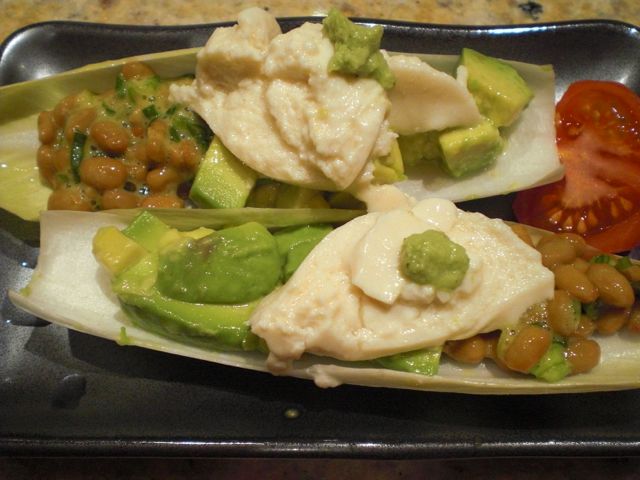
Natto, avocado and tofu on Belgian endive チコリの納豆、豆腐とアボカドの乗せ
Thursday, October 20, 2011
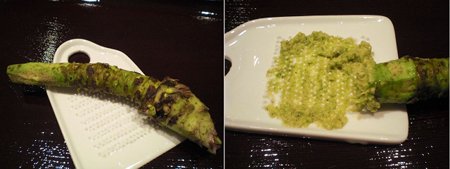
Real wasabi from Oregon 本物のオレゴン州産山葵大根
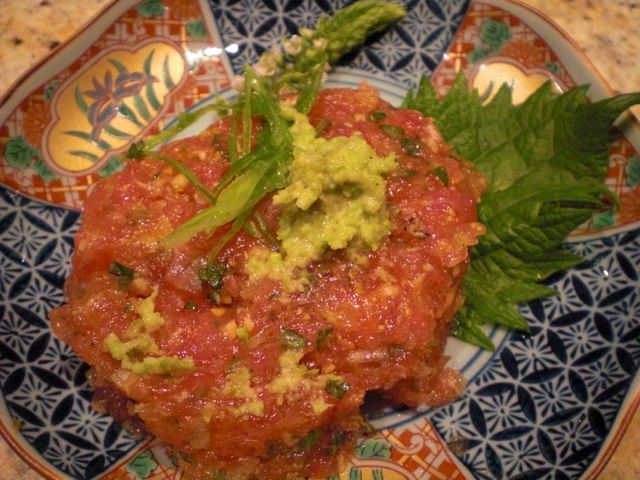
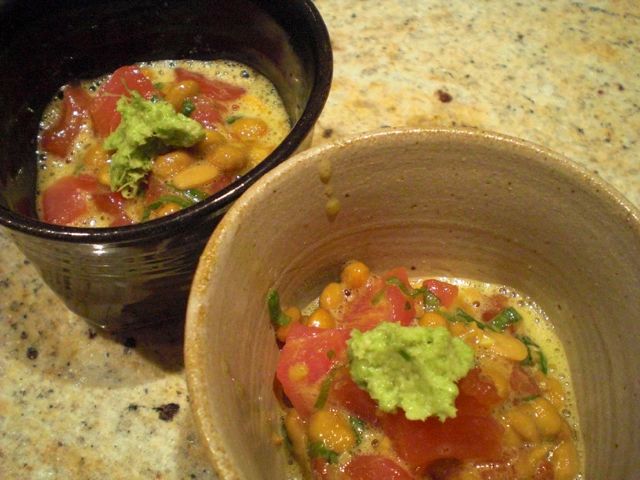
If you have not tasted freshly ground real wasabi, you are missing a lot. The fresh wasabi does have some heat but it is much fresher and flavorful than the stuff served at sushi bars that cleans out your sinuses. All these "usual" suspects I prepared as driking snacks got upgraded one notch by simply adding fresh wasabi!
Friday, June 10, 2011
"Sekihan", red rice 赤飯
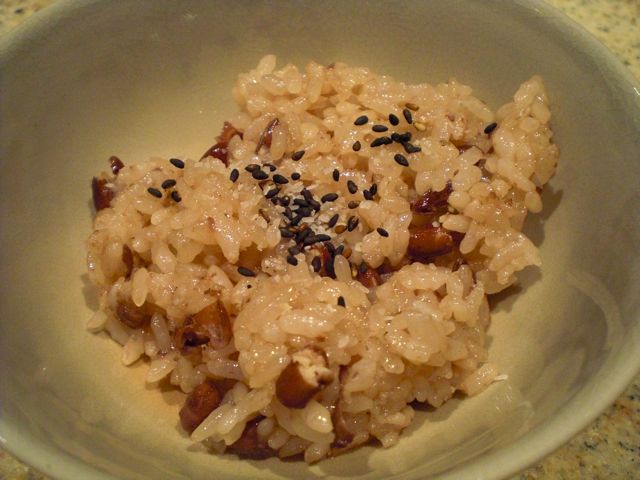
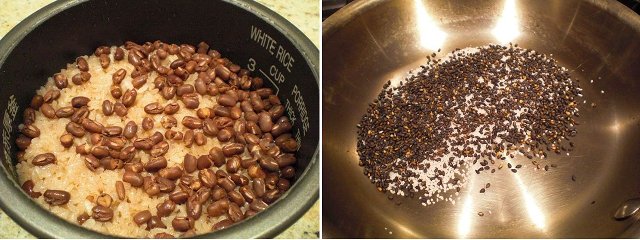
I sprinkled gomashio over the sekihan and served. I do not think this is worth the effort but the roasted sesame and salt indeed added a lot. The nutty and salty flavors were definitely needed here. After making sekihan, I felt like, at least, I paid adequate respect to azuki beans and this is the last of my azuki dishes.