Monday, October 25, 2010

Brie and Fuji Apple quesadilla ブリィチーズとリンゴのケサディア

This is a very interesting quesadilla. I bet you will not get this in Mexico but it is perfect with wine. We saw this in "Cooking Light" (paper copy) and both my wife and I independently thought it was interesting. Although the recipe came form "Cooking Light", by no means, is this dish "light". 
This is essentially just like any quesadilla but instead of Jack cheese and some kind of meat,  brie and Fuji apple are used, which make it very unique. Disclaimer: I did not follow the recipe to the letter, so the end product may have been slightly different. I used two small flour tortillas (instead of using a one large tortilla and folding it in half). The recipe calls for regular brie but it turns out I picked up goat milk brie instead, Fuji apple, and baby arugula.

I spread a thin layer of Dijon mustard (Grey Poupon) on one side of both tortillas. In a small (8 inch) frying pan on low flame, I add 1 tsp of olive oil and placed the first tortilla with the mustard side up and placed slices of brie on the tortilla.  After the cheese started melting, I placed thinly sliced Fuji apple on the cheese to cover the surface (I peeled and cored the apple before slicing) and a handful of arugula on the top. I sprinkled freshly cracked black pepper over it. I then placed the other tortilla with the mustard side down. I pressed gently with a spatula. After few minutes, I flipped it to brown the other side and cook it for 2-3 more minutes.

As you can see in the above image, melted brie started oozing out as I tried to cut it. The unique combination of goat milk brie, mustard, black pepper, apple (still crispy, sweet and sour) and slightly peppery arugula, all works together. The goat milk brie had a very pleasant somewhat "gamey" flavor. This was a very nice Franco-Mex (?) hors d'oeuvre indeed, which goes particularly well with wine. We had this with red wine but any white, particularly something like Riesling will also do.

Sunday, October 24, 2010

Pork cutlet bowl カツ丼


This looks like the classic lidded Japanese bowl you may see in "Taishu shokudo" 大衆食堂、which is the Japanese equivalent of American diners.  I do not remember when I got this bowl but it must have been in California. I have not used this bowl for a long time for some reason. This dish, Katsu-don カツ丼, is a classic dish being served in Japanese eateries and this bowl is perfect for it. Since we had already made pork fillet cutlets, I made this classic dish from the leftovers and frozen rice. Of course, you could make this from just fried tonkatsu and freshly cooked rice, which would be much better.

There are two distinctive styles in "Katsudon". One type is with soy sauce based broth and beaten egg anchoring everthing together called "Tamago-toji katsudon" 卵とじカツどん, which is, by far, the most popular style and is usually referred as simply "Katsudon". Another (more  regional and less popular) kind is tonkatsu dipped in semi-Western style tonkatsu "sauce" with shredded raw cabbage placed on the top of rice, which is called  "sauce Katsudon" ソースカツどん. I am from the area of Japan where the former style is the only type of Katsudon available. I personally never had a "sauce" Katsudon but I do not think I am missing much (I can easily image how that would taste). 

Here is the view with the lid off, served with beer marinated daikon. Perfect dish to make quickly on a weekday evening. I could have worked on the presentation, though.
To make this dish, you could use the special pan shown below (also perfect for Oyako-don 親 子丼) but I do not have one. Any small (8 inch) frying pan with a fitting lid will also work. You have to use one pan for making one serving. So, in our case, I use two 8 inch frying pans.

Broth/sauce: This is a typical dashi, soy sauce, mirin combination. How much and how strong the broth should be depends on personal preferences. Japanese diners tend to go with a strong broth and a small amount. My wife likes enough broth to moisten the rice adequately. I favor less broth but a bit stronger taste. For this evening, my broth is a compromise. For two servings, it iconsists of dashi (1/3 cup, instant granulated dashi dissolved in hot water), mirin (1 tbs), and soy sauce (1 tbs) but you have to taste and decide how sweet and how strong you would like the broth to be. You could also add sugar, if you like it sweet. I tasted and adjusted further (a bit more soy sauce). I seasoned it more severely than soup you will drink but not as strong as a dipping sauce.You could use any type of tonkatsu. I used "hirekatsu" ヒレカツ or fried fillet of pork.

I arranged the ingredients except for the snow peas in a small frying pan, which makes one serving. I used one medallion of pork per serving for us but I suggest two for most people; sliced in 1/3 inch (or about 1 cm) thick. For vegetables, I used fresh shiitake mushroom (one medium, stem removed but not sliced, with a decorative cut but you can not see it well in the picture), onion (1/4 medium, halved and thinly sliced) and snow peas (2 or more). I add the broth above (1/6 cup or half of what I made). Put a tight lid on the pan and cook for 4-5 minutes on a low flame. I add beaten egg (1 large) and the snow peas and cook another two minutes or so with a lid on.  I take the pan off the heat when the egg is just barely congealed in the center.

I place the cooked rice (in our case, microwaved froze leftover rice) in the bottom of the bowl and slide the topping onto the rice with all the remaining broth (The broth reduces a bit. The special pan in the picture comes in handy if you have one). Put the lid on the bowl and let it stand for a one minute or two. If you like the eggs to be a bit runny skip this last step. If you do, please use pasteurized shell eggs). If you have already made rice and tonkatsu, this is a very quick weekday evening meal. Everything tasted pretty good except my wife wanted more broth.

Saturday, October 23, 2010

Japanese Breakfast 日本風朝ご飯

Hangover or "futsuka-yoi" 二日酔い is sometimes an inevitable by-product of the izakaya scene. In my bar hopping days in Japan, hangovers were unavoidable. There are many folk remedies for hangover but their effectiveness is dubious. One such remedy recommended by fellow imbibers while I was living in Japan, was the administration of tomato juice or miso soup--but this never worked for me. Of course, "hair of the dog" or "mukaezake" 迎え酒 (meaning welcoming sake) may be the ultimate cure but it may set you up for the next day's hangover and a vicious cycle may ensue. "Moderation" (what's that) and "hydration" probably are the best way to prevent hangovers.

In any case, you may want to try a traditional breakfast to combat hangovers after having too much fun in Izakayas the night before. Here is my Japanese breakfast but I did not have a hangover and I ate it as supper (Please do not ask why because I don't know why. I had all the ingredients and it just struck my fancy). If you have a hangover, you will feel better after eating this.

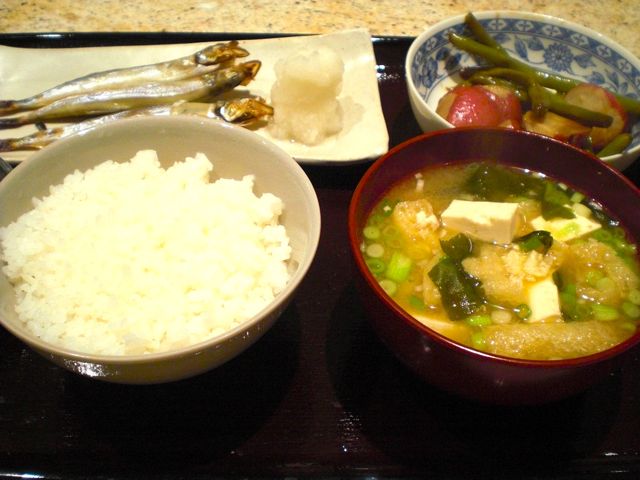
 Of course, you need rice and miso soup with any Japanese breakfast.

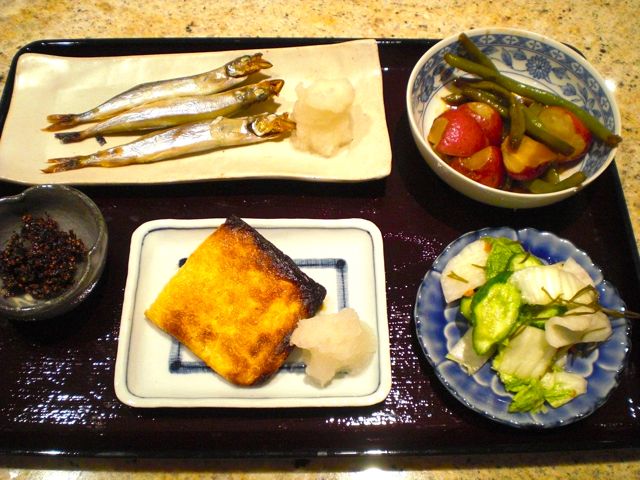
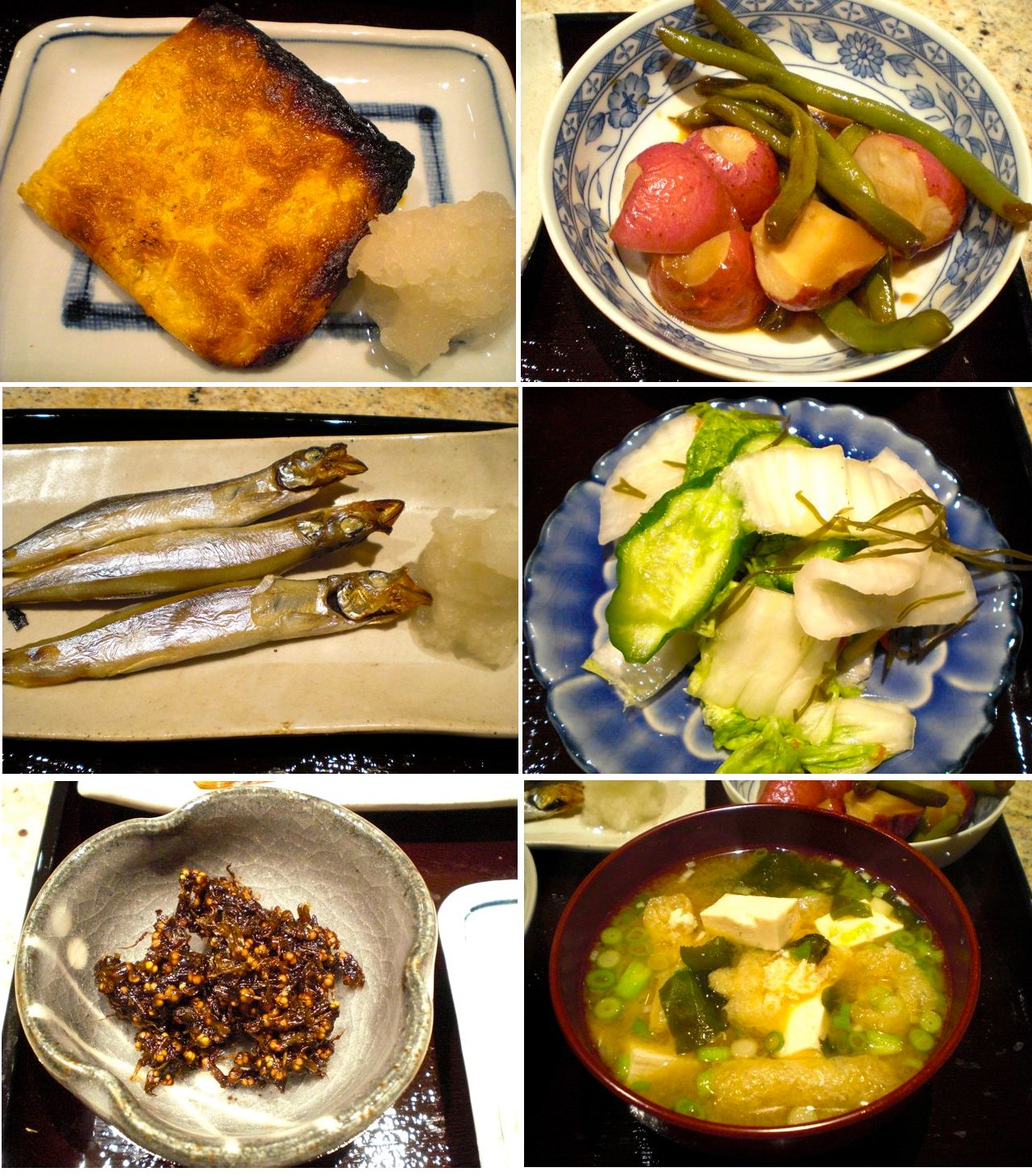
This example consists of grilled aburaage 焼き油揚げ (top left in the picture below, a bit over done), stewed potatoes and green beans (top right), grilled shishamo 焼きシシャモ (middle left), asazuke 浅漬け (middle right), Perila seedpod tsukudani (bottom left) and miso soup with tofu, wakame sea weed, and aburaage (bottom right).

Other common items include seasoned dried nori (味付け海苔), raw eggs (生卵), natto (納豆), Japanese omelet (卵焼き), and any kind of condiments such as tsukudani (佃煮) of small fish, kelp, and nori.

I am not sure how you feel about eating raw egg over hot rice called "Tamago kake gohan" 卵掛けご飯 (This subject actually appears in Wikipedia--truly amazing!) with a bit of soy sauce (all mixed well), but this is a very popular way to enjoy rice and egg especially in the morning. There is strong following for this dish in Japan with restaurants specializing in it and even a special soy sauce to use on it. (the link is in Japanese).  

Several years ago, we stayed at Kinkazan Shrine/Island 金華山 overnight. Why I decided to visit and stay there is a long story. I think I was expecting to have an experience similar to the lovely time we had at a Buddhist temple in Koyasan 高 野山 a few years earlier. Suffice it to say that was not the case. Just a quick hint; the men's showers had only cold water. Breakfast was served after the morning prayer ceremony (participation in the ceremony was mandatory for all guests--something we didn't know before we arrived). The ceremony occurred at 5:30 AM with 50 or so other fellow worshipers. When we say participate I mean literally. The guests are expected to run part of the ceremony. Luckily I was provided with a crib-sheet of instructions to be learned hastily before going to the main alter in front of all those people to "perform". The priestess conducting the ceremony announced our family name and stated that, as devoted worshipers, we came all the way from Washington, DC. Since I am Japanese (at least from outward appearance), I was expected to sit on the hard floor with legs folded (pure agony) but my wife was provided with a folding stool. In my agony, I didn't think that was quite fair. After the ceremony, all 50 guests were herded into another big room where long bench tables were set with a traditional Japanese breakfast. 

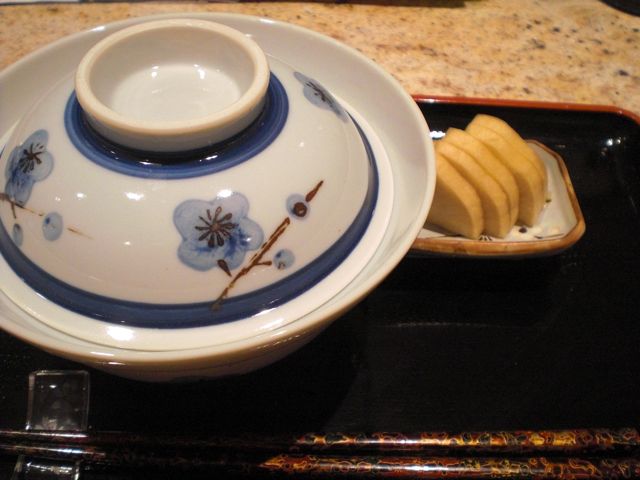
Next to all the usual Japanese breakfast items sat an egg in a small bowl just like the one shown in the picture. While I knew immediately what it was and what it was for, my wife automatically assumed it was a hard boiled egg, something often served in an American breakfast or at Japanese coffee houses. As she was getting ready to smack the egg hard on the table to crack the shell and eat it, something caused her to stay her hand. And a good thing too. Imagine how embarrassing it would have been to deliberately smash a raw egg onto the table while all the other guests, who were Japanese, were managing to get their raw egg onto the rice. How surprised the other guests would have been! It didn't occur to her for even a second that the egg could possibly be raw! Nobody serves a raw egg in the shell for breakfast in the United States (not even our household) !! But she now knows that, in Japan, they do. 
Friday, October 22, 2010

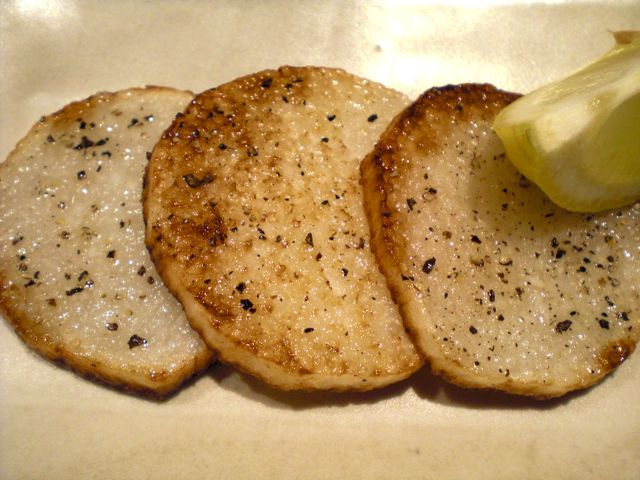
Sauteed nagaimo 焼き長いも

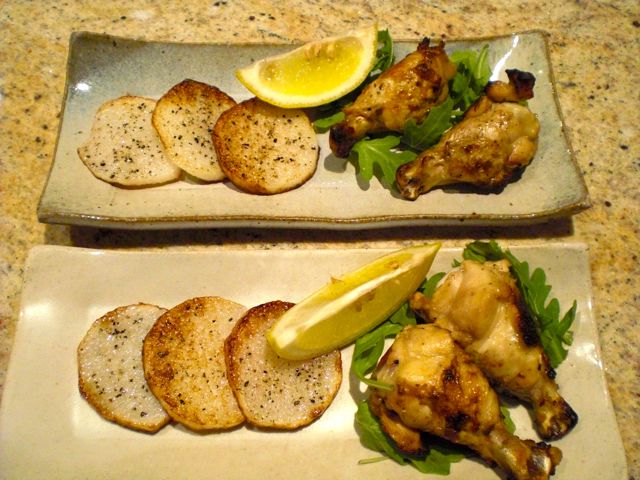
I have posted quite a few dishes of nagaimo 長芋. You can make so many variations, either cooked or raw, but this grilled nagaimo with black pepper and salt has been featured not once but twice by the expert expats Izakaya connoisseurs and I decided to make my version. Since this was a weeknight, I did not charcoal grill the nagaimo but pan fried it.

This dish is simple to make. Since I do not like the skin I removed it but you could keep the skin on. I sliced it into rather thin (1/4 inch) disks but this could be a bit thicker. I blotted any moisture from the surface using a paper towel. I added light olive oil (1 tbs) to a hot frying pan on medium-high flame and browned one side rather well (bottom side) for 2 minutes. I flipped it over and fried for 1 more minute. I flipped it over again and sprinkled salt and freshly cracked black pepper. You could use different seasoning such as Japanese 7 flavored red pepper  七味唐辛子, sansho 山椒, or even cumin or curry powder if you like.

We had this as an opening dish with leftover yakitori drumettes reheated in a toaster oven as seen above. The nagaimo has a nice mild crunchy crust and becomes very sweet (some starch must convert to sugar). It is really satisfying and the salt and pepper make this dish. Nagaimo can be simmered in broth as well but I never posted it. Maybe that will be my next post on nagaimo.

Wednesday, October 20, 2010

Grilled Baby Octopus and grilled smashed potatoes 子鮹のグリルと焼き潰しジャガイモ

I don't think I've ever seen uncooked baby octopuses in a regular grocery store.  Last time we went to the market to get pasteurized eggs, to our surprise, they had fresh baby octopuses. It was also very cheap (less than $5 per pound and I could not resist getting some). I decided to marinade them in both Western and Japanese styles and just grill them on a charcoal fire.

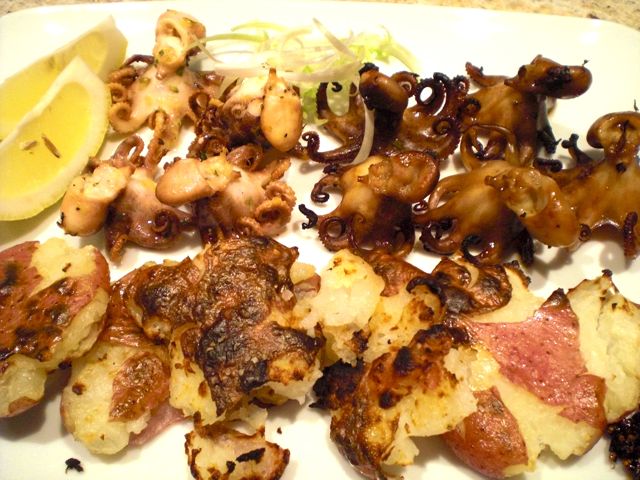
In the picture below, the left four are Western style and the right 5 are Japanese style in the back row (This is the first batch that we grilled, we had much more). Aren't they cute? The front row is smashed and grilled potatoes. I think this definitely qualifies for Izakaya food.

Western style Marinade: Lemon juice (from one medium lemon), lemon zest (from one lemon before squeezing its juice using a micrograter), olive oil (3-4 tbs), salt and pepper. I also added fresh thyme (finely chopped) from our herb garden.

Japanese style marinade: Sake, Mirin, and soy sauce (1:1:2) with several slices of fresh ginger.

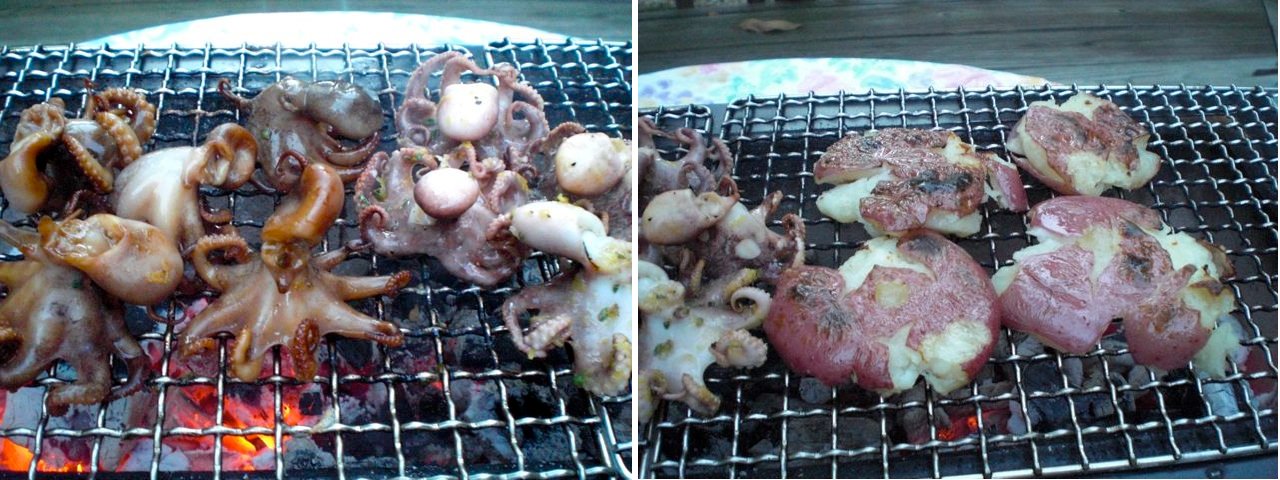
I marinated the octopuses for several hours in the refrigerator. I drained the marinade and simply grilled them for 2-3 minutes turning frequently (below, left). As per my wife's idea (she got the idea from one of the issues of Cook Illustrated), she microwaved baby red potatoes, then coated them with oil and smash them flat. We then grilled both sides (below, right).

Both styles had lots of flavor, especially the Western version had nice lemony and thyme flavors. Only problem was that both were a bit chewy. For most Japanese, this degree of chewiness is Ok but not for most Westerners including my wife. I ended up cutting them into small pieces.

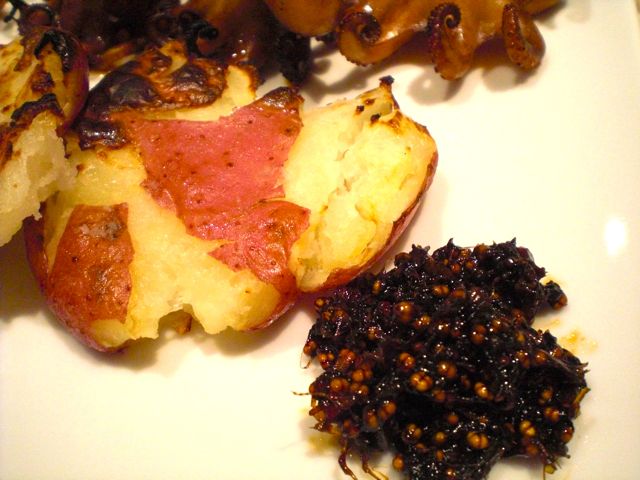
Since we made perilla seedpod Tsukudani 紫蘇の実の佃煮, we tried it on the potatoes. it is much better than just salt. It has very interesting taste, sweet and saltiness and popping texture. We also made our usual grilled rice balls. These food all went very well with cold sake and we stayed until dark on our back deck. 

Our neighbor's dog showed up and hung around despite her owner's calling. She was not about to leave our barbecue. She may get in trouble if this continues.