
Thursday, March 3, 2011
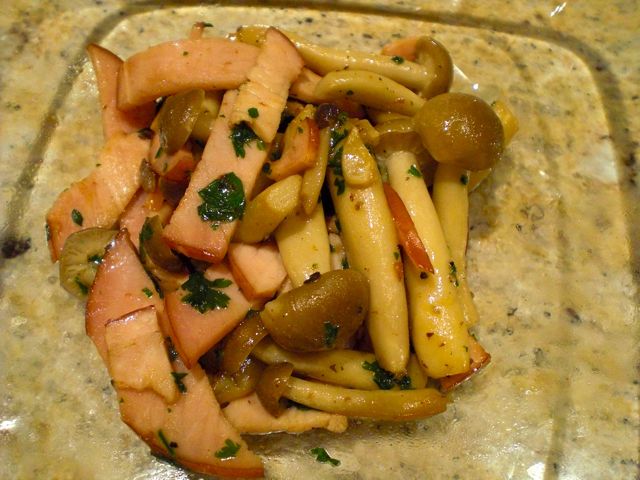
Shimeji mushroom and Canadian bacon stir-fry しめじとハムの炒め物
I had a package of fresh shimeji mushroom ホンシメジ and leftover Canadian bacon. Using these two items, I came up with this small dish. I could have used good quality ham rather than Canadian bacon. I did not know of the existence of Canadian bacon (as it is called in the U.S. but not in Canada) until I came to the U.S. it appears you can get it in Japan.
I just cut the root end of the shimeji mushroom and separated the stalks (1 package). I cut the Canadian bacon (4-5 slices) into half inch strips. I added olive oil (2 tsp) and butter (1 tsp) to a frying pan and sauté the shimeji for a few minutes and added the Canadian bacon. I seasoned with a splash of sake, soy sauce, salt and pepper to taste. Finally, I add finely chopped parsley just before shutting off the heat. Somehow, the Canadian bacon just tasted off (may be it wasn't in its prime) which ruined the dish somewhat. The idea was good and I am sure better quality Canadian bacon or ham would have made this dish much better. Although I ate everything, my wife only ate the mushrooms (she is a picky eater).


Tuesday, March 1, 2011
Simmered squid with daikon イカ大根
I found a package of cleaned frozen squid in our near-by gourmet market's freezer case. I decided to give it a try. I found that it was OK in a pinch but they were small squid and it was not as good as "Japanese" frozen squid. Since I had only a few inches of daikon left, I made this simmered squid with daikon dish, which is a rather common homey dish and also perfect for Izakaya.
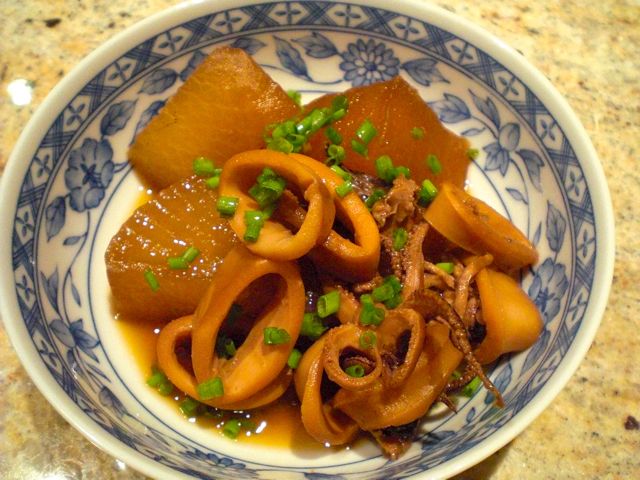
The recipe is found in "Otsumami Yokocho" Volume 1, page 40. I used my own way to make this dish but it is essentially the same dish.
For 2 servings, I used one package of frozen cleaned squid with tentacles thawed (2/3 of 8 oz or about 200 grams; 1/3 was used for the "sunomono" 酢の物 dish below) cut into half inch wide rings.
Daikon: I used daikon about 3 inches long. I peeled and cut it into 1 inch thick rounds and then quartered. I precooked the daikon in water with one pinch of raw rice for about 20 minutes and then washed it in cold running water. Although I have not done any scientific comparison, adding raw rice or using rice washing liquid or 米のとぎ汁 to precook daikon is traditional and is said to reduce the strong smell of daikon, make it softer, season better, and also prevent the cut surface from concaving during cooking. With so many claimed benefits, why argue? I just followed tradition.
Cooking liquid: I added water (1.5 cup), sake (2 tbs), mirin (2 tbs) and soy sauce (2-3 tbs) and a few thin slices of fresh ginger root into a pot on a medium flame.
I added the precooked daikon and squid rings and tentacles to the cooking liquid. When it came to a boil, I turned down the heat to simmer and skimmed off any scum that developed on the surface several times. I put the lid askew and let it simmer for 30 minutes.
Just for color, I garnished with chopped chives. This is a classic home-cooked dish. Despite not-really-good quality squid, this was a good dish and perfect for sake.
In addition, I made "karashi sumiso-ae" 芥子酢みそ和え of squid, cucumber, and wakame, which I posted before. For this dish, I used 1/3 of the body of the squid, which was cut into rings, cooked in salted and sake-added boiling water for 30 seconds and drained. I immediately seasoned them with "sushi vinegar" (from the bottle) while it was cooling.

I made "Karashi sumiso" or hot mustard miso vinegar sauce and dressed all the ingredients. I made the "sumiso" dressing a bit too "mustardy" this time (i.e. hot, since Japanese mustard is really hot). These two dishes only go with sake, which is not too difficult to accommodate for us.
I made "Karashi sumiso" or hot mustard miso vinegar sauce and dressed all the ingredients. I made the "sumiso" dressing a bit too "mustardy" this time (i.e. hot, since Japanese mustard is really hot). These two dishes only go with sake, which is not too difficult to accommodate for us.
Monday, February 28, 2011
Cabbage rolls ロールキャベツ
I do not know why and when thinly sliced raw cabbage became the most common accompaniment for Japanese Western style cuisines called "yoshoku" 洋食. It appears that a famous yoshoku restaurant in Ginza called "Rengatei" 煉瓦亭 invented raw shredded cabbage as an accompaniment for their yoshoku dishes. I suppose in contrast to "nappa cabbage" or "Hakusai" 白菜, regular cabbage is considered a "Western" vegetable, thus, an appropriate accompaniment of "Western" dishes. Although many "yoshoku" items are now considered uniquely "Japanese" dishes such as "tonkatsu" トンカツ, you can not serve tonkatsu without shredded cabbage. Another cabbage related dish, cabbage rolls, also became a classic Japanese home cooked food, although it is a Japanese modification of Western cabbage rolls. I suppose many Western cultures have similar dishes with a Polish version or American Polish version (especially in Chicago), "Gołąbki [ɡɔˈwɔmpki]", being the most famous. I mentioned previously that my old favorite "Oden-ya" おでん屋, "Katsu-ya" in Sapporo, served a Japanese version of cabbage roll or "ロールキャベツ", or "roll cabbage" as Japanese call it. My wife usually does not like cabbage and I have not made this dish for a long time but I convinced my wife that I was running out of dishes to bog and made this Japanese style cabbage roll.
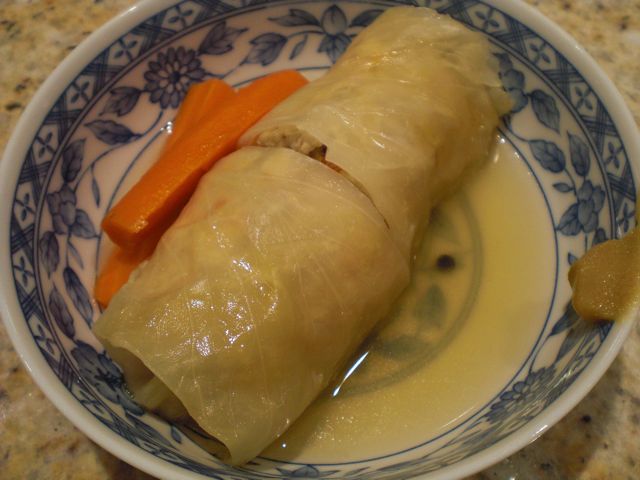
The amount below is four small Japanese size cabbage rolls.
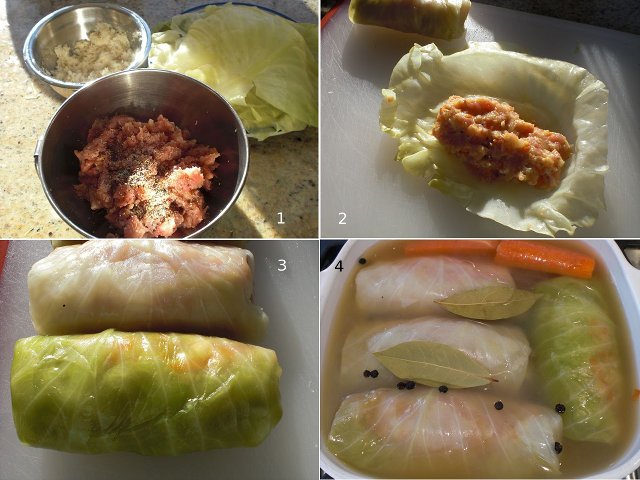
Cabbage leaves: In large scale productions, you boil an entire large head of cabbage and then separate the individual leaves. For my small scale production and small-sized cabbage rolls, I separated each cabbage leaf by first cutting into the bottom veins and then using running water (introducing it between the leaves), to separate each leaf without tearing it. (I prepared 4 leaves). I used a rather small head of cabbage. I boiled the leaves in a large pan with salted boiling water for 10 minutes covered with a plate which fit snugly inside of the pan to keep all the leaves submerged during cooking. After the leaves were cool enough to handle I shaved off the large veins toward the bottom of the leaves without cutting through them (the #1 image below in the right back).
Stuffing: I finely minced onion (1/3 medium), carrot (1/2 medium), garlic (1 clove), and ginger (one thin slivers) which I sauteed in vegetable oil for few minutes and seasoned with salt and pepper and set aside to cool. You could also add shiitake mushroom, finely chopped, but I did not have one.
For the meat, I used trimmings from a pork tenderloin. I hand chopped it into ground pork (about 200 gram, I guess. The image #1). I mixed in the vegetables above,with bread crumbs (1/4 cup, I use panko, moistened with milk, the image #1 below in the left back). I added an egg (1 large) and seasoned it with freshly ground nutmeg, salt and black pepper. I mixed it well until the stuffing become elastic and hung together.
Assembly: As seen in the image #2, I made a small cylinder and placed it closed to the root end of the precooked cabbage leaf and rolled with the both side tucked in and made four rolls. Try not to over stuff the cabbage (the image below #3). (I had some stuffing left over. I made small patties and cooked it like a hamburger and braised it with mirin and soy sauce in teriyaki style. I served it with the side of a Japanese coleslaw. I forgot to take a picture)
Cooking: I used a Japanese-Western hybrid broth. I used Swanson non-fat reduced salt chicken broth and added bay leaves, sake, whole black pepper corns and a half a carrot (left over from the above). The cabbage rolls should fit snugly submerged in the cooking liquid (the image below #4). Of course, you could cook the cabbage rolls in "Oden" broth or tomato sauce if you like. On a very low flame, I gently simmered it with the lid mostly on and when it started boiling, I set the lid slightly askew and cooked for 40-50 minutes (I added more sake in the middle to compensate for the evaporation).
Here is the cut surface after cooking.
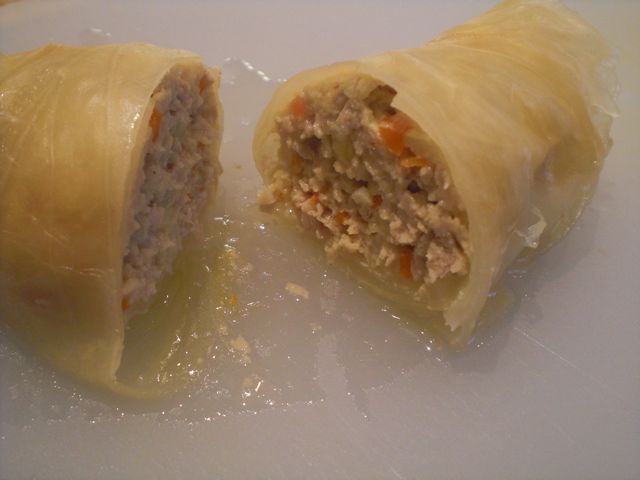
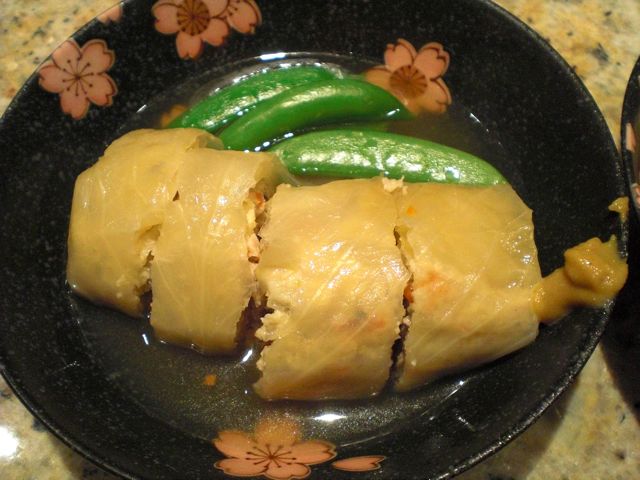
I served it in a small bowl with some broth and a small dab of Japanese hot mustard as would be used for oden. The stuffing was very tender and fluffy with very subtle rich flavor. The pork did not have a porky taste and seemed more like chicken. It was permeated with an interesting amalgamation of western and eastern flavors. The cabbage was also nicely cooked and not too strong. It was very soft, so much so you could cut the rolls with chopsticks. The hot Japanese mustard gave it a contrasting sharp jolt. Even my wife liked this one (it passed our "Mikey likes it" test). She particularly liked the light texture which was so different from the dense heavy classic stuffed cabbage with tomato sauce she learned to dislike as a kid. This dish will go with almost any drink but chilled G-sake was our choice.
Cabbage leaves: In large scale productions, you boil an entire large head of cabbage and then separate the individual leaves. For my small scale production and small-sized cabbage rolls, I separated each cabbage leaf by first cutting into the bottom veins and then using running water (introducing it between the leaves), to separate each leaf without tearing it. (I prepared 4 leaves). I used a rather small head of cabbage. I boiled the leaves in a large pan with salted boiling water for 10 minutes covered with a plate which fit snugly inside of the pan to keep all the leaves submerged during cooking. After the leaves were cool enough to handle I shaved off the large veins toward the bottom of the leaves without cutting through them (the #1 image below in the right back).
Stuffing: I finely minced onion (1/3 medium), carrot (1/2 medium), garlic (1 clove), and ginger (one thin slivers) which I sauteed in vegetable oil for few minutes and seasoned with salt and pepper and set aside to cool. You could also add shiitake mushroom, finely chopped, but I did not have one.
For the meat, I used trimmings from a pork tenderloin. I hand chopped it into ground pork (about 200 gram, I guess. The image #1). I mixed in the vegetables above,with bread crumbs (1/4 cup, I use panko, moistened with milk, the image #1 below in the left back). I added an egg (1 large) and seasoned it with freshly ground nutmeg, salt and black pepper. I mixed it well until the stuffing become elastic and hung together.
Assembly: As seen in the image #2, I made a small cylinder and placed it closed to the root end of the precooked cabbage leaf and rolled with the both side tucked in and made four rolls. Try not to over stuff the cabbage (the image below #3). (I had some stuffing left over. I made small patties and cooked it like a hamburger and braised it with mirin and soy sauce in teriyaki style. I served it with the side of a Japanese coleslaw. I forgot to take a picture)
Cooking: I used a Japanese-Western hybrid broth. I used Swanson non-fat reduced salt chicken broth and added bay leaves, sake, whole black pepper corns and a half a carrot (left over from the above). The cabbage rolls should fit snugly submerged in the cooking liquid (the image below #4). Of course, you could cook the cabbage rolls in "Oden" broth or tomato sauce if you like. On a very low flame, I gently simmered it with the lid mostly on and when it started boiling, I set the lid slightly askew and cooked for 40-50 minutes (I added more sake in the middle to compensate for the evaporation).
Two days later, we reheated the cabbage rolls with snap peas. It tasted even better.
Saturday, February 26, 2011
Buffalo wings バッファローウイング
This is a classic American bar food. The dish is named after the city in New York state not the animal--buffaloes don't have wings. These wings come from chicken. This was said to be first served at Anchor Bar in Buffalo, hence the name Buffalo wings. This is my tamed down version.
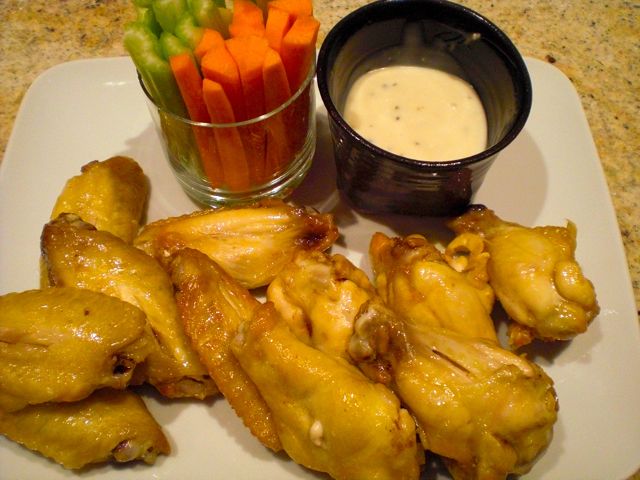
Although the classic recipe calls for the wings (and drumetts) to be deep fried, I baked these to make them somewhat less deadly. I also used only a small amount of melted butter and Tabasco.
This will go well with cold beer but we stuck to red wine (for our cardiovascular health).
For two servings, I first washed and pat dried the wings and drumetts (6 each). I then made slits between the two bones of the wings. I lightly salted them and baked in a 400F pre-heated convection oven for about 20 minutes. In retrospect, I should have broiled or baked it in higher temperature to make the skin more crispy.
I melted 2 tbs of sweet butter in a metal bowl over a very low flame and added Tabasco. I added Tabasco in stages so that the butter had a Tabasco taste but was not too hot. The amount of Tabasco and butter is up to you; some people make the wings "red" but we are not that kind of people. Just toss and coat the cooked wings and serve.
Traditionally, this is served with celery sticks with blue cheese dressing (I suppose to cool down the palate). I added carrot sticks as well. The blue cheese dressing is from the bottle (I just chose it based on the shape and appearance of the bottle and avoided big names like "Kraft") This happened to be a really good one with chunks of real blue cheese. It was creamy, sweet, and tangy in flavor. If you so prefer, you could make it from scratch with quality blue cheese, butter milk and sour cream but, I am sure, for the original Buffalo wings at Anchor bar, they must have used commercial blue cheese dressing from a gallon bottle. The sauce has just enough Tabasco to taste some heat, vinegary and buttery flavors but it is not too hot or overwhelming. If you want more heat, it is easy to add more Tabasco on your wings.
This will go well with cold beer but we stuck to red wine (for our cardiovascular health).
Thursday, February 24, 2011
Duck breast and avocado salad 鴨の胸肉とアボカドのサラダ
This is another one of making-something-from-leftover dishes. We had leftover roasted duck breast. I thought I was making a starter dish for sake but I was told that we were having red wine instead. So I had to change my menu on a dime and came up with this starter.
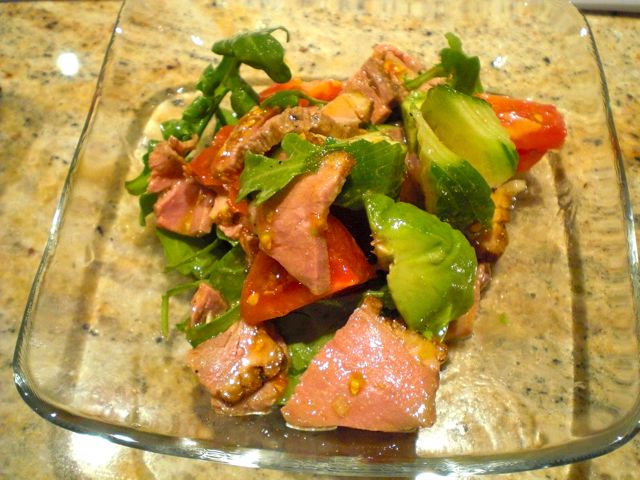
This is just a small salad consisting of greens (baby arugula and spinach), avocado, tomato, cucumber and sliced duck breast. The avocado was nicely ripe and made this dish. The avocado was cut into 1/2 inch cubes. I cut the cucumber in my usual snake belly fashion and then cut into half inch segments. Campari tomato was skinned, peeled and quartered. The duck breast was thinly sliced and halved. The dressing is my usual mustard, honey dressing (Dijon mustard, honey, finely chopped shallot, rice vinegar, olive oil with salt and pepper).
Again nothing special but the combination worked well. We had this with a glass of red, Maroon Winery Spring Mountain District, Napa Valley Cabernet Sauvignon 2007. Despite vinegar in the dressing (the dressing is sightly sweet from honey and rice vinegar is mild), this salad went well with this wine. After this, I made three tuna sashimi dish from frozen yellow-fin tuna including tuna and avocado cubes, tuna "zuke" sashimi, and Yamakake. We switched to a U.S. brewed Gekkeikan sake, "Black and Gold", surprisingly pleasant sake and we enjoyed both the sake and the food. Only problem was that this was Sunday evening instead of Saturday or Friday.
Subscribe to:
Posts (Atom)