Friday, April 13, 2012

American Wagyu New York strip steak アメリカ和牛のニューヨークストリップステーキ

Wagyu 和牛 is a breed of cattle developed in Japan (As I understand it they are a cross between Japanese native and western cattle. Reportedly, only a few pure native Japanse cattle remain in Kagoshima 鹿児島 and Yamaguchi 山口 prefectures). The breed was selected for its highly marbled meat. To us, classic Japanese Wagyu beef is too fatty when eaten as a steak but it is considered one of the most prized beef. When eaten raw, it has a mouth feel reminiscent of  fatty tuna but once cooked it tastes a bit too fatty to me. Beef fat has a strong taste to me particularly when in excess (unlike pork fat which can be eaten to any excess as far as I am concerned).  Dependining on the regions of Japan in which a particular breed was developed, it is named, for example, "kobe-gyu"  神戸牛, "Matsuzaka-gyu" 松坂牛 or "Oumi-gyu" 近江牛. Often, this beef is served thinly sliced for grilling (yakiniku 焼肉) or sukiyaki すき焼き.

My niece married into a family of cattle farmers near Sapporo. They raise Wagyu but I was told they mostly raise the cross between Wagyu and black Angus. I learned from my niece and her husband that the wagyu is rather delicate and has to be housed in a barn during the cold snowy season but the cross breed with black Angus is much more robust and can stay outside in the snow and survive (and thrive).

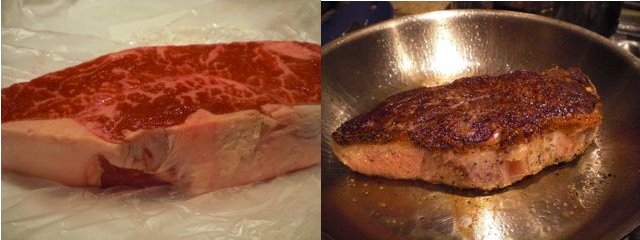
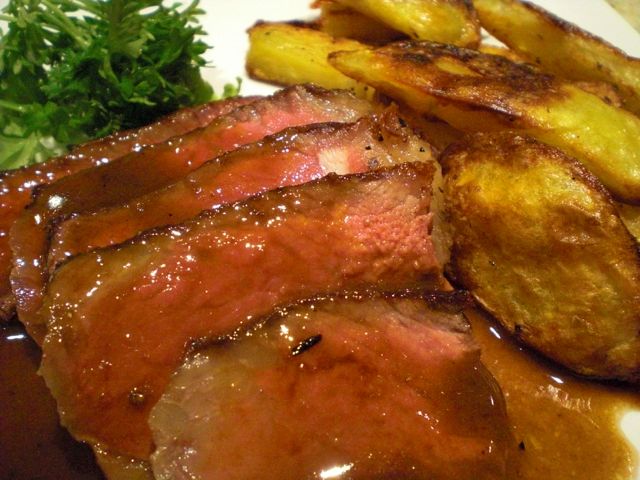
In the U.S., one could get genuine wagyu beef imported from Japan but it is prohibitively expensive (we never tried it). It is not worth it in my book. Instead, like ones raised in my nice's farm, American wagyu (cross between Wagyu and Black Angus) is raised in US and Australia and its meat is widely sold in a gourmet market at a reasonable (relatively speaking) price. The meat is much redder and not as highly marbled compared to genuine Wagyu beef as you can see in the picture below but it is much fattier and marbled than typical American prime or choice beef. The cut I got this time was  New York strip steak and I bought it as one serving. It weighed almost 1lb! (Between two of us we ate only less than half this evening).

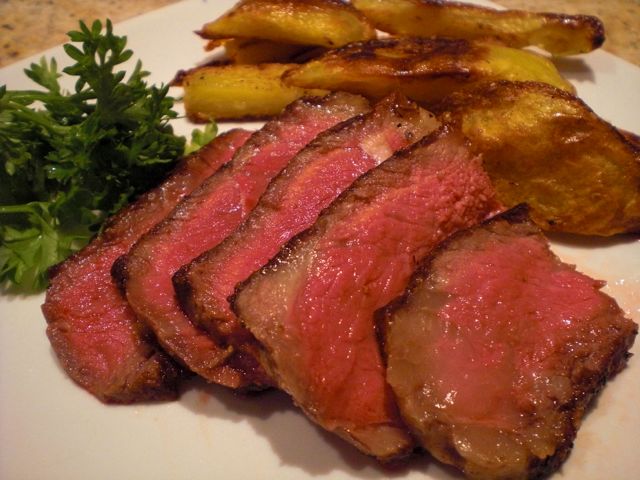
I did not do anything special to cook the steak. I first let it warm up to  room temperature and seasoned it with Kosher salt and freshly cracked black pepper. Using a small amount of light olive oil, I seared both sides on medium high flame until a nice brow crust was formed (The above image on the right). I finished it in a 350F oven for 8 minutes (for medium rare  as you can see below). I removed the steak from the pan to a plate and covered  loosely with aluminum foil to let it rest for 10 minutes. It was homogeneously pink without the center being totally raw. The marble lines were almost not visible since the fat became semitransparent but it was there.

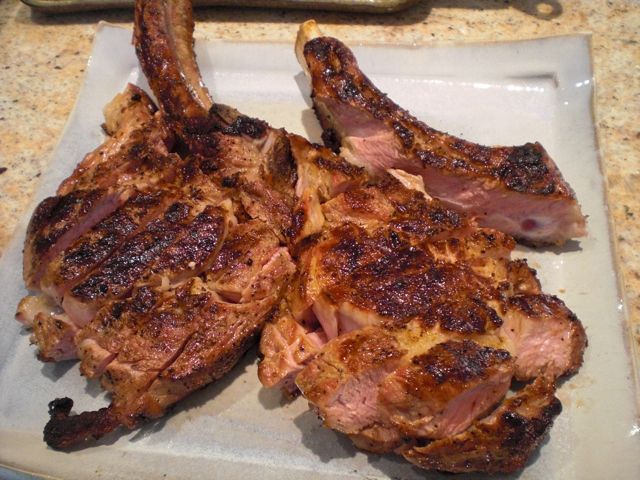
I served it sliced with the side of oven fried potato. For sauce, I degrazed the pan with sake (4-5 tsp) and reduced it to 1/3 and added soy sauce (1 tsp). I then added 4-5 pats of butter to make an emulsion.  Off heat, I added real wasabi (1/2 tsp) and poured it over the slices of steak (the first picture).

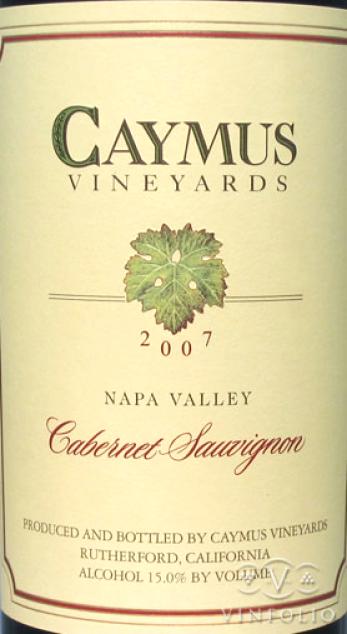
This was certainly a great steak. (Of course, it was perfectly cooked, if I do say so myself). The wasabi flavor did not come through as much as I expected. Is it better than U.S. prime stake? I am not so sure. The oven fried potatos were excellent. They had a crunchy crust and creamy soft inside (my wife's contribution). We were still enjoying the wonderful 2007 Caymus Cabernet Sauvignon with this steak.

Wednesday, April 11, 2012

Pork belly braised in miso sauce 味噌味豚の角煮

Fresh pork belly used to be difficult to get in the past but with the opening of the new gourmet grocery store near us, we now can get pork belly any time. Japanese (including me) somehow love this portion of the hog. Thinly sliced pork belly (like bacon) is called "bara-niku" バラ肉 or "sanmai-niku" 三枚肉 and is widely used in Japanese dishes. But the ultimate is "Butano-kakuni" 豚の角煮 which I have posted several iterations made from pork spare rib, salted pork, and a block of a genuine pork belly. Since we happened to shop in this gourmet grocery store the other day, we bought some pork belly along with fresh whole fish.

I pondered what to make and decided to make a variation of "Kaku-ni" that is miso flavored. This is inspired by a recipe I read but I made substatinal changes since just reading the recipe, I could imagine the meat would not be that tender and the braising sauce would be too salty as well as too sweet. Pork belly requires a long time cooking especially if it is cooked as a block rather than thinly sliced. So I borrowed the idea of using a braising miso sauce from the recipe I read but deviated substantially and made this dish as though making "Kaku-ni" in a more traditional way by pre-boiling it in water (more traditional as compared to what I posted before as "Kakuni").

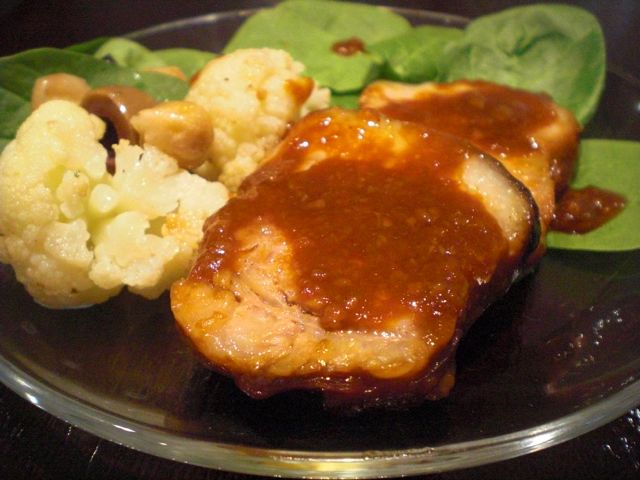
The 1 pound of pork belly which I bought will easily serve 8-10 of the small servings pictured above. 

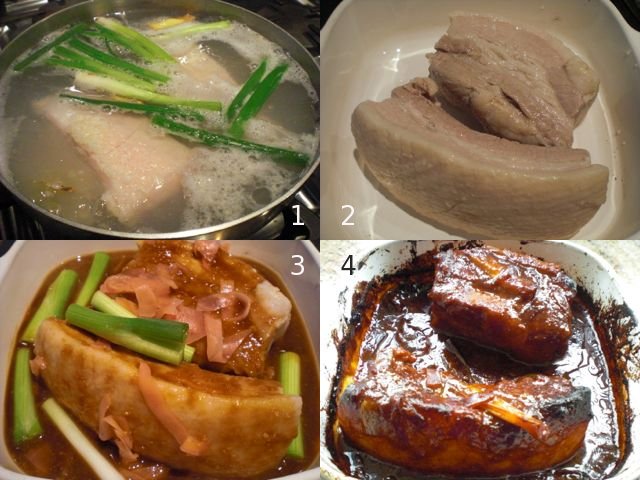
I first cut the pork belly block in half so that it would fit better in the pot. I boiled it in enough water so the pork was covered "comfortably". I added scallions (2, cleaned and light bruised including the green parts), ginger root (thinly sliced , 5-8 slices), and raw rice (1 tsp). I placed the pork belly in the cold water and put the pot on a medium flame. When It started boiling, I turned down the flame to simmer and skimmed off any scum that appeared on the surface (#1). I simmered it for over 1 hour with the lid on.  I then washed the prok belly in cold running water and put it in a tight fitting (relatively speaking) baking dish (I used a small Pyrex baking dish with a glass lid) (#2).

Sauce/Marinade: The amount of the marinade has to be varied depending on the size of the baking dish. To accommodate the baking dish I used  the marinade consisted of miso (2 tbs), mirin (4 tbs) and soy sauce (2 tbs). As I mixed the miso into the liquid, I added a bit more mirin to make it a saucy consistency. I did not add sugar but I could have added sugar to make it sweeter. (I thought the Mirin was plenty sweet).

I poured the marinade over the meat put a lid on and placed it in the refrigerator for several hours  (or overnight) turning several times (or I could have used a Ziploc bag, with the air squeezed out). Just before putting it into the oven, I added scallion (3, cleaned and cut into 2-3 inch length) and pickled ginger (10, julienned, which added some sweet and sour ginner taste) (#3).

I pre-heated the oven to 350F. I cooked the pork belly with the  lid on for 1 hour occasionally basting with the marinade. After one hour, I removed the lid and continued baking for 30 more minutes basting several times (#4). The marinade became dark brown and thick. If needed, add water during the baking/braising (I did not).
I sliced it in half inch thick pieces and served it with additional sauce on the top on the base of baby spinatch and a side of baked cauliflower and garbanzo beans

This is as good as the more traditional pork belly kaku-ni. The fat layer melted in the mouth and was very sweet.  The meaty portion had a good but tender consistency and porky flavor. The miso marinade became nice nutty, salty and sweet sauce. Since this is a rather deadly dish, portion control was an order and I only served three slices per person.

Although sake would be my usual choice of libation, sturdy red wines will go very well. Actually, we were having this with 2007 Caymus cabernet sauvignon. This is one of our favorite wines. It has a nice dark chocolate mingling with complex predominantly black fruit. Hoping that  the red wine would lessen the ill-effect of pork belly fat while experiencing hedonistic pleasures in two ways; pork fat and good wine.

Monday, April 9, 2012

Veal Chops with Shiitake Dashi 子牛のチョップのシイタケソース添え

I am digging out old food pictures here. I volunteered for recipe testing over a year ago when Chef Tadashi Ono and Japanese food report fame Harris Salat were preparing the Japanese grill cookbook. I tested a few meat dishes and side dishes. 

I thought this was a rather nice dish. The sauce is nicely earthy with a Japanese touch. Veal chop are not usual cuts of meat I use. I was told that I could blog this after the publication of the cookbook. The book was published sometime ago and I bought a copy myself. Since I am running short of something to post I decide to post this dish.

This is the instruction I received. I did not compare the final recipe with this one.

Serves 4

For the shiitake dashi:
12 whole dried shiitake mushrooms, about 1/2 ounce
1 cup water
1/2 cup sake
1/2 cup soy sauce
2 tablespoons mirin
1 tablespoon corn starch
1 tablespoon water
4 veal chops, about 4 pounds
Salt
Freshly ground pepper

To make the shiitake dashi: Add the shiitake and water to a saucepan and let it soak for 4 hours at room temperature. Transfer the shiitake to a cutting board, without discarding the water in the saucepan, and thinly slice the mushrooms. Return the mushrooms to the liquid in the saucepan. Add the sake, soy sauce and mirin to the saucepan, and bring it to a boil over medium heat. Lower the heat so the liquid simmers, and cook for about 15 minutes, until the liquid reduces by 1/3. Skim off any scum that appears on the surface. While the dashi simmers, mix together the corn starch and water in a small bowl, and set aside. When the dashi has reduced, remove the saucepan from the heat. Add the corn starch mixture, and stir until the dashi thickens. Let the dashi come to room temperature.

Use a meat pounder or mallet, or the side of a heavy knife or cleaver, to pound the veal chop 6 times, to flatten and condense the meat. (Be careful not to strike the bone.) Season with salt and black pepper on all sides of the chops. Slap the sides of the veal with your palm, so the pepper sticks to the meat.

Preheat a grill to medium-hot heat. Grill the chops for about 5 minutes on each side for medium rare. When the chops are done, the bone will stick out, as the meat along it shrinks, and the veal will become richly caramel colored. Test for doneness using the nick and peek method. Let the chops rest for about 3 minutes. Drizzle 2 tablespoons of shiitake dashi over the veal chops, and serve.

Other uses for shiitake dashi: Drizzle over steaks and burgers. The dashi can keep in the refrigerator for 3 weeks, and also freezes well.

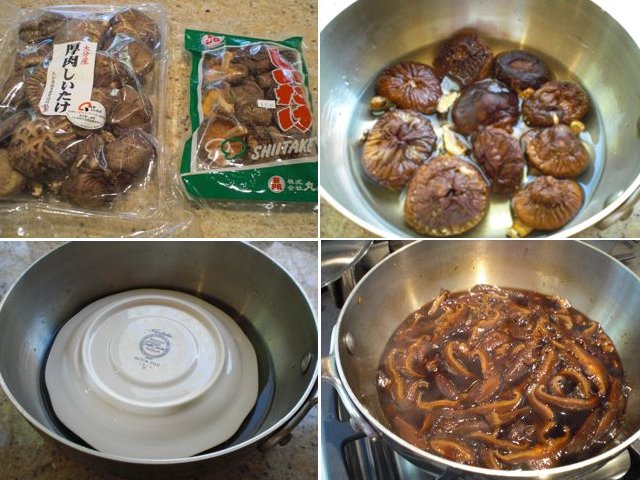
The picture below is just showing the dried mushroom on the left upper image. The quality of dried mushroom could be quite different from brand to brand. I rehydrated the dried mushroom by placing the small plate so that the mushrooms are completely submerged. The right lower image is the final Shiitake dashi sauce. I did not take the picture of pork chops with this sauce on it.
I am trying to remember what this tasted like. When I tasted the sauce by itself, I thought it was too salty and strong. But once it was poured over the cooked veal chops, it was just right amount of saltiness. The sauce added a very nice "umami"-laden mushroom flavor. When I did this, I invited 2 couples (non-Japanese) and asked them to taste and give us feedback. I think this was very well received.

Saturday, April 7, 2012

Cream cheese with salted kelp クリームチーズの塩昆布和え

I saw this recipe on line sometime ago. While we were at the Japanese grocery store last time, I found a package of salted kelp or "Shio Konbu"  塩昆布 and I got a package (see the second picture). This is an extremely simple but unexpectedly excellent  drinking snack.

Essentially, I mixed softened cream cheese and salted kelp from the package. The only change I will make is to cut the strands of kelp shorter next time so that it is easier to get a small amount of the cheese to smear on a cracker. The original recipe suggested adding cracked black pepper. 
"Salted kelp", I remember when I was living in Japan, this was chewy square pieces of kelp with its surface covered with salt. Apparently many new kelp products have been created in recent years including kelp snacks I posted before.

This version of salted kelp is from a company called "Kurakon" and the package has a cartoon of a character who is supposedly the manager of the company. It appears that different recipes by him using salt kelp are printed on each package. This one had a recipe for a rice ball with cheese and salted kelp and the image of the package at the company web site had cheese toast with salted kelp, which I may try later.

In any case, the combination of salty kelp and creme cheese was indeed a good one. We had this with Moffett Vineyards Willows Blend Napa Valley Red Wine 2007. This is an interesting blend of Cab Saub (47%), syrah (28%), and Cab Franc (25%). This is similar to the blends popularized by Aussie wineries.

This is a quite decent California red with nice black fruit upfront with some earthy spices and just right amount of vanilla. It has silky tannin with reasonable finish. I will give 92. This red went so well with the salt kelp cream cheese concoction on craker. Sitting outside under the cherry blossoms also helped, I have to admit.

Thursday, April 5, 2012

Small Japanese covered containers 珍味入れ

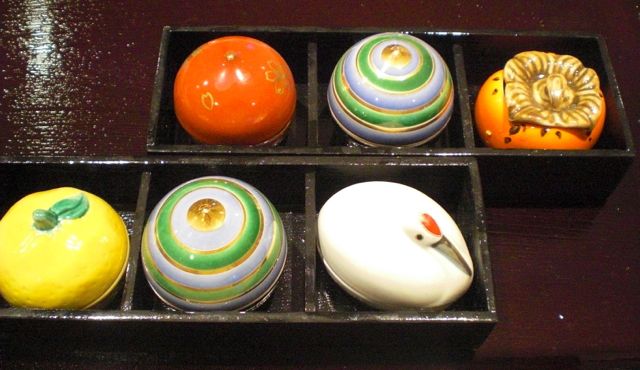
Last time we were in Kyoto, somehow we ended up in the Nishiki Market 錦市場 early in the morning. Many stores just opened or were getting ready to open up. My wife spotted a small china store. The middle aged man, who apparently was the owner, was still unpacking the items in front of the store.  He had a very extensive collection of small covered containers which Japanese like to use to serve a small portion of "extraordinary tastes" or "chinmi" 珍味. He even unpacked more of these containers for her. These are six she chose (I sanctioned the limit to 6). Some are spheres with a concetric ring pattern or with plum flowers. She chose two of the spheres with concentric ring pattern since she really liked it. She chose one of each for others. The owner said this happened to be the most popular item and praised my wife's keen eye and good taste but I had a feeling if she liked other container he would have made that one most popular. In any case, we hand carried all these contianers and boxes home on the airplane. Somehow, I completely forgot that we had this. I was pleasantly surprised when I found them in the back of the cupboard.

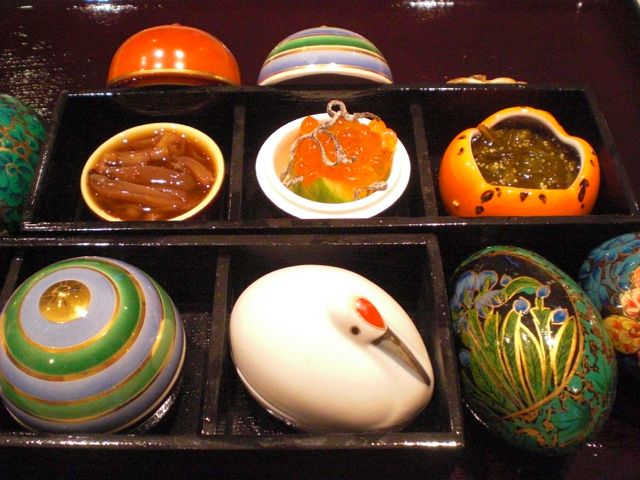
Nothing new here, but I served squid marinated in mirin and soy sauce or "Okizuke" 沖漬け(left), Ikura salmon roe in cucumber cup and garnished with salted kelp (center) and "mozuku" sea weed in sweet vinegar (right). All prepackaged, I just thawed and arranged.

These are nice containers to have, especially if you are into serving drinking snacks for sake like we are. Only problem is that all these containers need to be hand washed and it is easy to break (we have not, yet). By the way, the picture shows some lacquered easter eggs that my wife collected. She thought they were seasonal and added them to the picture.