One of our friends who has a farm in the area and raises cattle, chickens and other livestock gave us two fresh grass-fed beef tongues. The cattle were never stressed in the process and the tongues were promptly vacuum packed and frozen before we received them. I was concerned that we may be depriving her of a delicacy but she assured me that the tongues otherwise would have been discarded. Since she read our blog about beef tongue, however, she decided to send them to us. She told me that the smaller one was from a 3/4 Dexter* and 1/4 Angus and the larger one from a half Dexter and Angus. We decided to cook up the small one the morning we received them. I prepared it exactly as before. After it was boiled, we tasted the slices and made a beef tongue stew and later we made tongue sandwiches.
The stew was made from the middle and back portions of the tongue.
We made sandwiches from the remaining tip portion with pumpernickel bread. I served this as a lunch with green salad consisting of our home grown arugula, blanched broccoli, sugar snap, skinned and sliced Campari tomato, feta cheese. Dressing is my usual honey mustard with rice vinegar and olive oil.
As before, I simply toasted the bread with one side smeared with mayo and the other whole grain Dijon mustard.
This is a cut surface of the tip portion of tongue. I think it is leaner than the store-bought.
I sliced rather thinly to make this sandwich.
This was an extremely (meaning only) rare occasion on which we had access to fresh tongue from totally organic and grass-fed happy cattle. When I started preparing the tongue, the first thing I noticed was that the slightly unpleasant gamey smell usually associated with store-bought tongue was (thankfully) absent. Also, another sign of the freshness of the meat was that I had some difficulty removing the skin after boiling. Generally it is very easy to remove the skin from a store-bought tongue.
While we mentioned in previous blogs how good the store-bought tongues were, we had no idea how really good beef tongue could be until we tasted this. The difference between store-bought and this was amazing; This made clear what beef is really all about. In both the stew and sandwiches, especially the sandwiches, the flavor was a bright, fresh, strong (in a very pleasant way) clean taste of beefiness. (While it may sound like the flowery language used to describe wine I don't know how else to describe it.) I would say compared to this, the taste of even steak is cloudy. In both dishes, the meat maintained its integrity but it was so tender it seemed to melt in your mouth. Especially with the simple tongue sandwich, the difference between the store-bought and the one gifted to us became much more prominent. My wife was ecstatic. She said, while the store-bought was good, this one really tasted exactly like the one she remembered and transported her back to her childhood in rural Pennsylvania. This has become a new flavor benchmark for us. Many, many thanks to our friend for this wonderful gift. We really enjoyed it and will savor it while looking forward to eating the second one.
* Dexter: I had never heard of Dexter cattle before my friend mentioned it. It is an Irish origin breed described as friendly and the smallest in Europe. It is versitile serving triple-pourposes; milk, beef and drafting.
Monday, July 23, 2018
Friday, July 20, 2018
Tofu cutlet with scallion sauce 豆腐のカツレツねぎソースのせ
This was inspired by the "Perfect Pairings" book. The original recipe is a tofu cutlet with scallion sauce. I happened to have several thick rectangles of marinated tofu that I would use to make spicy marinated tofu which I usually cook in a pan frying. Since I had heated up some oil and had breading ingredients all ready to deep fry egg whites for my wife's deviled eggs, I decided to bread and deep fry the marinated tofu too. Since the tofu was on the thick side, I cut it in half before serving.
The sauce in the recipe appears to be a variation of a Japanese scallion "negi" sauce ねぎソース with chopped scallion, vinegar and olive oil. I reduced the amount of oil and added light colored soy sauce to make it closer to the "negi" sauce.
Ingredients:
One block of firm tofu, cut in half horizontally, and cut into equal sized rectangles.
Oil for deep frying
Marinade (optional):
2 tbs soy sauce
2 tbs mirin
1tsp rice vinegar
1tsp dark sesame oil
1tsp (or more) Suriracha hot sauce
1/4tsp grated ginger root
Breading:
AP flour for dredging
1 egg and water for egg water
Panko
Sauce:
2 finely chopped scallion, white and green parts
2tbs rice vinegar
2tbs light olive oil
1tsp light colored soy sauce
Directions:
For the American tofu I used, I boiled it in water for a few minutes with a dash of sake to remove the "smell". I drained it and let it cool to room temperature (for better quality firm tofu, this process can be skipped).
I placeed the marinade in a Ziploc bag and added the tofu. I removed as much air as possible, sealed the bad and let the tofu marinate in the refrigerator overnight or for a few days (optional).
I removed the tofu from the marinade and dredged it in flour, then the egg water and roll it in panko to coat.
I deep fried it in 350 F oil turning once. When all sides developed a crust, I lowered the oil temperature to 250 F and fried it for 5-7 minutes.
Then I raised the temperature to 350 F again and cooked for 1-2 minutes more.
When done, I drained the oil. When it was cool enough to handle, I cut the tofu in half horizontally.
I arranged the tofu alternating the cut surface and crust (the first picture).
I added a line of the "negi" sauce.
Although we did not taste much of the marinade (my usual, pan fried and then simmered in the marinade makes the taste much stronger and spicier), the combination of crunchy crust and soft center and the "negi"sauce go very well. The cookbook suggested paring with Pino Grigio. I do not remember what we had for wine.
The sauce in the recipe appears to be a variation of a Japanese scallion "negi" sauce ねぎソース with chopped scallion, vinegar and olive oil. I reduced the amount of oil and added light colored soy sauce to make it closer to the "negi" sauce.
Ingredients:
One block of firm tofu, cut in half horizontally, and cut into equal sized rectangles.
Oil for deep frying
Marinade (optional):
2 tbs soy sauce
2 tbs mirin
1tsp rice vinegar
1tsp dark sesame oil
1tsp (or more) Suriracha hot sauce
1/4tsp grated ginger root
Breading:
AP flour for dredging
1 egg and water for egg water
Panko
Sauce:
2 finely chopped scallion, white and green parts
2tbs rice vinegar
2tbs light olive oil
1tsp light colored soy sauce
Directions:
For the American tofu I used, I boiled it in water for a few minutes with a dash of sake to remove the "smell". I drained it and let it cool to room temperature (for better quality firm tofu, this process can be skipped).
I placeed the marinade in a Ziploc bag and added the tofu. I removed as much air as possible, sealed the bad and let the tofu marinate in the refrigerator overnight or for a few days (optional).
I removed the tofu from the marinade and dredged it in flour, then the egg water and roll it in panko to coat.
I deep fried it in 350 F oil turning once. When all sides developed a crust, I lowered the oil temperature to 250 F and fried it for 5-7 minutes.
Then I raised the temperature to 350 F again and cooked for 1-2 minutes more.
When done, I drained the oil. When it was cool enough to handle, I cut the tofu in half horizontally.
I arranged the tofu alternating the cut surface and crust (the first picture).
I added a line of the "negi" sauce.
Although we did not taste much of the marinade (my usual, pan fried and then simmered in the marinade makes the taste much stronger and spicier), the combination of crunchy crust and soft center and the "negi"sauce go very well. The cookbook suggested paring with Pino Grigio. I do not remember what we had for wine.
Tuesday, July 17, 2018
Deviled eggs for 4th of July デビルドエッグ
For the 4th of July, we did not do any barbecue this year especially since we had lots of food we prepared in the refrigerator (we tend to cook more than we can eat). Instead, my wife wanted to make deviled eggs. We had already made potato salad, macaroni salad, and coleslaw so we decided to have these instead of our usual barbecue. This time my wife made two interesting variations on deviled eggs. Again, I made guacamole. Having guacamole is very convenient since a glob of it on the plate under the deviled egg makes a base so the eggs won't slide around on the plate and, of course, it provides additional flavors.
This is a new one. The egg white was breaded and deep fried.
This is the classic.
MY wife came up with this one by mixing in salmon salad.
Ingredients :
#1 with deep fried egg white
2 tbs of Greek yogurt
1 tbs mayonnaise
1 tsp Worcestershire sauce
1 tsp mustard
a sprinkle of onion salt to taste
Sriracha hot sauce to taste
Oil cured olive for garnish
Hard boil the eggs. Peel, cut in half and remove the yolks. Dredge the egg whites in flour, egg water, and panko and fry (See picture below). Mix all the ingredients listed above into the mashed egg yolk, then put mixture back into fried egg whites.
#2 The classic
2 tbs of Greek yogurt
1 tbs mayonnaise
1 tsp Worcestershire sauce
1 tsp mustard
a sprinkle of onion salt to taste
stuffed olive for garnish
Hard boil the eggs. Peel, cut in half and remove the yolks. Lightly season all the egg whites with salt. Mix all the ingredients listed above into the mashed egg yolk, then put mixture back into egg white.
#3 with salmon salad.
Flaked cooked leftover salmon (about 1/3 lb).
Celery finely diced, 2 stalks
Vidalia onion (small, half) finely diced
Mayonnaise (2 tbs)
Greek yogurt (2 tbs)
Dijon mustard (1 tsp),
Fresh dill, finely chopped, 2 tbs
lemon juice (1 tsp), salt and pepper.
(mix the above, I made this few days ago. My wife took whatever amount appropriate for this deviled eggs)
Hard boil the eggs. Peel, cut in half and remove the yolks. Lightly season all the egg whites with salt. Mix all the ingredients listed above into the mashed egg yolk, then put mixture back into egg white.
All three types of deviled eggs were good. We really liked them. The one with breaded and fried egg white was very unique. The frying gave and interesting flavor and texture. If they are served soon after coming out of the fryer they are a bit crispy. Otherwise the fried breading gives a nice dimension to the flavor profile. These deviled eggs are perfect for starting the evening.
This is a new one. The egg white was breaded and deep fried.
This is the classic.
MY wife came up with this one by mixing in salmon salad.
Ingredients :
#1 with deep fried egg white
2 tbs of Greek yogurt
1 tbs mayonnaise
1 tsp Worcestershire sauce
1 tsp mustard
a sprinkle of onion salt to taste
Sriracha hot sauce to taste
Oil cured olive for garnish
Hard boil the eggs. Peel, cut in half and remove the yolks. Dredge the egg whites in flour, egg water, and panko and fry (See picture below). Mix all the ingredients listed above into the mashed egg yolk, then put mixture back into fried egg whites.
#2 The classic
2 tbs of Greek yogurt
1 tbs mayonnaise
1 tsp Worcestershire sauce
1 tsp mustard
a sprinkle of onion salt to taste
stuffed olive for garnish
Hard boil the eggs. Peel, cut in half and remove the yolks. Lightly season all the egg whites with salt. Mix all the ingredients listed above into the mashed egg yolk, then put mixture back into egg white.
#3 with salmon salad.
Flaked cooked leftover salmon (about 1/3 lb).
Celery finely diced, 2 stalks
Vidalia onion (small, half) finely diced
Mayonnaise (2 tbs)
Greek yogurt (2 tbs)
Dijon mustard (1 tsp),
Fresh dill, finely chopped, 2 tbs
lemon juice (1 tsp), salt and pepper.
(mix the above, I made this few days ago. My wife took whatever amount appropriate for this deviled eggs)
Hard boil the eggs. Peel, cut in half and remove the yolks. Lightly season all the egg whites with salt. Mix all the ingredients listed above into the mashed egg yolk, then put mixture back into egg white.
All three types of deviled eggs were good. We really liked them. The one with breaded and fried egg white was very unique. The frying gave and interesting flavor and texture. If they are served soon after coming out of the fryer they are a bit crispy. Otherwise the fried breading gives a nice dimension to the flavor profile. These deviled eggs are perfect for starting the evening.
Saturday, July 14, 2018
Bolivian spicy cheese cornbread ボリビアのスパイシーなチーズコーンブレッド
It would appear that my wife is "binge baking"...something I fully endorse. This recipe comes from "Milk Street". She decided to make it because we had several ears of fresh corn left over after making corn souffle and she thought this would be an interesting way to use them. We've never seen a corn bread recipe that used raw fresh corn this way.
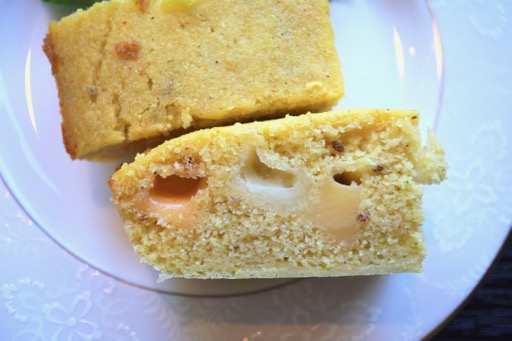
On the cut surface, you can see the melted cheeses. You can also see the hole that is left when the cheese melts into the bread. The original recipe calls for Monterrey Jack. Maybe we will use that next time.
Ingredients:
2 1/2 cups cornmeal
1/3 cup white sugar
1 Tbs. aniseed
2 1/2 Tsp kosher salt
2 Tsp. baking powder
1/4 tsp. cayenne pepper (or more if a hotter bread is preferred)
3 cups corn kernels
1 jalapeno pepper diced
1 1/2 cups whole milk
4 large eggs
1 1/2 sticks salted butter melted and slightly cooled
8 Oz. pepper jack cheese cut into 1/2 inch chunks (we used double Gloucester, smoked Gouda and Gruyere)
Directions:
Grease a 9 x 13 baking dish. (I greased the dish then added parchment paper cut to size and greased it as well. I have found this is a sure proof way to keep the bread from sticking.)
Put the cornmeal, sugar, aniseed, salt, baking powder, and cayenne pepper in a mixing bowl and stir to combine. Combine the corn, jalapeno and milk in a food processor. Process until very smooth. Add the eggs and butter and process until smooth again. Pour the corn mixture into the flour mixture and mix until smooth. Add half the batter into the prepared baking dish. Dot the surface with the cheese squares (#1) then cover them with the rest of the batter.
Cook in a 375 degree oven for 30 to 35 minutes until a toothpick inserted at the center of the bread comes out clean (#2). Let the bread rest for 20 minutes before serving.
This is a pleasantly spicy bread with a rich moist texture. The cheese chunks add a nice burst of cheese flavor. (We suggest using cheeses that hold their form when heated like the smoked Gouda. We found the melting cheeses such as Gruyere melted into the bread leaving a small hole behind.)
On the cut surface, you can see the melted cheeses. You can also see the hole that is left when the cheese melts into the bread. The original recipe calls for Monterrey Jack. Maybe we will use that next time.
Ingredients:
2 1/2 cups cornmeal
1/3 cup white sugar
1 Tbs. aniseed
2 1/2 Tsp kosher salt
2 Tsp. baking powder
1/4 tsp. cayenne pepper (or more if a hotter bread is preferred)
3 cups corn kernels
1 jalapeno pepper diced
1 1/2 cups whole milk
4 large eggs
1 1/2 sticks salted butter melted and slightly cooled
8 Oz. pepper jack cheese cut into 1/2 inch chunks (we used double Gloucester, smoked Gouda and Gruyere)
Directions:
Grease a 9 x 13 baking dish. (I greased the dish then added parchment paper cut to size and greased it as well. I have found this is a sure proof way to keep the bread from sticking.)
Put the cornmeal, sugar, aniseed, salt, baking powder, and cayenne pepper in a mixing bowl and stir to combine. Combine the corn, jalapeno and milk in a food processor. Process until very smooth. Add the eggs and butter and process until smooth again. Pour the corn mixture into the flour mixture and mix until smooth. Add half the batter into the prepared baking dish. Dot the surface with the cheese squares (#1) then cover them with the rest of the batter.
Cook in a 375 degree oven for 30 to 35 minutes until a toothpick inserted at the center of the bread comes out clean (#2). Let the bread rest for 20 minutes before serving.
This is a pleasantly spicy bread with a rich moist texture. The cheese chunks add a nice burst of cheese flavor. (We suggest using cheeses that hold their form when heated like the smoked Gouda. We found the melting cheeses such as Gruyere melted into the bread leaving a small hole behind.)
Wednesday, July 11, 2018
Nattou and avocado salad 納豆とアボカドのサラダ
I had several ripe avocados in the refrigerator. Whenever we have extra avocados, I usually make guacamole. This time, I remembered a Japanese recipe I saw that used nattou 納豆 and avocado. Since I had frozen nattou which was getting old, I decided to make this dish. As usual, I took the liberty of changing the recipe using my common sense. Since nattou is involved, I served with cold sake (our house sake "Mu" daiginjou 八重垣『無』大吟醸) as a first dish .
As a garnish, I used a chiffonade of basil and dried nori strips. The only reason I used basil instead of perilla was that some cuttings of basil which my wife had harvested were sitting in a glass of water on the counter in front of me. I served more nori strips on the side so we could add more as we ate the salad and mixed the ingredients together.
The avocado and tomato were dressed with Mayer lemon juice (I happened to have one. We love the flavors of Meyer lemon), olive oil and Kosher salt.
Ingredients (for 2 small servings):
1 small package of nattou, previously frozen, thawed, prepared by adding the sauce and mustard that comes in the package with the nattou. Using my nattou mixing contraption, I mixed well (a few hundred times). This will reduce the smell making it to palatable for my wife.
Half ripe avocado, stone and skin removed and cut into bite-size cubes
2 Campari tomatos, skinned (by blanching) and cut into bite-size cubes
Kosher salt, olive oil (we used our favorite spicy Spanish olive oil), and lemon juice from one half of a Meyer lemon (it has the taste between orange and lemon juice).
Several leaves of basil, cut into fine chiffonade
1 package of seasoned nori sheets, cut into thin strips
Directions:
Add the lemon juice to the avocado and tomato and coat well, season it with salt and drizzle olive oil.
Top it with half of the prepared nattou
Garnished it with chiffonade of basil leaves and nori strips
Before eating mix everything together and add more nori strips.
Although nattou was a bit sticky, at least, there was no strong smell (which is good for my wife). This is a really interesting combination and the addition of olive oil and Meyer lemon juice was a key to this dish.
As a garnish, I used a chiffonade of basil and dried nori strips. The only reason I used basil instead of perilla was that some cuttings of basil which my wife had harvested were sitting in a glass of water on the counter in front of me. I served more nori strips on the side so we could add more as we ate the salad and mixed the ingredients together.
The avocado and tomato were dressed with Mayer lemon juice (I happened to have one. We love the flavors of Meyer lemon), olive oil and Kosher salt.
Ingredients (for 2 small servings):
1 small package of nattou, previously frozen, thawed, prepared by adding the sauce and mustard that comes in the package with the nattou. Using my nattou mixing contraption, I mixed well (a few hundred times). This will reduce the smell making it to palatable for my wife.
Half ripe avocado, stone and skin removed and cut into bite-size cubes
2 Campari tomatos, skinned (by blanching) and cut into bite-size cubes
Kosher salt, olive oil (we used our favorite spicy Spanish olive oil), and lemon juice from one half of a Meyer lemon (it has the taste between orange and lemon juice).
Several leaves of basil, cut into fine chiffonade
1 package of seasoned nori sheets, cut into thin strips
Directions:
Add the lemon juice to the avocado and tomato and coat well, season it with salt and drizzle olive oil.
Top it with half of the prepared nattou
Garnished it with chiffonade of basil leaves and nori strips
Before eating mix everything together and add more nori strips.
Although nattou was a bit sticky, at least, there was no strong smell (which is good for my wife). This is a really interesting combination and the addition of olive oil and Meyer lemon juice was a key to this dish.
Subscribe to:
Comments (Atom)