Sunday, March 15, 2020

Squid fritters イカのすり身揚げ

This recipe is from "The real Japanese Izakaya Cookbook". This dish is featured on the cover. I ended up, by necessity, having to modify the recipe. Despite the modification, this dish turned out to be very good. I served it, as per my wife's suggestion, with a wedge of lemon rather than "Japanese sauce" as the original recipe suggested. I served it with my usual sugar snaps and Campari tomato.


Since the squid legs were only coarsely chopped, you can see them in the cut surface which gave texture to this dish.


Actually, I made a soup using the squid mixture as per the original recipe. As I dropped the mixture into the broth, I realized the squid balls were not sticking together as well as I expected. For the soup, this was not much of a problem but I did not want the squid balls to fall apart in the hot oil. So, I had to modify the recipe by adding more "binders"(egg, more flour and panko bread crumbs).


This clear soup was made of dashi from my usual dashi pack, sake, mirin and light colored soy sauce. I made "quenelles" using two teaspoons and dropped them into the simmering soup. They did not maintain a quenelle shape but mostly stayed together. I added silken tofu and chopped scallion to the soup. Just before serving, I added frozen "yuzu" skin to the soup bowls. Despite the fact the squid mixture became a rather amorphous blob this was a pretty good soup.
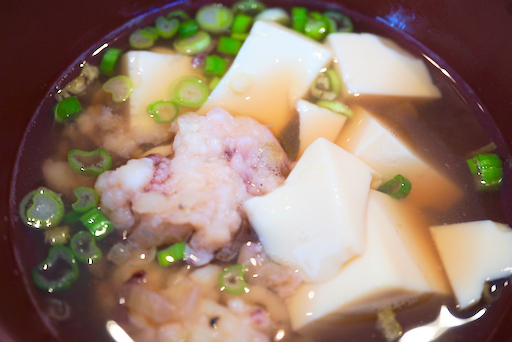

The squid balls in the soup were based on the original recipe. When I saw how they cooked in the soup I realized I had to alter the recipe to make sure they did not dissolve when I put them in the hot oil. The instructions below are for the squid fritters and include my modifications.

Ingredients (This is my modification):
1lb cleaned squid, tentacles and body, half and half (the body hand chopped into small pieces , #1 and the tentacles cut into small chunks, #2).
2-3 tbs Panko Japanese bread crumbs
1 egg
2 tbs flour
1/2 tsp salt
1/4 tsp black pepper

For frying
Flour, egg+water, panko
Peanut oil for deep frying

Directions:
Mix all ingredients well and make small oval patties. Usual frying process; dredge in flour, dip in egg water, and coat with panko crumbs (#3)
Deep fry for 4-5 minutes turning occasionally (maybe because of the egg, the fritters puffed up into a ball (#4)


I think the reason I had to add more binders (flour, bread crumb and egg) is because the body of the squid was not chopped finely enough (to paste). Next time I will use a small food processor and make it more the consistency of mousse.  It is not easy to hand chop squid.

In any case, the end result was pretty good. We think just lemon is better than Japanese Worcestershire sauce for these rather delicate tasting squid fritters. During the week we heated up the remaining fritters in the toaster oven for a week night appetizer and that worked out very well.

My wife found the daffodils in the front yard with large buds on them. She brought two inside and put them in a Japanese style flower vase. A few days later it bloomed beautifully. Spring is coming!


Friday, March 13, 2020

Cheesy spinach squares

My wife is into making small cheesy appetizers--particularly green cheesy appetizers. This recipe fulfilled both conditions and she had to make it.


The cheese squares were fairly easy to make but despite all the cheese and other ingredients that went into it, we felt, in general, it was pretty bland. The spinach gave it a green color but didn't add much flavor. To jazz it up a bit we tried it with my tomato sauce which was made from skinned Campari tomatoes. The addition of the tomato sauce added more flavor and really helped.


My wife was on the look-out for other ways she could improve the cheese squares and one evening when she was frying up some scrapple for an appetizer she decide she would fry up the cheese squares the same way since she had peanut oil in the pan and it was hot  .


She dredged the squares in flour and fried them on all sides until they had a nice brown crust as shown in the picture below. This was an improvement. The crust had a nice crunchy toasted flavor and the inside was soft with a slight cheesy flavor.  It was okay but not outstanding.


Ingredients (#1 in the composite picture):
1 cup flour
1 tsp salt
1 tsp baking powder
1 cup milk
1 and 1/2 cups grated cheddar cheese
2 eggs, lightly beaten
4 tbs butter, melted
1 cup chopped fresh spinach (original recipe calls or 1package or 9oz frozen chopped spinach).


Directions:
Mix all the ingredients (#1 in composite picture) together (#2 in composite picture) . Place the mixture in a greased 9 inch square pan lined with parchment paper and greased again. (This makes it easier to get out after it is done.) (#3 in composite picture)  Bake in a 350 degree oven for 30 to 35 minutes. Loosen the edges from the sides of the pan as soon as it comes out of the oven (#4 in composite picture) . Let it cool slightly before cutting.

This wasn't bad and certainly went together quickly. It was quite edible but not exciting. If we make it again we will have to make some significant alterations.

Tuesday, March 10, 2020

Salmon sashimi three ways 鮭の刺身3種

Whenever we get frozen sashimi salmon from Catalina offshore products, I have to come up with several ways to serve it since having it as only straight salmon sashimi gets to be a bit too much of a good thing.  The first evening after the salmon was thawed, I served only the belly portion as sashimi for a small starting dish. The next evening, I prepared the plate shown below with three different salmon preparations, octopus leg and several vegetables.


The picture below shows straight salmon sashimi with my usual sugar snap in salted broth スナップ豌豆の塩びたし shown on the right.


The below is a new and very simple dish which I read about somewhere online. I just marinated the salmon sashimi in "shio ko-ji" 塩麹 for a few hours in the refrigerator. I served it topped with "ikura" salmon roe and garnished with chopped chives.  The shio ko-ji made the salmon sashimi softer but added a bit slippery surface texture. This is certainly different and not bad but not our favorite way of serving salmon sashimi.


The picture below shows salmon cured overnight in Russian marinade 鮭のロシア漬け. Since the salmon is marinated only overnight, just the surface of the salmon pieces are chemically cooked but the center is still raw. This partial curing is possible because this is sashimi grade salmon. If I made this dish from regular salmon filet, I would make sure the center was opaque indicating that it was completely chemically cooked. I garnished this with a chiffonade of perilla leaves. We liked this preparation very much. To the left of the salmon is a salad of thinly sliced cucumber in sushi vinegar 胡瓜の酢の物 and sliced Campari tomato. On the right side is blanched broccolini dressed with mustard soy sauce.


Since we had boiled octopus leg from the Japanese grocery store, I served it with sumiso dressing as usual.


We really enjoyed this medley of salmon dishes but luckily there was still a small piece of salmon left to look forward to the next evening.

Saturday, March 7, 2020

Straw grilled bonito at Tako Grill 藁焼きカツオ

On  a recent visit to Tako Grill, the owner Mr. Terry Segawa 瀬川哲紀さん told us that he was going to get some fresh bonito 鰹 from Japan and cook it in the traditional Japanese way of searing and smoking it over a straw fueled fire 藁焼き. Since Mr. Segawa is originally from Kochi 高知 in Shikoku 四国 which is famous for this dish, this was clearly something we couldn't miss and we are glad we didn't.  Firstly, the cooking of the bonito as shown in the pictures below was quite a breath-taking display.


Mr. Segawa placed a small shiny brand-new metal garbage can and filled straw under the restaurant's industrial strength exhaust hood. He told me that he got the straw from a near-by farm. When he lit the straw, the flame flared up bright and strong. As you can see, it made a pretty impressive fire. (From deep inside the restaurant I heard a child's voice pipe up "Daddy, is that a real fire?") I suspect other customers were also taken by the impressive display.


Mr. Segawa skillfully seared the outside of the bonito leaving the inside still raw, i.e. Katsuo tataki カツオのたたき. Not only was the outside seared but it was also washed in the fragrant straw smoke. The result was the dish shown below. It was served with grated ginger, thinly sliced garlic and red onion. Needless to say, the bonito was melt-in-your-mouth tender with a contrasting seared bark texture on the surface and a wonderful straw-grilled flavor. Compared to our usual pre-packaged frozen bonito tataki, this is in a totally different class. This was a wonderful experience without having to go to Kochi ourselves. Thanks, Segawa-san.


I also took some video.


Wednesday, March 4, 2020

Hijiki stir fry and other otoshi ひじきの炒め物と他2品

This is a starter line-up for one evening. Nothing is particularly new. From left to right are "aji-tsuke-tamago" 味付け卵 marinated soft boiled egg, hijiki seaweed and fried tofu stir fly ひじきと油揚の炒め物, and salt-broth soaked sugar snap スナップ豌豆の塩びたし.


Over the years I changed the way I make aji-tsuke tamago a bit (made it simpler and easier). As usual, I use pasteurized eggs. For some time, I have been using "boil-steam" cooking method for boiled eggs which works much better than just submerging eggs in water and boiling. I use just enough water to come half way up the sides of the eggs. (The eggs are cooked by steam). I pierce the eggs first and place them in the water that is boiling rapidly on medium high flame. I put on the lid and cook for 6 minutes 30 seconds for soft boiled eggs with runny yolk (I usually ask Siri to time the 6 1/2 minutes). I cool the eggs using cold running water and then further cool them down using ice water. This appears to make peeling the egg easier (I think). I then put the peeled eggs in a small Ziloc bag and just pour in a small amount of concentrated "men-tsuyu" めんつゆ noodle sauce from the bottle. I remove the air as much as possible and seal. I let it marinade for a few days in the fridge changing the position whenever I open the fridge door. After a few days, the runny yolk jells into an almost custard consistency. To serve I cut one in half and sprinkle with salt. This is usually a topping for ramen noodles but it is also great as an appetizer.


The dish shown below is very similar to what I posted before. I made this because I hydrated too much hijiki when I made the takoyaki variation. This is made of just hijiki, julienned carrot and thinly cut "abra-age" deep fried tofu pouch, stir fried with sesame oil, mirin and soy sauce. This can be a good condiment for rice or as we did here, a great snack.


The dish below has become our favorite way to have sugar snaps. Just blanched sugar snaps are nice but this extra step of trimming both ends of the pods and soaking in salt seasoned Japanese "dashi" broth makes it much better. The only caution is when you bite into them the salt broth that migrated into the sugar snap while it was soaking may squirt out.


So these three items with cold sake nicely started the evening. This home Izakaya is not bad if I say so myself.