Monday, August 9, 2021

Tako Grill Take-out タコグリルからテイクアウト

Our Izakaya substitute "Tako Grill" has been close for dining-in for some time. Mr. Terry Segawa indicated that they would operate in a take-out rather than sit-in format. He also added a Japanese grocery section. Although we will miss being able to  interact with the sushi chefs and Mr and Mrs Segawa, we have been enjoying Omakase sushi and take-out all during covid. One of the pluses of take-out is that we do not have to worry about driving home afterwards. To make the experience more enjoyable, I usually re-plate the food. An example of which is shown in the next picture. Using the garnish they provided, I rearranged the sashimi into two servings; one for me and one for my wife instead of sharing the plate (which is what we used to do at Tako Grill at the sushi counter).


Today, we got nicely marbled “toro tuna” almost looking like Wagyu beef, in the center is “hamachi” and on the right is “aji” horse mackerel. Since aji sashimi is best eaten with grated ginger and soy sauce, I used sauce bowl which had two wells and served both wasabi (using Tako Grill provided one) and added grated ginger (from tube) soysauce
 

I rearranged “uni” sea urchin and squid sashimi into a small bowl and added a garnish of nori strips and wasabi dissolved in soy sauce.


Whenever, we get “Aji” sashimi, Sushi Chef  Santos always serves us deep fried aji skeleton. Even for the take-out, this is included. We heated it up in the toaster oven on toasting  mode. It comes out hot and crispy almost like just out of hot oil. Since there is only one, we share it. We essentially eat everything including the head.


Like we are dining in, we finish with some sushi. Today, we got Japanese “tai” red snapper, toro and eel sushi and our usual California roll made of real lump crab meat and addition of  tobiko roe.


Although someday, we may be able to dine-in again, we are quite happy with this arrangement. We also get some Japanese groceries which is definitively a big plus. We are regularly getting frozen edamame (they have the best quality edamame), Japanese crackers (especially my wife likes them), Tonkotsu ramen, and green tea ice cream daifuku among others.  We hope this new format will work for Tako Grill as a business. We are certainly very happy with this format.

Friday, August 6, 2021

Big eye tuna sashimi 4 ways めばち鮪刺身 四通り

When we got firefly squid from Regalis food, we also got 3 lbs. of fresh bigeye tuna sashimi メバチマグロ (akami 赤身). Since this was too much tuna sashimi for us to finish in one sitting, I divided it into 4 portions. We finished one portion fresh. The remaining three portions were vacuum packed and frozen.  Over time we have been enjoying the frozen portions and finally we came to the last one. Although this tuna tasted fairly good, certain portions, including this last one, were very “sinewy”.  So I had to tailor the dishes I made to make the sinew less noticeable. The dishes I made are shown in the next picture. The upper row from left to right are “yamakake” やまかけ, “sashimi” 赤身刺身, tuna with avocado cubes マグロとアボカドの角切りand the lower row is imitation “negitoro” 擬制ネギトロ. I did a similar combination of dishes using frozen yellowtail tuna but these made with big eye tuna were much better.
 

For the yamakake, I marinated  cubes of tuna for several hours in concentrated (x4) Japanese noodle sauce and also added soy sauce with dissolved wasabi to the grated nagaimo. I topped it with thin strips of nori. This is a classic and also sort of filling because of the grated nagaimo.


I chose the portion with the least sinew and made a small serving of straight sashimi. It was quite good.


This is another dish I make often. The dressing contains chopped garlic, soy sauce, sake, and dark sesame oil. The similarity of textures of tuna sashimi cubes and avocado works well. Since I did not have fresh chives, I used the green part of scallion for garnish.


Finally, imitaion negitoro. The combination of mayonise and tuna cannot go wrong. As usual, I left a half portion of tuna in small cubes and mixed it with the more finely chopped tuna with mayo, Japanese noodle sauce and chopped scallion. I served this with slices of cucumber (American minicucues) and small rectangular  sheets of Korean nori 韓国海苔. We made small nori rolls with the cucumber and negitoro. This is really great and also filling.


After finishing these 4 tuna sashimi dishes, we enjoyed  “edamame” 枝豆 and assortment of Japanese rice crackers and few more cups of cold sake and we were quite full.

Tuesday, August 3, 2021

Mixed seafood fry 海鮮フライ

This is our effort to clear up some frozen seafood inventory that has been in our freezer “long enough”. Among the items in danger of exceeding their allotted time were  scallops we got from Great-Alaska-Seafood and Pacific Oysters we got from Vital Choice wild seafood. I added shrimp also from Great-Alaska-Seafood to these items so that I could make a mixed seafood fry.

The picture below is not one of my better jobs at presentation, but hot out of the oil, these fried items were great. I served them with homemade Pa Dutch coleslaw, Campari tomatoes and wedges of lemon.


Although the scallops had freezer burn, I carefully shaved it off before cooking. Despite that, they tasted good. We should not be eating this type of fried food too often but when we  do, we  really enjoy it.

Saturday, July 31, 2021

Nagaimo dressed in cod roe 長芋の鱈子和え

I started going back to our Japanese grocery store again. The last time, I got a fairly good hamachi sashimi. This time, I hit the jack pot! I knew that the Japanese grocery store gets sashimi bluefin tuna or “hon-maguro” or “kuro-maguro” once a month but I did not try to find out when and never went specifically to get sashimi maguro. Just by happenstance I went just a day after they got the maguro. So I had a choice of chu-toro or akami maguro sashimi. I chose a package of “akami” with two good sized portions and also, as an added benefit, some hamachi. That evening, we had a combination sashimi feast of tuna 鮪, hamachi はまち, vinegar cured mackerel しめ鯖 (frozen). I also made imitation “negitoro” 擬制ねぎとろ from this tuna sashimi because the tuna portions were not regular “saku” 柵 blocks for sashimi and I ended up with some odd pieces after slicing the sashimi pieces.  Compared to our usual imitation negitoro which I make from a frozen block of yellofin tuna, this was much much better.  I did not take any pictures, however. Next evening, I served the remaining sashimi, deep fried fish cake or “satsuma-age” さつま揚げ which I also got at the Japanese grocery store (heated in the toaster oven served with soy sauce and grated ginger). I also made a sort of new dish from cod-roe and nagaimo.


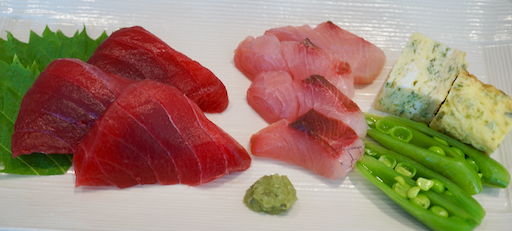
Here is the close up of the sashimi dish which I served with dashimaki だし巻き Japanese omelet and sugar snap in salt broth スナップ豌豆の塩びたし.


The next picture shows the “new” nagaimo dish I made. I did this because I had thawed “tarako” たらこ cod roe and found out the membrane in the back was already broken. So, I removed the roe from the remaining sac, mixed it with a small amount of sake, although I did not have a firm idea at the time of what I would make from it. I then remembered that we had a small segment of  nagaimo 長芋 in the refrigerator which had to be used soon. So I just combined the two.  I garnished it with a chiffonade  of perilla and nori. This was a good dish. This tarako was a bit on the salty side but the addition of sake in combination of the crunchy refreshing nagaimo, really worked.


Ingredients:
1 inch segment of nagaimo, skinned, sliced and cut into fat match sticks.
1 tsp sake
One sac of salted tarako, cod roe
Perilla leaves and nori chiffonade for garnish

Direction:
Soak the nagaimo sticks in water with a splash of rice vinegar and gently wash to remove surface sliminess. Blot dry using a sheet of paper towel.
Remove the roe from the sac using the back of the knife and mix it with 1 tsp of sake. Taste and if not salty enough, add soy sauce (mine was salty enough).
Dress the nagaimo and garnish it with the perilla.

So every time I go to our Japanese grocery store, we have a number of  “goodies” for dinner that evening.

Tuesday, July 27, 2021

Chashu egg v2 チャーシューエッグ

 Chashu pork or “yaki-buta” 焼き豚 can be made from different cuts of pork. I used to make it from pork loin but it tends to be too dry since it does not contain enough fat. I also made it from pork belly which is good but it is a bit excessively fatty for this type of preparation. Because of the COVID, we started having groceries delivered. They come directly from the warehouse (I suppose) rather than the retail store so some items are different from what is available in the store. One of them is pork shoulder/butt. This is a cut we have never seen at the store. It is a large portion; either shoulder or butt but it is always called “shoulder”.  The butt is composed of a  portion of butt (naturally) including thigh down to the knee joint. Sometimes the skin is intact. The shoulder cut contains a good portion of scapula and surrounding meat. It is quite a large amount of meat. The only way to cook this cut as a whole piece is probably “true” Southern style barbecue, cooked for long time at low temperature. Since we are not equipped/skilled to do such a preparation, I reduce the piece into more manageable portions by removing the skin (if present), and bone, then dividing the meat into three potions;  the largest roast for cooking in our Weber grill, the smaller roast for Chashu and the rest cut in to small chunks for stew or curry. This time we got  butt and the portion I made into Chashu was a perfect mixture of fat and meat. So I made Chashu egg  which is the combination of sunny-side-up egg (I used home pasteurized egg) with a thick slice of Chashu.


I think this is the perfect combination. The chashu is not too fatty or dry. You could eat or not eat the outside rather thick fat rind. Although it is a bit of work to prepare this big bone-in cut of pork, it is very reasonably priced and the meat we get out of it is quite good.