Sunday, October 31, 2010

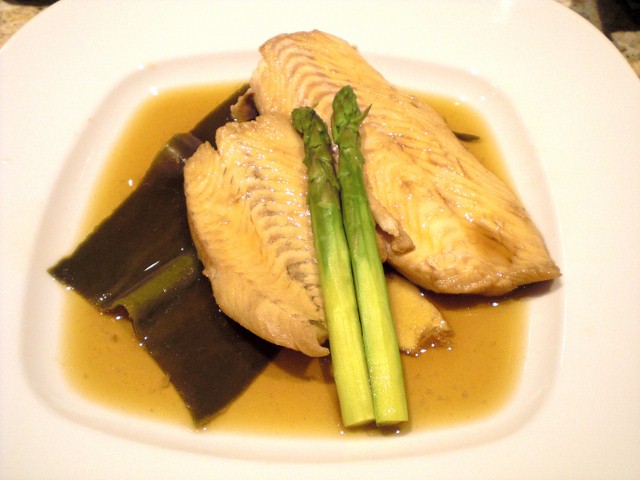
Flounder simmered in Japanese broth カレイの煮付け

I do not think I ever made this dish before. Probably because I somehow associate this dish with being ill as a kid. This was the first solid food my mother served me when I was recovering from some GI ailment. My mother thought this dish was the most mild flavored, easily digestible and highly nutritious food she could serve to speed recovery. All this is probably true but I can't imagine feeding this to an American kid just getting over a tummy ache.

I bought too much fluke (flounder) which I used in my matsutake dish. I thought about making  menier or grilled or fried flounder but I decided to make this dish. One of the reasons I chose this dish is because I had extra kelp broth left over from when I made matsutake rice.

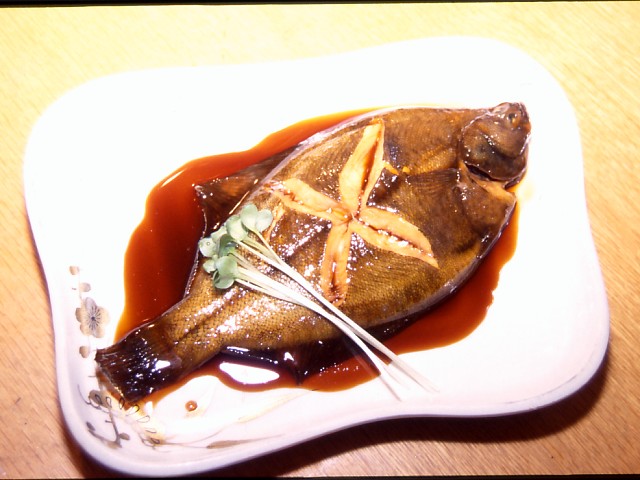
The different Japanese and English names for flatfish are numerous and confusing. I usually associated the Japanese name "Karei" カレイ 鰈 (The left symbol which makes up this kanji letter is "fish魚" and the right symbol is "leaf葉") with sand dabs and "Hirame" 平目 (meaning "flat eye") with flounder or fluke but I am not sure this is a correct association. A classic Japanese recipe calls for small sand dabs or karei for this dish so that the whole fish with skin on is simmered in broth (see image below). The skin adds a slightly slimy texture which, I suppose, the Japanese like but I only had previously skinned and boned fillets of flounder.

Broth: Again, this is typical Japanese seasoning combination. I used kelp dashi, sake, mirin, and soy sauce (2:1:1:1). If you like you could add sugar (up to 1 tbs) to this. You must add enough slices of fresh ginger (3-4 thin slices) to add a good ginger flavor to this dish. I placed the seasoning liquid in a flat wide pan like a sauté pan so that the fillets are in a single layer and covered with the seasoning liquid. I gently simmered it for 10 minutes. Since this was a fillet, I did not bother with "otoshi buta" 落とし蓋 but instead, I covered it with a piece of kelp while the fish was cooking.

I served the fish with the kelp on the bottom (as decoration, just becase I had it) and boiled asparagus. I had to admit, this is not one of my favorites but it has a nice gentle texture and the taste of fresh ginger. Oddly, I am already feeling better.

Here is a more classic image of "Karei no nituske" カレイの煮付け(http://www.jf-net.ne.jp/kagyoren/image/santi/12-6.jpg

Friday, October 29, 2010

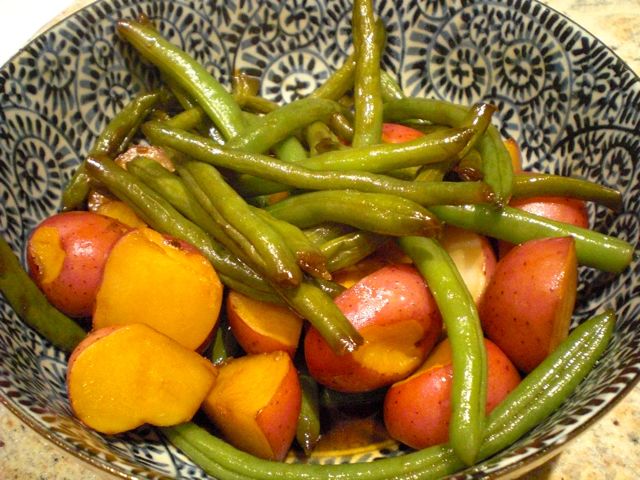
Braised potatoes and green beans 小芋とインゲンの煮物

This is a very homey and simple dish. My mother used to make it often. I made this one evening since my wife washed and dried green beans but did not have a time to make the dish she had in mind and was in the process of putting them away in the refrigerator. I just grabbed a handful of green beans and made this dish.

One of the problems I have is that I do not measure anything especially for this kind of dish The amount of ingredients and seasoning is just a guesstimate. The above picture is the entire amount I made; about 20 green beans and 6-7 baby red potatoes.

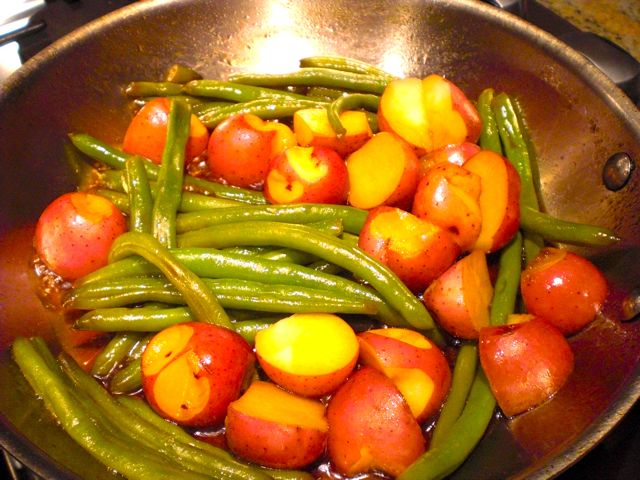
I removed the "eyes" of the potatoes and cut them in half or quarters depending on their size. In a large frying pan on a medium flame, I added 1/2 tbs of vegetable oil and a splash of dark roasted sesame oil. When the oil was shimmering, I added the green beans (please make sure they are dry, otherwise it splatters) and the potatoes and sautéed briefly so that all the vegetables are coated with oil. I added 2-3 tbs of mirin and tossed it around. After 1 minute or so I added chicken broth (3-4 tbs, non-fat and reduced sodium Swanson as usual but you can use dashi, sake, or water). I put on a tight fitting lid and turned down the flame to a low simmer.  I let it cook for 10 minutes or so and added 1 tbs of soy sauce. I put back the lid and simmered it for another 5-7 minutes. I opened the lid and checked the potatoes to see it they were done (insert a skewer or knife tip). If the potatoes are not done and not much liquid is left, add more water or chicken broth. (In my case, the potatoes were done). The liquid should be reduced quite a bit at this point (Picture below). I added a half tbs more soy sauce (to give a fresh soy sauce flavor) and tossed it around and let the liquid evaporate almost completely (another 1 to 2 minutes).

This is a somehow very comforting dish for me since it was one of my mother's repertoire. Classic Japanese seasoning but the fresh taste of green beans comes through. Perfect side for any Japanese meal or you could have it by itself with sake like we did.

Wednesday, October 27, 2010

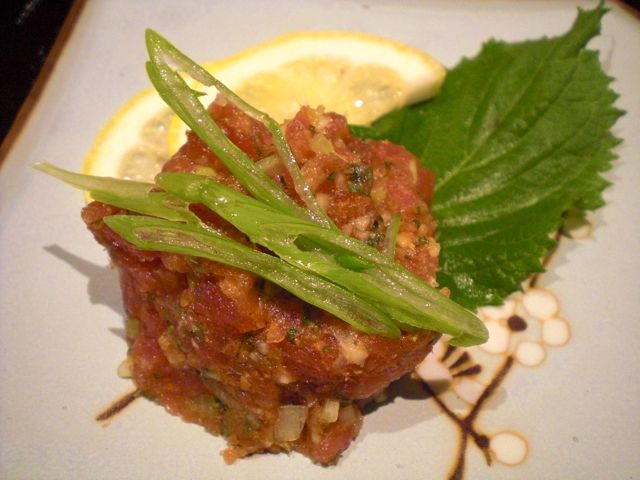
Tuna "namerou" tartar 鮪のなめろう

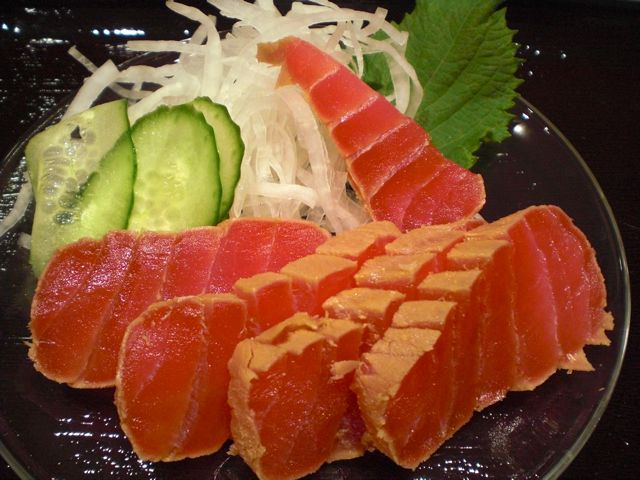
I have done posts about frozen yellow-fin tuna sashimi block or "saku" 冊 previously several times. Although it is by no means quality tuna sashimi, it is very convenient to have in your freezer and affordable. My quest to make this frozen tuna palatable continues. This evening, I made three different dishes--one of them I attempted for the first time.

This is called "namerou" なめろう. It is a type of "tataki" たたき or Japanese style tartar type preparation. I am not sure of the origin of the name but "nameru" なめる means "to lick". This dish was said to be made by a fisherman on the boat, simialr to the origin of "okizuke" 沖漬け. The fish used in this dish is usually a blue-white shiny skinned fish, "hikarimono" ひかりもの, such as mackerel. Tuna is not commonly used but I made this with the frozen tuna.

I used about 1/3 saku since I made three different dishes shown here. I first roughly chopped the tuna into small cubes, sliced scallion, minced perilla and fresh ginger (amounts all arbitrary). I added half a tsp of red miso paste to start. I minced (or "tataku", meaning to bang or hit with a knife blade) all these together until it became sticky and well mixed but still retained some shape. I tasted it and added a little more miso to finish. If this becomes too stiff, you could add a small amount of sake to make it the right consistency, which I did not need to do. This was a great success! Because of the many flavors especially the miso and the nice consistency, it was perfect to nibble while sipping cold sake. If you were not told, you would not be able to tell that this was made of frozen yellow-fin tuna.

This is variation of "zuke" 漬け. Last time I made it, it was very good but, for me, it was a bit too salty, so I made some modifications to make it more like slightly flavored sashimi than a classic "zuke" preparation. I used the same type of marinade but increased the amount of sake and mirin (sake, mirin, regular dark soy sauce and usukuchi syouyu in 2:2:1:1 ratio). I also added ginger juice (from freshly grated ginger root), and coarsely ground roasted white sesame as before. I also did a "shimofuri" 霜降り process and then marinated it for 2 hours in the refrigerator. This is not quite "zuke" and the consistency of the tuna did not change too much to the point of "sliminess" like in a classic "zuke" preparation. The marinade did impart nice flavors and the consistency of the tuna was quite good. I sort of like this preparation. So far, two solid hits for me tonight--one more to follow, bases loaded. Actually, at this point, probably more than just "bases" are loaded. These two dishes are so perfect with sake we may be "enjoying" ourselves too much at this point.

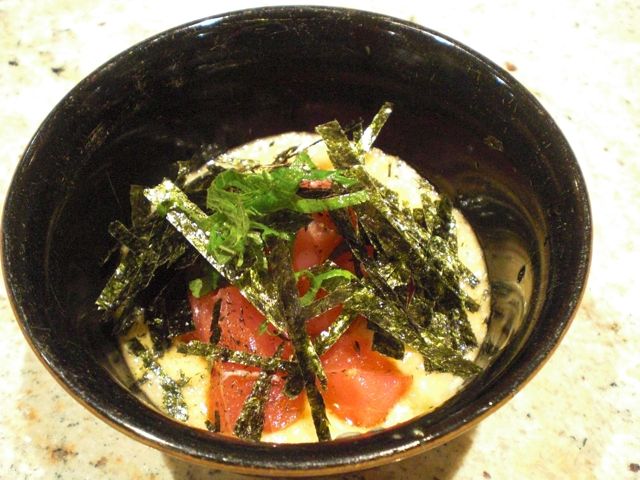
The third tuna dish is our usual stand-by and is nothing new; just classic "yamakake" やまかけ.

We think, even for frozen saku of yellow-fin tuna, these three dishes I made tonight were quite good (I know my standards may have fallen substantially compared to those of Japanese food connoisseurs out there, especially a few in Tokyo).

Monday, October 25, 2010

Brie and Fuji Apple quesadilla ブリィチーズとリンゴのケサディア

This is a very interesting quesadilla. I bet you will not get this in Mexico but it is perfect with wine. We saw this in "Cooking Light" (paper copy) and both my wife and I independently thought it was interesting. Although the recipe came form "Cooking Light", by no means, is this dish "light". 
This is essentially just like any quesadilla but instead of Jack cheese and some kind of meat,  brie and Fuji apple are used, which make it very unique. Disclaimer: I did not follow the recipe to the letter, so the end product may have been slightly different. I used two small flour tortillas (instead of using a one large tortilla and folding it in half). The recipe calls for regular brie but it turns out I picked up goat milk brie instead, Fuji apple, and baby arugula.

I spread a thin layer of Dijon mustard (Grey Poupon) on one side of both tortillas. In a small (8 inch) frying pan on low flame, I add 1 tsp of olive oil and placed the first tortilla with the mustard side up and placed slices of brie on the tortilla.  After the cheese started melting, I placed thinly sliced Fuji apple on the cheese to cover the surface (I peeled and cored the apple before slicing) and a handful of arugula on the top. I sprinkled freshly cracked black pepper over it. I then placed the other tortilla with the mustard side down. I pressed gently with a spatula. After few minutes, I flipped it to brown the other side and cook it for 2-3 more minutes.

As you can see in the above image, melted brie started oozing out as I tried to cut it. The unique combination of goat milk brie, mustard, black pepper, apple (still crispy, sweet and sour) and slightly peppery arugula, all works together. The goat milk brie had a very pleasant somewhat "gamey" flavor. This was a very nice Franco-Mex (?) hors d'oeuvre indeed, which goes particularly well with wine. We had this with red wine but any white, particularly something like Riesling will also do.

Sunday, October 24, 2010

Pork cutlet bowl カツ丼


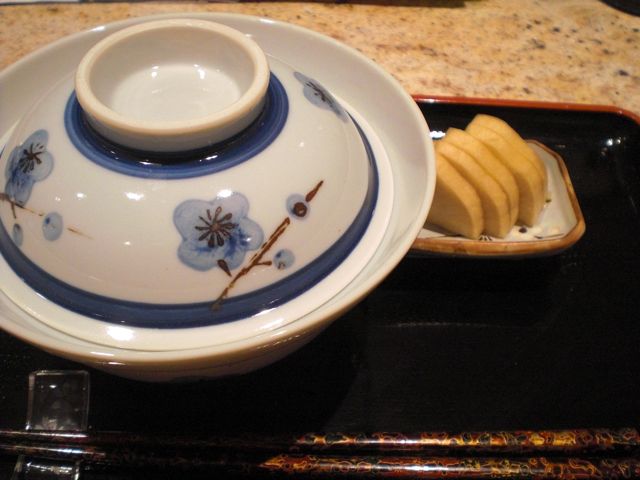
This looks like the classic lidded Japanese bowl you may see in "Taishu shokudo" 大衆食堂、which is the Japanese equivalent of American diners.  I do not remember when I got this bowl but it must have been in California. I have not used this bowl for a long time for some reason. This dish, Katsu-don カツ丼, is a classic dish being served in Japanese eateries and this bowl is perfect for it. Since we had already made pork fillet cutlets, I made this classic dish from the leftovers and frozen rice. Of course, you could make this from just fried tonkatsu and freshly cooked rice, which would be much better.

There are two distinctive styles in "Katsudon". One type is with soy sauce based broth and beaten egg anchoring everthing together called "Tamago-toji katsudon" 卵とじカツどん, which is, by far, the most popular style and is usually referred as simply "Katsudon". Another (more  regional and less popular) kind is tonkatsu dipped in semi-Western style tonkatsu "sauce" with shredded raw cabbage placed on the top of rice, which is called  "sauce Katsudon" ソースカツどん. I am from the area of Japan where the former style is the only type of Katsudon available. I personally never had a "sauce" Katsudon but I do not think I am missing much (I can easily image how that would taste). 

Here is the view with the lid off, served with beer marinated daikon. Perfect dish to make quickly on a weekday evening. I could have worked on the presentation, though.
To make this dish, you could use the special pan shown below (also perfect for Oyako-don 親 子丼) but I do not have one. Any small (8 inch) frying pan with a fitting lid will also work. You have to use one pan for making one serving. So, in our case, I use two 8 inch frying pans.

Broth/sauce: This is a typical dashi, soy sauce, mirin combination. How much and how strong the broth should be depends on personal preferences. Japanese diners tend to go with a strong broth and a small amount. My wife likes enough broth to moisten the rice adequately. I favor less broth but a bit stronger taste. For this evening, my broth is a compromise. For two servings, it iconsists of dashi (1/3 cup, instant granulated dashi dissolved in hot water), mirin (1 tbs), and soy sauce (1 tbs) but you have to taste and decide how sweet and how strong you would like the broth to be. You could also add sugar, if you like it sweet. I tasted and adjusted further (a bit more soy sauce). I seasoned it more severely than soup you will drink but not as strong as a dipping sauce.You could use any type of tonkatsu. I used "hirekatsu" ヒレカツ or fried fillet of pork.

I arranged the ingredients except for the snow peas in a small frying pan, which makes one serving. I used one medallion of pork per serving for us but I suggest two for most people; sliced in 1/3 inch (or about 1 cm) thick. For vegetables, I used fresh shiitake mushroom (one medium, stem removed but not sliced, with a decorative cut but you can not see it well in the picture), onion (1/4 medium, halved and thinly sliced) and snow peas (2 or more). I add the broth above (1/6 cup or half of what I made). Put a tight lid on the pan and cook for 4-5 minutes on a low flame. I add beaten egg (1 large) and the snow peas and cook another two minutes or so with a lid on.  I take the pan off the heat when the egg is just barely congealed in the center.

I place the cooked rice (in our case, microwaved froze leftover rice) in the bottom of the bowl and slide the topping onto the rice with all the remaining broth (The broth reduces a bit. The special pan in the picture comes in handy if you have one). Put the lid on the bowl and let it stand for a one minute or two. If you like the eggs to be a bit runny skip this last step. If you do, please use pasteurized shell eggs). If you have already made rice and tonkatsu, this is a very quick weekday evening meal. Everything tasted pretty good except my wife wanted more broth.