Showing posts sorted by relevance for query persimmon. Sort by date Show all posts

Wednesday, December 5, 2012

Persimmon salad 柿のサラダ

Persimmon or “kaki” 柿 is a quintessential autumn fruit of Japan. Persimmon are not particularly popular in the U.S. mostly because the varieties available may be inedible if not completely ripe—supremely unpleasantly puckering in the mouth. Well, you have to know the type of persimmon and how to avoid the astringent puckering taste (tannin). In contrast, persimmon in Japan are lusciously sweet. Fortunately, the sweeter varieties are appearing in the market in the United States. In any case using sweet persimmons, I made a quick salad one evening by also using leftover blackened Brussels sprouts from Thanksgiving.

CIMG5563

I just sliced American mini-cucumber, blackened (baked)  Brussels sprouts and dressed with mayonnaise and seasoned with salt and black pepper. I placed the salad on the bed of baby arugula. I think you could do “shira-ae” 白和え using tofu as a dressing (tofu, sesame paste, light colored soy sauce).

Because of the nice sweetness of persimmons and different textures of persimmon (firm but soft), cucumber (crispy and refreshing) and Brussels sprout (soft) but also sweet in its own way, this was a nice salad to start.

Digression alert: A few words about persimmon. Persimmon contain a large amount of tannin (the same substance that develops in red wine). Depending on the type of persimmon and its ripeness, it could be astringent or it could be wonderfully sweet. Many Americans do not know this and often end up biting into a totally inedible astringent persimmon and never to try it again. My wife fell into this category.

When I was growing up, there are many kinds of persimmon including some with big stones (seeds) inside and some which puckered your mouth called “shibugaki” 渋柿 but, in my more recent memory, all the persimmon were sweet or “amagaki” 甘柿 with no seeds or stones. This must have been because of the selection of cultivars with only the seedless sweet variety being sold. Other ways to remove the tannin from persimmon is by drying them called “Hoshigaki” 干し柿.  I used to eat this often as a kid. Another way is soaking them in alcohol or “tarugaki” 樽柿. I read also that placing them in carbon dioxide also removes tannin, which was reportedly done on a  large industrial scale.
In any case, at least in our area, at some gourmet grocery stores, you can get persimmon and I see two different kinds being sold.

Here is one kind called “Hachiya” 蜂谷. This one has a pointed end and is classified as “Shibugaki” 渋柿 or astringent persimmons. This  means that if you eat this before the meat of fruit become soft and pudding-like, it will pucker your mouth in a big way—”like the mouth of a tightly pulled drawstring purse” according to my wife. I let it sit on the counter for almost 2 weeks before we ate it. As you can see on the right, the meat of the fruit became soft and semi-transparent. This type has a nice sweetness and the fruit melts in your mouth with nice soft pudding-like texture.

Persimmon Hachiya

Here is another type called “Jiro” 次郎. This is square in shape with a flat bottom. This is classified as “amagaki” 甘柿 or sweet persimmon. As long as it is ripe, you do not have to wait until the meat becomes soft. As you can see on the right, the appearance of the meat of this persimmon is quite different from the previous one and the fruit is still firm yet it is not astringent. This is the one I used in the salad.

Persimmon, Hacchin

Once you know these tips about enjoying persimmons, it is one of the most wonderful fruits you can have. Unfortunately, only a small percentage of people in the U.S. enjoy persimmon. On second thought maybe that is good thing; more for those of us who know what to do to enjoy them.

Finally, here is a famous Haiku of Shiki Masaoka 正岡子規 about autumn, the temple bell and persimmon.

柿食えば鐘が鳴るなり法隆寺

I am not going to translate this but Roger Pulvers did this for us in the article in Japan times (9/20/2010).
“As lovely and evocative as that is (referring to his friend Natsume’s autumnal haiku), Masaoka went one better than his friend with what has become one of the most well-known haiku in Japan, set at Horyuji Temple in Nara:

"Eat a persimmon / And the bell will toll / At Horyuji."


The tolling of the temple bell is a potent symbol, going back 1,000 years and resonant of the transience of life.”

Sunday, January 19, 2020

Persimmon, smoked oyster shira-ae 薫製牡蠣と柿の白和え

Actually, this was inspired by a dish we had at Sushi Taro Omakase and then by a variation that was in the 2020 osechi box and was called "kaki kaki kunsei" (Smoked oyster and persimmon). In Japanese, persimmon is "Kaki" with flat intonation and oyster is "Kaki" with an accent on "ki", so this was a sort of play on words. The quality of the smoked oysters and persimmon are important. The oysters used by Sushi Taro were smoked in-house and were wonderful. The persimmon was perfection. The osechi version of this dish (picture below) had a light olive oil-based dressing and was also extremely good. In the case of the dish I made, the importance of the quality of ingredients was driven home in spades. Both the oysters and the persimmon were not really great but the basic recipe is good so after several iterations we finally came up with a dish that was not bad.


We found a package of "kaki" persimmon 柿 from California at Whole Foods. It looked like "Shibu-gaki" 渋柿 meaning "puckering persimmon". But these must have been treated. There are multiple ways this could have been done. For example it could have been treated with carbon dioxide since this was apparently commercially done. (The "at-home" treatment to reduce the puckering effect is usually to wait until the persimmon is completely ripe and becomes somewhat gelatinous). The advertisement on the package stated "you can eat it as it is" and showed a cherub of a boy eating it like an apple.


Since the persimmon we bought were supposedly ready to eat, we tried it. It was still hard. Although it was not puckering, the "persimmon" flavor was not as pronounced as we would have liked. As the first iteration of trying this persimmon,  I made "shira-ae" 白和え a very common small dish which I blogged previously.

For the next iteration I served the persimmon with canned smoked oysters as my attempt to emulate what we had at Sushi Taro. Unfortunately, the canned smoked oysters which came from China and were bought at our local grocery store (shown as the bottom can in the picture below) were, as far as we were concerned, not suitable for human consumption. The oysters were fragmented, almost black in color and tasted terrible. They completely ruined the dish.


For the third iteration I used smoked canned oysters in olive oil from Whole Foods (shown as the top can in the picture above). (We didn't look to see where they came from). These were infinitely better than the previous batch. They were plump, whole and had a nice smokey flavor. This dish is shown below.


The strong smokey taste of the oysters and the sweetness of the persimmon' with the gentle sesame punctuated flavored dressing of tofu worked well.


This was one of three small starter dishes I served one evening with cold sake.


Of the other two dishes, the left most is fried salmon in sweet vinegar 鮭の南蛮漬け. I garnished it with sushi vinegar dressed cucumber キュウリの酢の物.


The center dish is my usual mackerel simmered in miso サバの味噌煮.


Ingredients:
One persimmon peeled and cut into bite sized pieces (below left).
One can of smoked oysters in olive oil.

For the Shira-ae dressing 白和え (below right)
1/4 silken tofu, wrapped in paper towel and weighted down to remove extra moisture.
1 tsp miso (or to taste)
1/4 tsp roasted sesame seeds, ground in a Japanese suri-bachi すり鉢 mortar.
1/4 tsp of light colored soy sauce


Directions:
Add all the shira-ae ingredients to a Japanese suribachi mortar and grind them until smooth (above right). Taste and if need adjust the seasoning.
Dress the persimmon pieces and top with the oysters. (I blotted off any excess oil and cut the oysters into two pieces.

Compared to the first try with oysters, this second try was much better. (As good as it was it did not hold a candle to the Sushi Taro version).  I do not think this type of persimmon is particularly good for this dish. I prefer another kind of non-puckering persimmon called  "ama-gaki"甘柿. It has a better texture, is sweeter, and has a stronger distinctive persimmon flavor. In any case, the contrast of the flavor of the persimmon with tofu dressing and smokey oyster flavors worked well enough.

Wednesday, October 13, 2021

“Hoshigaki” (dried persimmon) muffins 干し柿マフィン

 We bought dried persimmon or "hoshigaki" 干し柿 from Japan through the Japanese taste. We ate some and made a few small dishes. Although they were still good they were not getting any younger in the refrigerator, so we decided to make a concerted effort to use them. My wife tried to find recipes for dried persimmon on the U.S. (English language) internet and there seemed to be a few for fresh persimmon but basically none for dried aside from ‘eat them as-is for a snack.’ In contrast I found numerous recipes for dried persimmon on the Japanese internet. (I guess they are used more commonly in Japan.) In the dried fig stuffed muffins blog, my wife warned that a variation on the recipe using dried persimmon could be in the future so she decided to make good on her threat and use a variation of that recipe for the persimmon muffins.  Since many of the Japanese recipes paired dried persimmon with rum as a hydrating agent my wife decided there must be a good reason that combination appeared so consistently so she decided to use rum too. These muffins were very good. Since we used rum to flavor and loosen up the hoshigaki, the muffins were a bit rummy/boozy but had a nice subtle sweetness and texture.  These could also be a very nice dessert.


Ingredients (hoshigaki stuffing):
1 lb dried persimmon (#1 they are dusty white from the sugar that came out) trimmed and chopped
1 cup rum 

Directions (for hoshigaki stuffing)
Carefully remove the seeds (#2), some had seeds and some did not.
Finely chop (they are sticky and it is not very easy but using the heavy chef's knife, I was able to finely chop them.  The final weight was about 390 grams which made the stuffing for 17 muffins and some leftover).
In a small sauce pan, add the chopped hoshigaki and the rum and gently heat/mix.
Using a submersible blender, further chop it fine but not completely pasty (#3).

Ingredients: (For muffin batter)
2 1/2 cup AP flour
1 1/2 cup whole-wheat flour
2  tsp baking powder
1 tsp. baking soda
1 tsp salt
1 cup unsalted butter melted and cooled
1 cup sugar plus 2 Tbs. molasses (original recipe calls for dark brown sugar)
1/2 cup honey
2 eggs, lightly beaten
1 1/2 cups rum


Directions:
Liberally grease the muffin tins (or use paper muffin cups #4). In a large bowl mix the dry ingredients. In another bowl mix the wet ingredients. Add the wet ingredients to the dry ingredients. Add half the dough to the bottom of the muffin cups. Top with the fig mixture. Don’t let the fig mixture touch the side of the muffin cups (#4). Top the fig mixture with the remaining half of the dough (#5). Bake in a 400 degree oven for 15 to 20 minutes until golden brown. Let cool for about 5 minutes and remove from the tins to a cooling rack.


The hoshigaki-stuffing made a really nice and unique muffin. The butter used in the dough really came through in the final product and surprisingly the butter flavor really complemented the rum flavor. The flavor combination of dried persimmon, butter and rum really worked well together. (Those Japanese recipes really knew the right flavor combination to use with dried persimmon). Since my wife used rum, the muffins were slightly boozy; maybe not the breakfast choice for everyone (although no problem for us) they would be perfect for dessert.

Friday, November 27, 2026

Persimmon and Daikon Layered Pickles 柿と大根の重ね漬け

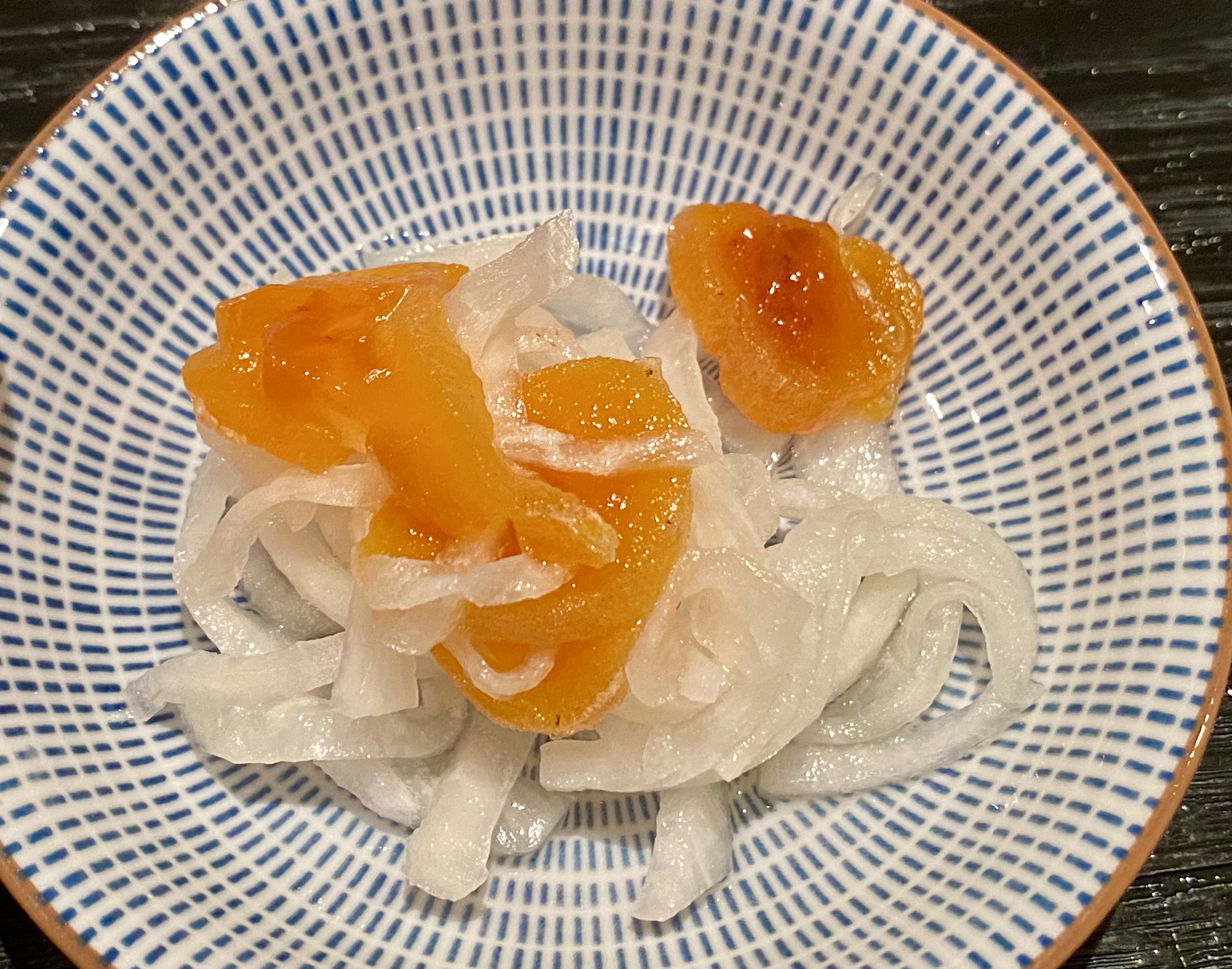
Among the autumnal delights we like is persimmon. This time, we got “Fuyu” persimmon 富有柿 in a box (about 4lb or 15 persimmon) from Weee. They were from California; mostly seed-less and very good. We did not have to wait for them to ripen and become sweet rather than puckering. I pontificated about differences in types of persimmon previously.  Although we started eating some of the ripe ones for dessert, we still had lots to go. We have made and posted quite a few dishes using persimmon. I wanted to make something we have not tried before. As I was looking for new recipes, I came across several versions of layered slices of persimmon and daikon or 柿と大根の重ね漬け (picture #1).  This turned out to be very good, refreshing and goes well with many dishes as an accompaniment.


After seeing and reading several recipes, I made this dish as described below.

Ingredients:
2 fuyu kaki, stem-end removed, peeled, halved and sliced 2-3mm thick
3 inch segment of medium-sized daikon. peeled, halved lengthwise and then sliced 2-3mm thick
3 tbs lemon juice (I used Meyer lemon)
1 tbs mirin
salt (3% weight of the daikon)

Directions:
Add salt weighing about 3% of the weight of the daikon and knead to coat all slices. Let it stand for 10 minutes and ring out the excess moisture. Make alternate layers of the daikon and persimmon slices and place in a container that can hold them snuggly (picture #2). Pour the lemon juice and mirin mixture over the daikon/persimmon and tightly cover with a plastic wrap. Let it marinate in the refrigerator for at least several hours before serving. The resulting pickles should last for at least few days or more in the refrigerator.


These pickles are a very refreshing combination of sweet soft texture from the persimmon and crunchy slightly bitter texture from the daikon. The taste, however, was tame enough that the pickles were a nice accompaniment for a number of other dishes.

Sunday, December 21, 2014

Persimmon in tofu dressing 柿とほうれん草の白和え

I did a post on persimmon previously. In the US, we can usually get either "Fuyu 富有 or Jiro 次郎" and "Hachiya 蜂屋".  This time we found Fuyu persimmons at the store and I let them ripen to the point where the meat of the fruit was soft and gelatinous but very sweet (I didn’t let them ripen to that point on purpose, I just forgot about them). Before they passed the point of no return, I quickly made this persimmon salad with traditional tofu dressing called "Shira-ae 白和え. "Shun-giku" 春菊 or edible chrysanthemum would be the traditional pairing but since I did not have it, I substituted blanched baby spinach.


I served this on two occasions.  Since I had a small persimmon shaped bowl, I served in this container but it was a bit too small (below).


Ingredients (for two servings as seen in the first picture)
Persimmon, Fuyu Jiro variety, one, skinned and cut into 1/4 inch slices.
Spinach, hand-full, quickly blanched in salted boiling water, quickly washed/cooled in cold running water and moisture squeezed out then cut into half inch long pieces.

Tofu dressing: I used a half container of sukui tofu. The seasonings can be variable but I added Japanese white sesame paste "Neri-goma" 練りゴマ (2 tsp), sugar (1 tsp) and salt (1/2 tsp). You could add light colored soy sauce or miso instead of salt. I mixed them up in a small Japanese pestle and mortar (suribachi with surikogi) as seen below. Using silken or sukui tofu makes the dressing very smooth and creamy.


I simply dressed the persimmon and spinach with the tofu dressing. It is nice small salad. Although there is no oil added, the tofu makes the dressing very smooth, rich and creamy. The persimmons we used was a bit over ripe but still this was a nice small starter dish.

Saturday, February 28, 2026

Persimmon and “Kabu” turnip salad 柿と蕪のマリネ

This is a quick impromptu dish I made one evening. This dish came about since I had a small fresh Japanese “kabu 蕪” turnip from Suzuki Farm, and “Fuyu” persimmon 富有柿 from Weee. In addition, I had leftover “Kabosu miso カボスみそ”. So I made a quick marinated kabu and persimmon with added  wakame わかめ dressed in “Kabosu miso”. This was a refreshing small dish with interesting texture and flavor. The raw kabu turnip has a nice crunch with distinctive flavor (pungent in a good way) combined with the sweetness of persimmon in a dressing made of mixture of home-made sweet vinegar and olive oil. All worked well together. Although wakame is usually dressed with “Sumiso 酢味噌”, “Kabosu miso” worked as well or even better.


Ingredients (2 servings or 4 small servings like the one in the picture).
One small Japanese “kabu” turnip, top removed, skinned, halved and sliced thinly (depending on your preference; the thicker the crunchier)

One “Fuyu” persimmon, (firm one), peeled, halved and sliced similar to the “kabu”
1/2 tsp salt

Marinade/dressing:
1 tbs “amazu” sweet vinegar*
1 tbs extra virgin olive oil
salt and pepper to taste

*Amazu 甘酢: there are a few variation (see “daikon namasu” section of Norio’s New year dishes”). The one I had was made some time ago and kept in a jar. It was made of equal parts rice vinegar and water as well as sugar equal to half the amount of vinegar used and a pinch of salt.

Directions
Add the salt to the kabu, knead and let stand for 5 minutes and squeeze out any excess moisture.
In a small bowl, add the kabu and persimmon. Add the dressing and mix.
Refrigerate for 5 minutes before serving.

Because of the acidity in the dish, sake is the libation of choice.

Friday, May 7, 2021

Three appetizers with two new ones 新しいお通し2種

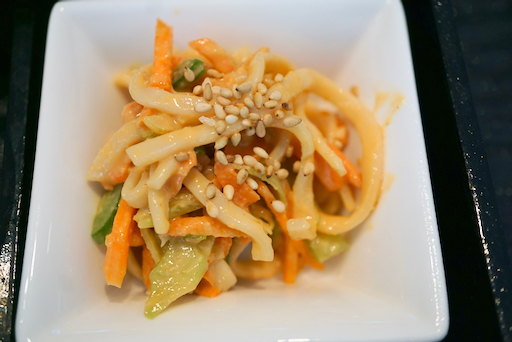
 I served these three appetizers one evening. The dish shown on the left in the first picture is my stand-by fried salmon in sweet vinegar or “salmon nanban” 鮭の南蛮漬け. The new ones are the one in the center “dried persimmon and daikon in sweet vinegar” 干し柿の大根なます and the one on the right, “udon noodle salad with peanut butter dressing” うどんのピーナッツバター和え.


The second picture is a close up of the dried persimmon and daikon in sweet vinegar sauce. This is loosely based on my compiled version of various recipes. I actually used the leftover marinade and vegetables from the previous batch of salmon nanban. (If I made this from scratch, I would make it close to the traditional New Year dish “daikon namasu” 大根なます and just add strips of dried persimmon). For a change, I also added roasted and ground sesame (fine grind but not paste) and a small amount of dark sesame oil. The combined taste of sweet and sour with added sesame flavor and refreshing daikon went well with the soft and sweet dried persimmon. Over time the persimmon got softer in the marinade. This is a good refreshing dish.


These are the ingredients and directions to make this dish from scratch (not reusing the vegetable and marinade of the salmon nanban).


Ingredients: 
2 dried persimmon, stem end and seeds removed and cut into strips.
1 inch segment of daikon, peeled, and cut into buttons then julienned.
Carrot and/or celery julienned (optional)
1/2 cup sweet vinegar (1/2 rice vinegar, 1/4 cup sugar or 2:1 ratio, pinch of salt, heat until dissolved. Then let it cool)
1 Tbs roasted white sesame seeds, fine ground (I used a Japanese mortar and pestle or suribachi.
1/2 tsp dark sesame oil

Directions:
Salt the daikon pieces and knead, then let it stand for 5-10 minutes.
Add all the ingredients and the sweet vinegar.
Let it marinate for at least 30 minutes in the refrigerator.

The next dish is a variation of sesame noodle salad. Since we had home-made peanut butter, instead of sesame paste or “neri-goma” ねりごま, I used the peanut butter. This was very similar but different because of the rather intense peanut flavor. I have not made the sesame noodle salad for sometime and never made it with peanut butter. This is a good salad as an appetizer, I should make it more often.


Ingredients: (amount is all arbitrary)
Cooked thin udon noodle
Carrot, julienned
Scallion, sliced thinly diagonally
Sesame seeds for garnish (or crushed peanuts)

For Dressing:
Peanut butter, soy sauce, and rice vinegar in 2:1:1 ratio
Dash of dark peanut oil
Sugar and sriracha to taste
Minced ginger and garlic to taste
Add warm water if the consistency is too thick

Directions:
Cut the noodles into 1-2 inch lengths (optional but for ease of eating)
Dress with the peanut dressing.
Garnish with sesame seeds or crush peanuts.

Thursday, October 19, 2023

Chestnut Flour Cake with Persimmons and Buttermilk チェストナッツフラワーと柿のケーキ

This is an another cake my wife made from the new chestnut flour.   She came across the recipe using chestnut flour, persimmons, and buttermilk. Since we happened to have all these ingredients, she went for it. The cake was very moist and had nice chestnut flavor but the persimmon flavor is very subtle (i.e. not discernible at all). It was not too sweet and perfect for breakfast.


Ingredients:
172 grams chestnut flour
148 grams or 5.2 ounces of persimmon puree. *
1/2 cup buttermilk (we used my wife favorite buttermilk from Harrisburg dairies.)
3 eggs, at room temperature
1/4 cup melted unsalted  butter
1 tsp vanilla extract
generous pinch of salt
1 tsp baking powder

* The persimmon came from Weee (#1 below). They are “Fuyu” 富有柿 (which is pronounced “fuyuu” meaning “wealthy”) variety and are called chocolate fuyuu because of the dark brown color of the fruit. They were not expensive but they were small with seeds. (Most commercially grown Fuyu persimmons are seed-less). They were irregular in shape with dark blemishes which made them look like they came from somebody’s backyard tree. But when ripened they are very good with pudding-like consistency and sweet. Only problem was that it was very difficult to remove all the seeds/stones.

Directions:
Preheat oven to 350°F (177°C). Butter 9" cake pan. (Having learned from our previous experience with the chestnut flour cake we added a buttered piece of parchment paper to the bottom of the pan and the cake came out of the pan with no problem) 
Puree the persimmon and set aside (#2). Sift chestnut flour to remove any larger bits/chunks.
Mix dry ingredients in bowl and set aside. Using either an electric mixer or a bowl whisk and beat the eggs. Add other wet ingredients. Fold dry ingredients into wet ingredients until fully incorporated (#3).
Pour batter into buttered pan and put into pre-heated oven for about 30 minutes, until the cake is firm in the middle and a toothpick pulls out clean. Remove from oven and cool on baking rack for at least 30 minutes before serving (#4). We reheated in the microwave for 15 seconds (First picture).


This cake was very moist, slightly sweet with a dense texture. The nutty chestnut flavor came through but we couldn’t identify any persimmon taste. This was a very good addition to breakfast.

Saturday, January 14, 2023

“Hoshigaki” Dried Persimmon “ Daikon-namasu 干し柿入り大根なます

Last year, we got “Hoshigaki” 干し柿 or dried persimmon from “Japanese taste”.  Since “kaki” 柿 persimmon is harvested in the fall and processed during the cold winter to make “Hoshigaki”, it usually becomes available in January. I requested that they notify me when it became available and they did recently. I ordered it immediately and (surprisingly) it came directly from Japan within only 4-5 days. This is again one of the best quality hishigaki called “Ichidagaki” 市田柿 from Nagano 長野 or “Shinshu” 信州 (old name of Nagano). It came in a nice box containing 24 or 2 dozen.


The surface is all coated with what appears to be powdered sugar but I am sure this is a natural sugar from the hoshigaki.


You can pull the fruit apart by hand revealing the pudding-like very sweet inside with concentrated persimmon flavors. Some have almost no seeds but others have large seeds like this one below. (See arrow). We enjoyed them straight out of the box at first then my wife suggested it may make them even better to warm them up a little bit. She microwaved one for 10 seconds. I agree it was much better. It got a bit softer and the flavors were enhanced.


I made “daikon-namsu” 大根なます with hoshigaki. I was thinking of using the left-over daikon-namsu from the new year’s dishes I made but by the time, I got around to it, we had finished all the daikon-namasu. So, I made a small new batch with finely cut strips of hoshigaki. I did not add any carrots. The sweet hoshigaki and crunchy daikon with sweet vinegar all worked well.


I served this dish with two other dishes to start the evening. The left side is dashi-maki だし巻きomelet I made. As an innovation I added small pieces of pre-seasoned herring roe or kazunoko 数の子 which I got from our Japanese grocery store for the new year. It happened to be rather too spicy to eat “as-is”. So I added some to the omelet which really toned it down and made it much more gentle and palatable. The center is left-over Russian salmon marinade 鮭のロシアずけ topped with ikura.


Although “hoshigaki” is excellent as is as a snack or dessert, I may explore other ways to incorporate it into other dishes. (That is if any are left by that time.)


Wednesday, April 28, 2021

Japanse dried "hoshigaki" persimmon compote 干し柿のコンポート

 I am not sure how this came about but I asked my wife if she had ever tried dried persimmon or "hoshigaki" 干し柿 and her asnwer was "no". There are many ways to convert "shibugaki" 渋柿 or bitter/tannic persimmons to edible sweet persimmons. Certain cultivars will become sweet when ripened. Drying it to make "hoshigaki" is another way to accomplish this.  I searched the internet to see if there was a place I could buy "hoshigaki". I found an interesting site called "Japanese taste" that sold Japanese food and other items . Through this site (located in Japan), I bought "hoshigaki" and other Japanese sweets from Hokkaido, Japan 北海道 where I grew up. The hoshigaki I got was called "Ichida-gaki" 市田柿 and is produced in a specific area in Nagano prefecture 長野県.  According to their English webpage, this is produced using a very labor intensive and long process including "hand massaging" the fruit after a certain level of dehydration is reached. In any case, this arrived from Japan about 1 week after I ordered it.


Of course, you can eat the persimmon as is but I also made a few dishes from it. The first one is called "hoshi-gaki compote" 干し柿のコンポート. The recipe came from a popular cooking program on NHK Japanese TV channel  on-line recipe . I served this with some yogurt my wife made and green tea.


The hoshigaki became softer and the cinnamon flavor is very nice. The slightly tart yogurt goes well with sweet persimmon.


Ingredients:
4 (four) Hoshigaki
1 cup water
3/4 white wine (I used French dry sauvignon blanc since I had it)
50 grams sugar
1 cinnamon stick

Directions:
Add the water, wine, sugar and cinnamon in a pot and let it boil.
Add the hoshigaki and let it come to boil again and then turn off the flame.
Let it steep and cool to room temperature and store it in the refregerator (should last 2 weeks)


This is how it looked the next day. I suppose you could serve this as is but I cut off the stem end, and cut it in half and removed the seeds.


This is certainly a better and elegant way to serve hoshigaki.

Wednesday, November 23, 2016

Sushi Taro Michelin ☆ Part 1, すし太郎 ミシュラン☆ その1

Finally Michelin came to Washington, DC and bestowed a galaxy of stars upon the city. While no 3 star constellations appeared, once they were done, 2 stars appeared behind the name of three restaurants, and one star for eight others. Among the eight restaurants which received one star was our "special occasion" Japanese restaurant "Sushi Taro" すし太郎 in Dupont Circle. We didn't need Michelin to tell us how good Sushi Taro is. We had discovered that some time ago all on our own. We gave it top rating among all the excellent restaurants we have visited even in Japan. The "star" is well deserved and as far as we are concerned, it shines bright as Venus. Despite our concern that, with the additional fame of a star, we would have difficulty getting a reservation, we were able to get a seat recently and had a fabulously memorable dinner. 

The night we were there, the main dining room was crowded and bustling but the Omakase Sushi Kaiseki 会席 area, which was separated from the main dining room, was serene and quiet. The roof top garden of bamboo highlighted in the large picture window in front of us contributed to the sense of tranquility. This was an Omakase (chef choice) dinner consisting of multiple small dishes reflecting the season and the best ingredients available. Sushi Taro deviates from a regular Kaiseki by prominently featuring sashimi and sushi. The counter accommodates 6 guests. They take only two parties and one seating per night. Each party gets the full undivided attention of Nobuhiro "Nobu" Yamazaki 山崎信博 (chef owner) or Masaya "Masa" Kitayama 北山勝也 (chef de cuisine)  for the entire length of the dinner.

We were warmly greeted by Chef de cuisine Masaya Kitayama. After choosing our sake, "Kubota Manju Diaginjo" 久保田万寿大吟醸 from Niigata 新潟 and our Guinomi ぐい呑 sake cups, an incredible course  of delicacies started. With the permission of Chef Masa, I took, or at least tried to take, some pictures. (Sometimes I got so wound up with excitement to taste the dish I forgot to take a picture.)

1. Grilled Goma-dofu 胡麻豆腐 with sesame sauce.

This is a variation of Sushi Taro's standard opening of "goma-dofu". The thin grilled crust contrasted with soft but elastic inside. Of course, freshly grated wasabi was nice with perfectly smooth sesame sauce.


2. House-smoked oyster with persimmon dressed in 150 year old balsamic vinegar 牡蠣と柿の和え物. 

This was an autumnal dish using a persimmon as a bowl which contained bite size pieces of house-smoked oyster (Kaki 牡蠣 in Japanese) and persimmon (Kaki 柿 in Japanese). So this was a whimsical play on words "Kaki and kaki in kaki". Crispy bits of deep fried "onion" (I am guessing this was  Tokyo scallion or "nihon negi" 日本ネギ) added nice flavor and crunch. The aged balsamic vinegar was sublime with just a hint of acidity and sweetness, which further brought out the sweetness of  the persimmon. The oyster was lightly smoked and very tender. Every aspect of the dish worked well together. 


3. Hassun 八寸 appetizer: 

Okinawan mozuku seaweed in sweet vinegar 沖縄モズク, chestnut encased in edible imitation "Iga" outer spiky shell イガ栗揚げ, mustard stuffed-lotus root 辛子蓮根,  stuffed ginko nuts 銀杏 (clockwise starting from left back) and pickled myoga ミョウガの甘酢漬け (center).

We were told that the chestnuts were from California. Among the batch of chestnuts Chef Masa received, he carefully chose those that did not have the tough inner shell separation characteristic of California chestnuts. The ones he used in this dish were visually perfect; just one example of his impeccable attention to detail. The chestnuts were cooked in a special way called "Shibukawa-ni" 渋皮煮. With this method, the papery brown inner skin is left on but is not bitter. The chestnut was encased in a puree of white fish ("surimi" すり身) and short segments of dried somen noodles ソーメン were attached to imitate "spines" of chestnut outer shell and deep fried. It was then partially opened up to show the chestnut inside, a nice depiction of chestnuts peeking through the outer spiny shell, but all edible.  Each morsel in the dish provided a different taste and texture which were distinct and unique but went well together as a whole. For example, the stuffed lotus root had a nice crunch and a slight zing of mustard, which went well with the soft texture and vinegar of the seaweed which in turn played in tune with the somewhat sweeter vinegar but coarser texture of the myoga with its own unique flavor. All the items were perfect for sipping sake..


4. Simmered abalone 鮑の柔らか煮, Japanese "Komatsuna" greens 小松菜 and Japanese "sato-imo" taro 里芋 in oyster broth.

The broth was very special with an intense brininess and pleasing essence of "Ocean". It was made from the cooking liquid in which many oysters were simmered for another dish according to Chef Masaya. This concentrated oyster broth was the basis for the seasoning for this dish. Chef Masaya told us that abalone does not have much of its own flavor but has a nice texture. To boost the flavor of the abalone, he let the oyster and other umami flavors of the broth permeate the abalone. Although it is generally not polite to drink the broth in this kind of dish, it was way too good to leave behind; without shame we both drank it dry.


Next is the sashimi and sushi course (to be continued).


Sunday, April 4, 2021

Hanami 2021 with healthy 4 Japanese appetizers 花見 2021

This year the cherry blossoms were early. We read it was the earliest full bloom of cherry blossom in Kyoto in 1,200 years. We have three cherry trees in our backyard; two were here when we moved in and one we planted 30 some years ago which was destroyed by a Nor'Easter in 2018. We replace this with a small cherry tree and it has grown but is still small. Usually these trees bloom sequentially rather than simultaneously but this year all three bloomed with some overlap in timing. So we had a few days when all three trees were at various stages of blossom and we enjoyed "Hanami" 花見. One day was warm enough for us to sit outside on the deck. Other days were cold or rainy so we enjoyed Hanami from inside. 

In the early morning on March 28 it was still a bit dark but through the cherry blossoms I spotted the full moon in the sky. This was the "Paschal moon"; the first full moon after the spring equinox. It is the moon on which the date for Easter is based i.e. Easter is the first Sunday after the Paschal Moon. True to form, Easter is next Sunday 4/4/2021. This moon is also known as "Worm moon". So named, supposedly, because worms start to emerge as the ground warms up. 


The picture below is of the cherry tree we planted in 2018 to replace the one that was destroyed in the nor’easter. It has grown a lot in the last 3 years but another 3 years will add to its role for hanami. Still it provided viewing enjoyment.


These are four appetizers I served one hanami evening. Before these dishes, we had Tuna sashimi made with frozen yellow fin tuna block from Great Alaska Seafood キハダマグロ.  As usual, I served it in marinated "Zuke" style ズケ; the surface charred with a kitchn blow torch in "Tataki" style たたき. I also  made a portion of it into imitation  “negitoro” ネギトロ,  We then had cold chawanmushi with marinated Ikura salmon roe 冷製茶碗蒸し. The four dishes shown below are the last dishes I served. They are vegetable rich and, hopefully, healthy items. 


This is a sort of salad made with dried persimmon 干し柿と大根の甘酢和え.  A recipe online was the inspiration of this dish but I did not follow the recipe. Besides the dried persimmon, which is cut into small bite sized pieces, I added daikon, carrot, sweet onion in sweet vinegar with added ground sesame and a splash of sesame oil. I garnished with roasted cashew nuts (or walnuts but the cashew happened to be available). The sweetness of the dried persimmon and the sweet vinegar dressing went well together. The dried persimmon got really soft and over time basically dissolved into the dressing.


This dish was a variation of the dish I made before from canned mackerel 鯖の水煮缶詰と大根. But in addition to daikon, I added cabbage and tofu and blanched broccoli just before serving.


This is “Hijiki” seaweed with carrot and deep fried tofu ひじきの炒め煮, exactly the same as I made before.


The last is a classic “mishime” 煮〆. It is simmered vegetables seasoned with soy sauce, mirin, and dashi broth. It includes shiitake, carrot, gluten cake “hanabu” 花麩. The rectangular pieces are freeze dried tofu or “shimidoufu” 凍み豆腐. I cooked this separately with much sweeter broth (I guess in Kyoto style). You cannot see it but there is renkon  on the bottom.


At this point, we were well fed and watered and gazing at the beautiful cherry blossoms. We were just enjoying existence.

Tuesday, January 20, 2026

Persimmon in Tofu Dressing 柿の白和え

“Shira-ae 白和え” meaning “white dressing”  refers to dishes in which the dressing consists mainly of tofu. The dishes usually use vegetables or fruit (persimmon being the most common fruit used). But protein such as chicken can also be added. There are variations of how to season the tofu but one ingredient consistently used is sesame; either sesame paste and/or coarsely ground sesame seeds. White miso or light colored soy sauce is often used. You can use either silken (Kinugoshi tofu 絹ごし豆腐 or firm Momen tofu 木綿豆腐). This time I used left-over medium firm tofu, ground re-roasted sesame seeds and hummus which I made a few days ago. For saltiness, I used “Shiro-dashi 白だし*” from the bottle. I used blanched green beans and persimmon (picture #1) which is rather classic.

* Shiro-dashi is a versatile light colored Japanese seasoning made of  light-colored soy sauce and Japanese  dashi-broth which is available in a bottle. 


I served this as a part of the appetizers (picture #2) one evening. The left is “Russian” marinated salmon 鮭のロシア漬け with “ikura いくら” salmon roe.
>


Substituting sesame paste with hummus worked very well. This is a good “healthy” appetizer.

Sunday, January 3, 2016

Unboxing Sushi Taro Osechi Box すし太郎の御節重箱

Again this year,  we got an osechi box 御節重箱 from Sushi Taro すし太郎. In addition to the box, we also got hand-cut "Juwari-soba" 手打ち十割そば for "Toshikoshi soba" or "End-of-the-year soba" 年越し蕎麦 and even a desert. The desert was a Japanese style black bean steamed bread with "maccha" green tea 抹茶 and white sweet bean paste (I may be wrong just a guess, see the last picture).  This was how unwrapping and unboxing went on new year's eve.


The menu is in both Japanese and English. The soba and steamed bread are not listed on the menu.


The upper box looked like this (picture below). All the "good luck" new year foods and more. Miso marinated kazunoko 数の子の味噌漬け, and baby mackerel nanban 豆鯵南蛮漬け were among some of the new items this year. I have never tasted miso-marinated kazunoko. It had a nice sweet nutty flavor. This one also had a really nice crunchy texture.


This was the lower box (picture below). Among the simmered dishes simmered conch/whelk バイ貝の柔らか煮 was new and very good. This year's daikon namasu 大根なます included sweet dried persimmon. This combination is also a first for me and the sweetness and soft texture of the persimmon created a good contrast. (I made a more traditional daikon namasu, myself, this year).


The plate below shows the first serving of the new year's eve feast. Everything was good as we sipped cold sake. The monk fish liver terrine あん肝豆腐 (front row second from the left) was our favorite as before. But everything on the plate was a treat. 


And we went back for seconds. The version of matsukaze-yaki 松風焼き (square chicken loaf) was sherry flavored. Indeed, we could taste the sherry and it was a pleasing variation. This year, we ourselves tried a variation on matsukaze-yaki including one with dried fig and Gorgonzola cheese (subject for future post). The daikon namasu  with dried persimmon 干し柿 is shown on the right in the back), we really liked it 


Although I was thinking about serving the soba as an ending dish or "shime" 〆 we had to pass on it because we were quite full. (We never seem to be able to eat soba on new year's eve for the same reason every year--too full). 

On the second day of the new year, we had the soba. We knew Chef Kitayama 北山料理長 was into making hand-cut "Juwari" soba from 100% buckwheat flour without any binders or "tsunagi" つなぎ such as wheat flour or mountain yam. "Juwari soba" is indeed the pinnacle of soba making prowess that only a real soba master can accomplish. His soba was just such an accomplishment. It was slightly thicker than usual soba, but had a more delicate texture with subtle soba flavor. I made warm soba with cooked vegetables or shippoku soba しっぽくそば but in the haste of enjoying it before the soba got soggy, I completely forgot to take a picture. The soba was fantastic. But I did take a picture of his steamed bread or "mushi pan" 蒸しパン which we had as a dessert with our short-drawn espresso (green beans are from Sweet Marias, Espresso Workshop#37 blend, home roasted to full city roast).


This was a perfect combination. Although I am sure green tea instead of espresso could also have been an excellent accompaniment, the contrast of the coffee really accentuated the flavor of green tea in the bread. This was indeed an elegant desert.