Tuesday, December 8, 2009

Kabocha hors d'oeuvres three ways カボチャのオードブル三種類

I found a rather good looking Japanese winter squash "kobocha" being sold as a "butter cup" squash in a near-by grocery store. I do not think this is a "butter cup" squash since the "cup" on the blossom end is not present but I do think this is a Japanse "Kabocha". In any case, I could not resist buying one. So I ended up with a rather large amount of kabocha. After I made my usual simmered kabocha かぼちゃの煮物 and pottage かぼちゃのポタージュ, I still had at least 1/3 of the kabocha left. I thought about making kabocha tempra etc but settled on these three quick dishes.

Kabocha and oninon with red miso sauce かぼちゃとタマネギのしぎ焼き
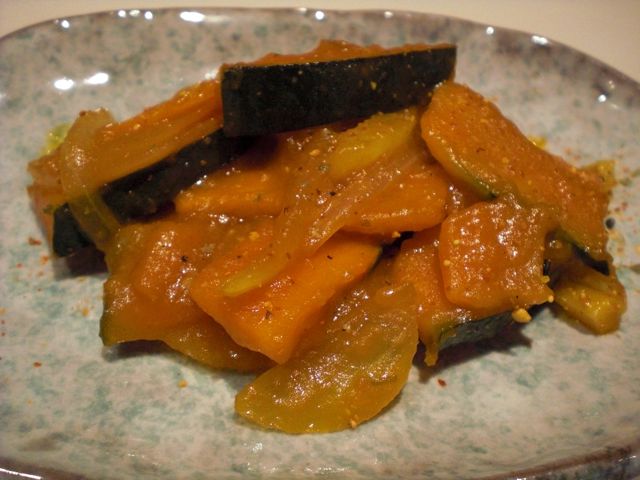
I was supposed to make this dish using a small Italian eggplant that I thought I had in the refrigerator. "Shigi-yaki" usually uses an eggplant braised in a sweet red miso sauce. I thought I would use Kabocha to accompany the eggplant--the kabocha should not have been the main ingredients of "shigi-yaki" dish. But as I was cutting the egg plant, it became obvious that this one had had a better day and I had to discard it. So, out of necessity, I came up with this dish. The sauce is a mixture of 1 part red miso, 1 part mirin, one part sugar and Japanese seven flavored pepper powder 七味唐辛子. This time, I used sake as well (instead of 1 part mirin, I used a mixture of sake and mirin) to make this dish not too sweet. I sauteed thinly cut (1/4 inch) kabocha pieces in light olive oil until slightly brown on both sides. I put the lid on the pan, turned down the heat and cooked for 4-5 minutes or until the kabocha is soft. I then added one onioun thinly sliced ( the proportion of onion to Kabocha is arbitrary) for few more minutes until soft. Then I added enough mixed sauce to coat all the ingredients. I braised until the sauce thickened and coated the ingredients. Although, this dish was not how I planned it initially, it turned out OK. Nutty sweet miso sauce was a good match to kabocha. We had this with a good everyday California Cab, Ghost pine 2007.  It was bit surprising that sweet miso and kabocha flavors go very well with red wine.

Broiled Kabocha with Raclette cheese かぼちゃとラクレットチーズ
Broiled Kabocha with Parmegian cheese and panko かぼちゃとパルメザンチーズ
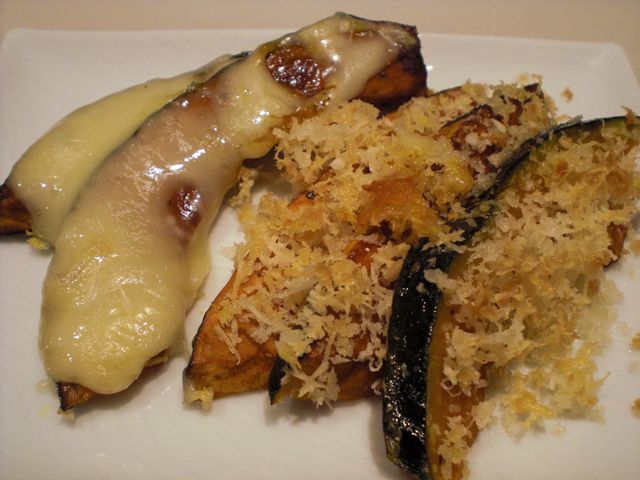
These are also a spur-of-the-moment type dish. I cut the kabocha into slices 1/4 to 1/3 inch thick, 2-3 inch wide and sauteed them similarly to the previous dish until soft. (I suppose one can do this step in a microwave oven.) It needed to cook a bit longer than the "shigi-yaki" dish since the pieces were thicker. (I did this when I made the first dish) and set aside on a paper towel lined plate. Just before serving, I put these kabocha pieces on a cookie sheet (small one which fits into my toaster oven); Some were topped with slices of raclette cheese (left two) and others (right three) were topped with a mixture of panko (mixed with bit of good oilve oil) and grated Parmigiano-Reggiano cheese (about half and half) and baked in the 450F toaster oven for few minutes until the raclette cheese melts and Panko-Parmesian becomes golden brown.

Sunday, December 6, 2009

Fried Ramen noodle 焼きそば

Yakisoba 焼きそば is another regular "teibann" 定番 dish in Izakaya. There must be as many variations as numbers of people who make this dish. I make many variations myself depending on what is available in my refrigerator or freezer. This time, I found the last of several packages of frozen ramen noodle from "Nishiyama seimen" 西山製麺 that I had bought some time ago. Since I am originally from Sapporo, I am partial to their noodles. They make good ramen noodles either dry or "raw" 生ラーメン (frozen).

I just boiled them for 3-4 minutes or until the noodles are cooked but still firm (al dente). Meanwhile, I chopped cabbage (2-3 leaves), onion (one small), carrot (one small), garlic (one clove), and separated oyster mushroom or "maikake" 舞茸 (which I happened to have). I also happened to have a leftover poached chicken breast with black vinegar sauce. (You could use any type of meat or sea food, shrimp, fish etc, either raw or cooked, or you do not have to use any meat.) I just sliced and cut the chicken into bite sized pieces. In a frying pan, heat 1tbs of peanut oil with a splash of dark sesame oil. When the oil is hot, add the onion, cabbage, and carrot and saute. Season with salt and back pepper. When these are soft, add garlic and mushroom, saute another minute and add 1-2 tbs of sake or water and keep sauteing until water evaporates (2 or so more minutes). Add about 1 tbs (adjust the amount depends on how reduced or salty the sauce is) of reduced black vinegar soy sauce (of course you could use a store-bought "Yakisoba" sauce or use Worcestershire sauce、tonkatsu sauce, soy sauce in any proportion). Add the cooked ramen noodle and saute. If needed, add more sauce and/or water to complete cooking. The final product should have almost no liquid left. Plate the yakisoba and garnish with thinly cut vinegared young ginger root (same one you have at sushibar), "aonori" 青のり powder, and white sesame seeds.

Friday, December 4, 2009

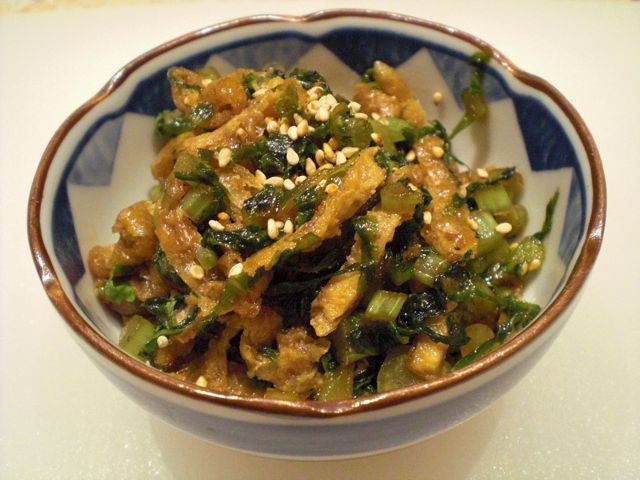
Daikon green and tofu pouch stir fry 大根葉と油揚の炒め物

Daikon 大根 is a popular Japanse root vegetable and widely available in the U.S. but I usually am not able to get daikon greens becase they are often removed before the daikon is sold. It is similar to how most carrots are sold here. But, recently, I happened to find a whole daikon with its greens attached in a near-by Japanese grocery store. Rather than discarding the greens, I made this dish based on a childhood memory. It is a kind of "collard greens with bacon" type dish in the Japanese style. Certainly, this one can be served as a condiment for rice or as is with your sake.
I used one large frozen tofu pouch "abura-age" or "aburage" 油揚 for all the daikon greens from one medium sized daikon. I placed the aburage in a colander and ran hot water over it to thaw as well as to remove excess oil. I squeezed out the moisture and cut it into small strips (approximately 1x1/4 inch) and set aside. Meanwhile, I chopped the daikon greens from one medium (about 10 inch long) daikon including stems into small pieces. In a frying pan, I added 1 tbs of peanut oil and a dash of dark sesame oil. Add the daikon greens and sauté until wilted, add the strips of abrage and keep sautéing for another minute. Add 2tbs of sake and 2tsp of mirin and 1tbs of soy sauce. Keep sautéing until almost all the liquid is gone. As a rice condiment, you may want to add more soy sauce to make it a bit saltier. If you like it a bit sweeter add more mirin. Remove from heat and sprinkle white sesame. You could use cabbage or other green vegetables instead of daikon greens. This is a perfect "tuskidashi" 突き出し or "otoshi" お通し dish.

Thursday, December 3, 2009

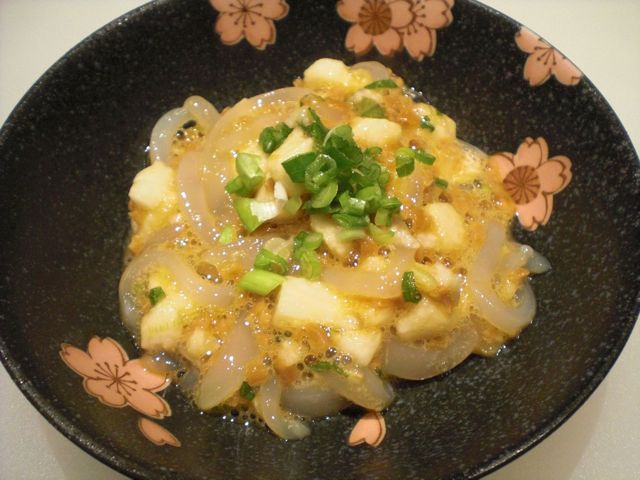
Squid sashimi with mountain potato and fermented soy beans 長芋のイカ納豆


Japanese appear to like slimy food. Often, Japanese recipes call for not just one but a multiple of slimy ingredients in one dish. This dish called for squid sashimi, mountain yam or "naga-imo" 長芋, and fermented soybean "natto" 納豆. All have a rather slimy texture. This dish probably qualifies to appear on the "Bizarre food" TV show. In any case, I saw this recipe on line. I happened to have all the ingredients and decided to make this dish. 

Squid sashimi was the pre-made frozen kind you find in a freezer case at a Japanese grocery store. I am sure it is treated with something before being frozen. I used one package (probably two servings) and one package of Natto 納豆. Natto is a difficult food to like especially for Westerners. Even among Japanese, some love it and some hate it. I already mentioned how my wife started enjoying natto. ("enjoy" may not be a right word, may be "tolerate" is a better choice.) Here, I used "hikiwari" natto 挽き割り納豆 in which whole soybeans are finely chopped. I used the same precautions I use to prepared natto with my special natto stirrer, which I also mentioned before. I just prepare the natto using the mustard and sauce that came with the natto package. The last ingredient was a mountain yam or "naga imo" (I mentioned several times in the past postings). I used a 2 inch long, 3 inch across (approximate) piece, peeled the skin, and cut into 1/2 inch wide sticks. I placed these in a zip-lock plastic bag and added 1-2 tbs of sushi vinegar. Do not seal the opening completely and hold the opening up (to prevent the bag from rupturing and the contents from spilling out in the next step), pound the naga-imo with a fist or a small rolling pin so that part of it remains chunky and part of it is mashed. Mix all the ingredients together in a bowl. I added wasabi and a concentrated (x2) noodle sauce that comes in a bottle (or you could make it yourself) or use just a straight soy sauce to adjust the seasoning. Garish with chopped scallion and perilla leaves.

It was indeed very slimy but the natto did not have a strong smell. I sort of liked it and even my wife finished the dish and she said she did not dislike it (delicately put). Since all the ingredients are slimy, it sort of worked. The only drink that goes with this dish appears to be sake.

Tuesday, December 1, 2009

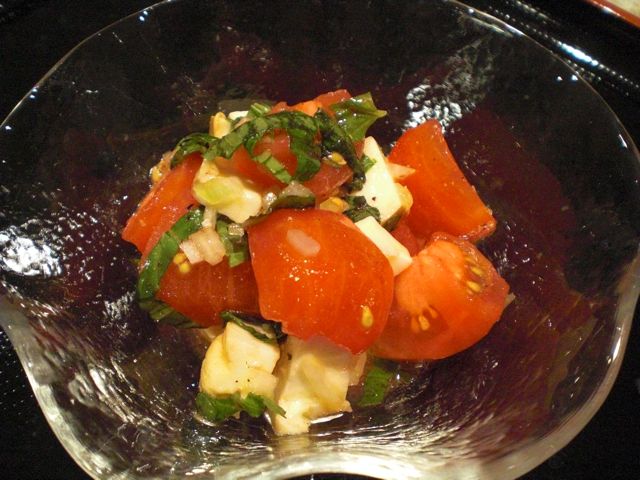
Tomato and Mozzarella cheese salad トマトとマッツレラチーズのサラダ

This is a very simple dish which can be made quickly and goes well with wine or whatever you happened to be drinking. Commercially grown tomatoes in the U.S. is not great especially when they are out of the season. The best tomatoes are definitely those that are homegrown either in your backyard or your friend's backyard during hot summer days. We used to grow tomatoes in our backyard but the trees have gotten taller every year and our backyard has been getting progressively shadier and shadier. We gave up growing tomatoes for some time. Hydroponically grown tomatoes are usually tasteless and not worth buying. Recently, Campari tomatoes became available in our grocery stores. This variety is a bit larger than cherry tomatoes and tastes much better than any other out-of-the-season tomatoes available in the grocery store. I am not sure Campari tomatoes are similar to so-called fruit tomatoes "フルーツトマト" in Japan. In any case, decent tomatoes are a "must" for this dish. I used smoked fresh mozzarella cheese here but fresh plain mozzarella is also fine.

This is a variation of a more common layered salad of tomatoes, basil, and Mozzarella cheese, "Insalata Caprese". In this version, I finely chop onion or shallot and mix in a good quality olive oil, salt, black pepper and dash of balsamic vinegar and dress cubes of mozzarella cheese and quarters of tomatoes (skin removed, either by peeling the skin with a knife as I did here or blanching very briefly) and garnish with chiffonade of fresh basil. Key to this dish is good quality ingredients including the olive oil and balsamic vinegar.