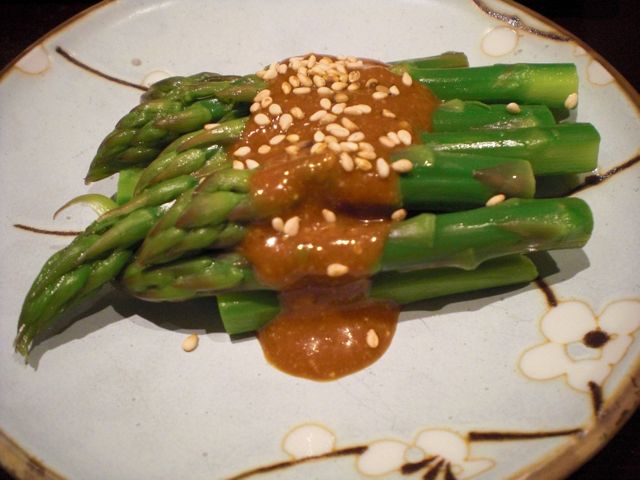
For sesame dressing, I first roast white sesame (1-2 tsp) on a dry frying pan for 4-5 minutes or until fragrant. Although white sesame I buy from a Japanese grocery store are already roasted, this will bring up the fresh taste. I started adding this extra step recently but it is worth the effort. Setting aside a small amount for garnish, tip the rest into suribach すり鉢 and grind coarsely using surikogi すりこぎ. I add Japanese white sesame paste or shiro neri-goma 白練りごま (1 tsp), sugar (1/2 tsp), soy sauce (2-3 tsp). Depending on the taste and consistency, add more soy sauce, sake, mirin or dashi to get desired consistency and taste. Pour it over the asparagus and garnish with the reserved sesame seeds. This is very nice small dish and could be served as a side dish or as a stand alone small dish.
Thursday, April 8, 2010
Green asparagus with sesame dressing グリーンアスパラのごま和え
This is a very simple dish but it is a healthy alternative to sauting them in butter. It is a good small dish perfect with a drink.

First, the hard bottom part of green asparagus are removed (I just bend the very bottom until it snaps) and I only peel the skin on the bottom hard part using a potato peeler. I blanch/boil the asparagus in lightly salted water until it is cooked but not too soft (it takes about 3 minutes for the asparagus above but the time it takes depends on the thickness of the asparagus) and then shock it in ice cold water to stop the cooking and keep it a nice green color. Dry on paper towels and cut into 2-3 inch long segments. I put the bottom parts on the plate first and place the tips on the top. (It looks like you got all tips....not!)
Tuesday, April 6, 2010
White asparagus with cream sauce ホワイトアスパラガスのクリームソース
Although I grew up in Sapporo, Hokkaido 札幌, 北海道 where asparagus are produced, my memory of white asparagus is a soft, limp, and overcooked white substance that came out of a can which was served cold with mayonnaise. I never liked it. (This comment is not meant for this particular brand in the image. It appears that there have been some improvement in the quality and taste of canned white asparagus in recent years, especially in Japan, but I have not tried them.) I do not recall my mother ever cooking or serving fresh white asparagus. Later, green asparagus became more popular and fresh green asparagus sauted in butter seems a much better choice to me. In many European countries, especially Germany, we noticed that people cherish white asparagus when in season. Recently, fresh white asparagus became available even in our neighbourhood grocery stores. This is a very simple dish I make from white asparagus and it is much better what I ate in my childhood.
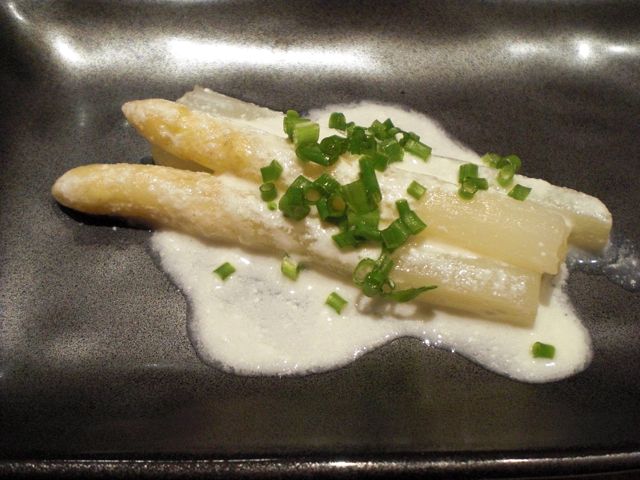
I simmer the asparagus for 10-20 minutes with the lid on (I like them throughly cooked). When they are cooked remove the asparagus carefully to a papertowel lined plate to drain. I then reduce the liquid by turning the flame to high for 10-15 minutes and strain, retrun the liquid to the pan or remove the asparagus bits and peels. Only a small amount of the liquid covers the bottom of the pan. If too much liquid remains, reduce further. I add 1/4 cup of cream and reduce briefly to a saucy consistency and adjust the seasoning (salt and pepper, if you like, use white pepper which looks better). I used light cream here and the sauce broke a bit. If you use heavy cream, the chance of breaking the sauce is less. I garnish with chopped chives (or parsley or tarragon if available). This is 100 times better than the canned white asparagus. You can serve it as a side dish or Hors d'œuvre for Home Izakaya. You could serve this with Bernaise sauce or mustard sauce (Dijon mustard, lemon juice, tarragon, and olive oil) or even store-bought mayonnaise (I would add fresh lemon juice, mustard, and fresh chopped tarragon or other herbs to spruce it up). If you have given up on white asparagus, this is worth a try.
Sunday, April 4, 2010
Cherry blossom gazing 花見
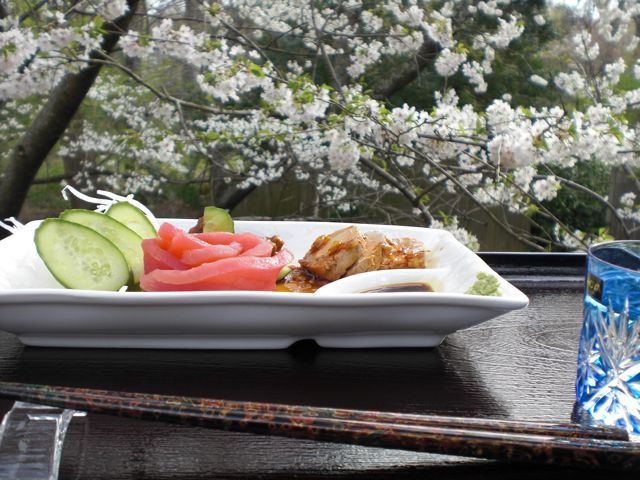
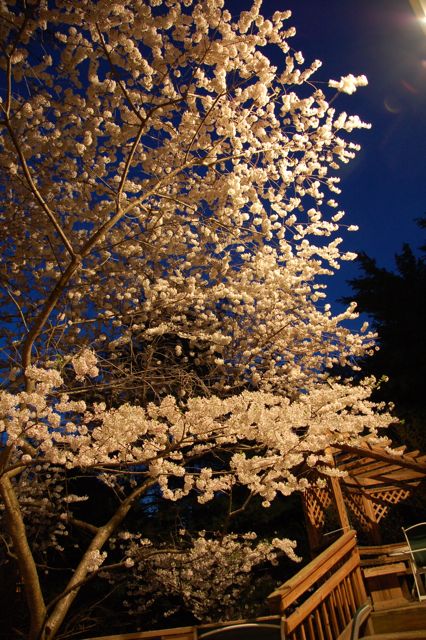
Cherry blossoms are the national flower of Japan and the progression of cherry blossoms across Japan, from south to north has been reported daily and is called "cherry blossom front" or "sakura zensen" 桜前線. In Japan people celebrate cherry blossoms by having "Hanami" or a drinking party under the cherry blossoms. The parties generally consist of people from the same work place, and can become quite noisy spectacles. This week was the conjunction of spring break for most local schools, cherry blossoms in full bloom and exquisitely beautiful spring weather. My wife's family came for a visit and they went to see the cherry blossoms at the tidal basin. They reported back to me that it was a "mad house", "way too crowded", "couldn't even see the trees for all the hoards of people". So it is nice to have a quiet Hanami in our own backyard.
We did not have anything special ready for the occasion. So I served whatever was in the freeezer and refrigerator. We started with tuna sashimi arranged in a flower shape, Monk fish liver or "ankimo" 鮟肝 and cucumber with moromimiso.
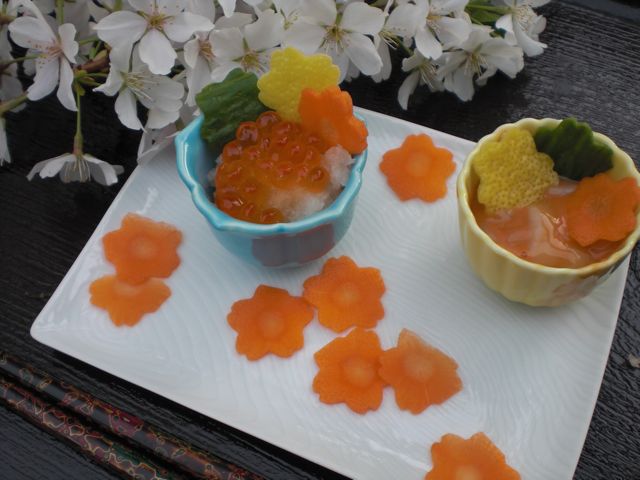
The left is graded daikon with sweet vinegar and salmon roe or "ikura". The right is store bought (frozen) squid and guts or "shiokara" 塩辛. For the occasion, using a very small cutting mold (from Kappabashi), I made cherry flowers from carrot, lemon peel and the skin of cucumber.

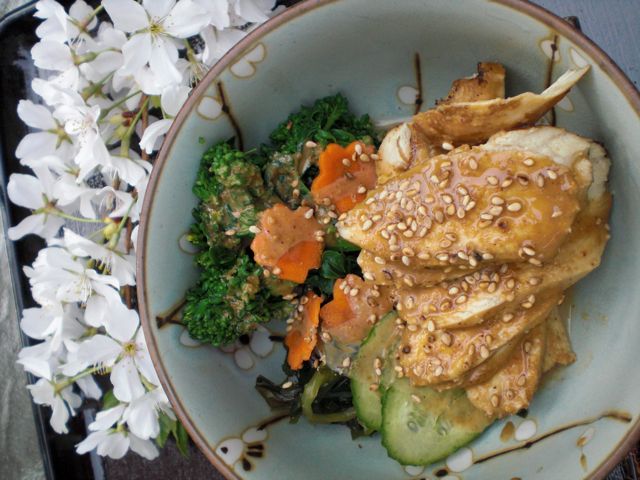
This is a small salad consisting of cooked chicken breast, seaweed salad, blanched broccoli rabe in my usual sesame dressing. Our Hanami went on until it got dark. We tunrned on the lights and then we were doing "Yozakura" 夜桜 or "night time cherry blossoms" gazing.

Saturday, April 3, 2010
Tuna carpaccio まぐろのカルパッチョ
Raw beef and raw tuna have some similarity in terms of color and texture. As a result, it was easier to be accepted by Westerners if tartar was made with raw tuna instead of beef and call it tuna tartar. Carpaccio is another very common Western adaptation of sashimi. Instead of using thinly sliced raw beef, you use thinly sliced raw fish, especially tuna. You can also make carpaccio using white meat fish such as Japanese snapper or tai 鯛, halibut or even scallops. I understand that, now in Japan, carpaccios of raw fish are very popular.
I first sprinkle a small amount of sea or Kosher salt on the plate, drizzle good extra-virgin olive oil and a good aged balsamic vinegar. I slice chutoro tuna into thin (1/4 in or 5 mm) slices and neatly arrange on the plate in a single layer. I again drizzle the olive oil and balsamic vinegar on the top and also soy sauce. You can use your imagination and try different things here (for example, ponzu, lime or lemon juice, grated garlic, roasted sesame oil, ground black pepper etc in different combinations but I will not omit olive oil). I garnish this with thin slices or shavings of a Parmigiano-Reggiano cheese (using a potato peeler), thinly sliced red onion rings, separated, kinshiran 金糸卵 or golden egg thread, roasted white sesame seeds and chopped chives. Again, you could use any combination of garnish here. This will give a bit different twist to tuna sashimi. Like beef carpaccio, this could go well with red wine or sake. We had this with 2007 Joseph Phelps Cabernet which we just received. "Shime" 締め or 〆, the last dish (usually starch) was Uni-Ikura donburi 雲丹いくら丼 tonight so we switched to cold sake, what a decadent night.
Thursday, April 1, 2010
Tuna sashimi with natto マグロ納豆
We got a 2 lb of block of fresh tuna, sashimi grade, from Catalina Offshore Products (2 lb is the minimum you can order for sashimi-grade fresh tuna). It has ootoro 大トロ, chutoro 中トロ, and a portion called 'chiai" 血合い. You have to first remove the skin and chiai, and then, block out these portions to rectangular blocks called 'saku" 冊 from which sashimi pieces can be cut. In other words, you have to know how to separate these portions to prepare the tuna block from Catalina. After I make the sashimi blocks, I wrap it using kitchen parchment paper, then using a paper towel. I put them in a Ziploc bag and put them back in the Styrofoam container in which the tuna came, add more ice gel packages, which I keep in the freezer, on the top. I put the entire Styrofoam box in our spare refrigerator. This appears to be the best way to keep these sashimi and the ice gels will not totally melt for 5 days or more. I can safely keep them up to 3 days. You could get frozen toro instead, which is easier to prepare since only toro is included, although you have to thaw it. We also tried the frozen toro and the quality is very good.
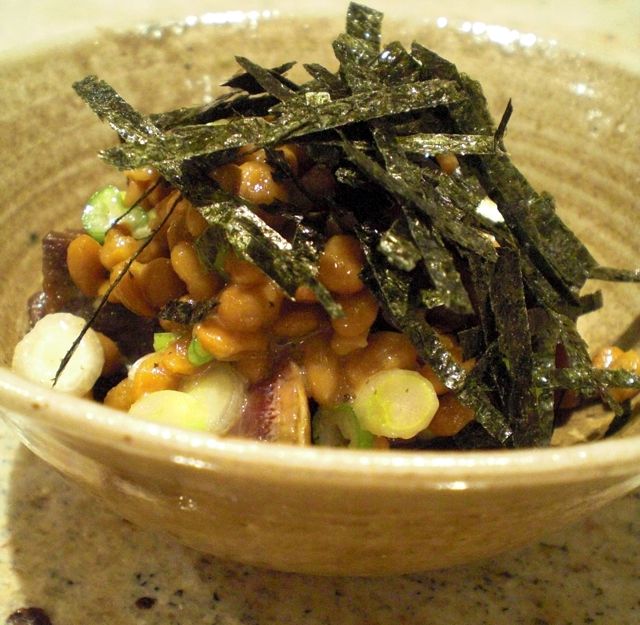
Chiai is at the edge of chutoro and looks very dark red. If you taste it as sashimi, it has an unpleasant bitter taste. Rather than throwing away this portion, it can be made it to a dish you can enjoy. I decided to make, maguro-natto using natto 納豆; one of the dreaded among Japanese food items.
I cut the chiai portion into small (1/2 to 1/3 inch) cubes and marinated in soy sauce, sake, and mirin mixture (2:1:1). You could add grated ginger (which I did not). I got enough chiai from the 2 lb block for two servings (probably about 100 grams or a bit less than 1/4 lb). I marinate over night in the refrigerator.
Next day just before serving, I prepare a small package (individual serving) of natto as I described before with a sauce and mustard included in the package and using my special mixing apparatus. Add thinly sliced scallion (1/3 to 1/2 scallion) and keep mixing (the longer you mix, the less the odor).
I place the cubes of marinated (excess liquid drained and pat dry) chiai in the bottom of a small bowl, top them with natto and garnish with thin strips of nori. It is rather strong flavored but it is good. This is not a high class food but it is perfect for Izakaya. You have to have this with sake. Again, even my wife enjoyed this dish. Of course you could make this dish using a regular akami 赤身 (red) tuna or, for that matter, any parts of tuna. I would not marinate or marinate for a shorter time if you use better quality portions of tuna.
Subscribe to:
Comments (Atom)