Friday, November 12, 2010

Mac and Cheese マカロニチーズ

"Macaroni and cheese" a.k.a. "Mac and Cheese" is a quintessential American comfort food. Most  people  in the U.S., including my wife, have grown up eating Kraft "Mac and Cheese" in the blue box. The product is bright yellow and sweet, made of powdered cheddar cheese--kids love it. In recent years, gourmet versions of "Mac and Cheese" started appearing in many good restaurants. We (mostly my wife) tried several and pronounced them "very good". Besides these restaurants, my wife had "Mac and Cheese" at a semi-gourmet fast food restaurant/cafeteria "Wolfgang Puck Express" at the the Denver airport. Since airlines no longer serve food, she found the nice, big, still warm, comforting bowl of really good "Mac and Cheese" especially gratifying and reported to me that she liked it. Sometime later, I too, had a chance to try Wolfgang Puck Express "Mac and Cheese" at the Denver airport during a business trip but I found it way too greasy and I did not like it. When I reported this to my wife she replied,  "for those who do most of their praying during take-offs and landings even greasy Mac and cheese is ethereal". Thus, mostly for my wife, I made my version of "Mac and Cheese".

I think that the quality and types of cheeses are most important. My recipe is nothing unusual.  I first make béchamel sauce and add cheeses, combined with cooked elbow macaroni and bake. This recipe is for about 6 oz of macaroni, which makes about 4 small servings. We cooked one box (16 oz) of elbow macaroni and we used about 2/3 for macaroni salad and 1/3 for Mac and cheese.

Macaroni: As per the instruction on the package, cook Macaroni (al dente, since this will be further baked). I season it with salt  and pepper in a colander immediately after draining and coat it with a small amount of olive oil. The macaroni alone at this stage should be well seasoned and taste fairly good.

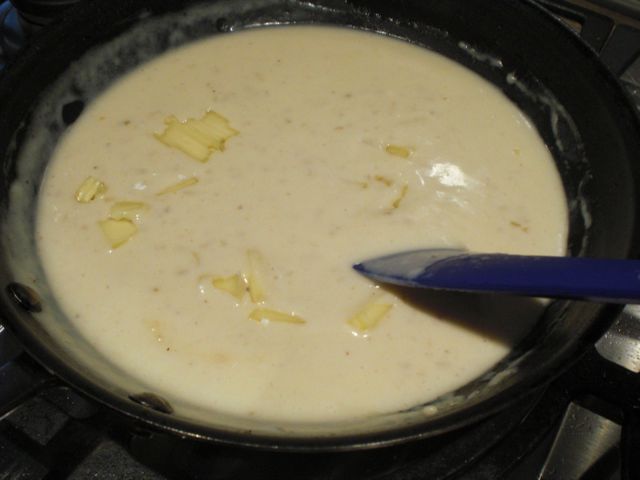
Sauce: I first make béchamel. I finely chop shallot (one medium or 1/2 large), and saute in olive oil (3 tbs) and butter (1/2 tbs) and add flour (3 tbs). Cook flour for 1-2 minutes (do not brown, we are not making brow roux) and add about 2 cups of milk (I used 1%) at once and whisk to resolve and keep stirring until it thickens. Add more milk depending on the consistency of the sauce. I keep this rather loose since the addition of the cheeses makes the sauce thick. I season it with salt, pepper, and freshly grated nutmeg. Using freshly grated nutmeg makes a big difference in taste.

Cheeses: Use decent quality cheeses. Cheddar cheese is an absolute "must". Unfortunately when it is cooked for a long time at a high temperature, it becomes grainy, so I mix it into the béchamel just before baking. Besides cheddar, I also use a combination of different cheeses depending on what we have in our refrigerator. This time, I made the mistake of using too much fresh goat cheese in the sauce. It made the sauce a bit grainy. I usually use any combination of Gruyere, Pecorino Romano, and Raclette. Tonight, I had Gruyere, Raclette, fresh goat cheese, and Parmigiano reggiano. The amount of the cheese is arbitrary but I used a total of 1 cup of shredded Gruyere and Raclette in addition to fresh goat cheese (1/4 cup). If the sauce becomes too stiff after the cheese is incorporated, you could add more milk. The sauce should be a bit runny because the macaroni absorbs some of the liquid while it bakes and the sauce may end up dry rather than creamy.

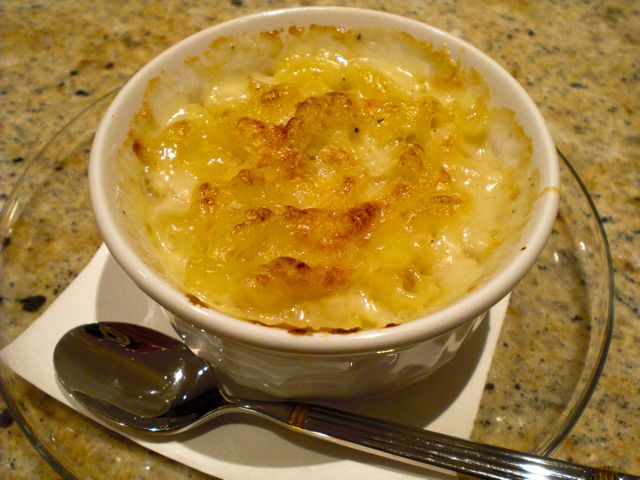
I poured the sauce into the cooked macaroni and mixed in shredded cheddar (1/2 cup, I used aged sharp cheddar). I tasted the mixture and adjusted the seasoning. I apportioned the mixture into 4 small individual ramekins. I grated Parmigiano reggiano cheese on the top. You could use bread crumbs on the top as well, but I did not. I baked it in a 400F (toaster) oven for 7-10 minutes or until the surface browns and the sauce is bubbling.

This was not bad (my wife's opinion was much less reserved but, then again, she may be biased). Nonetheless, to me, the sauce was a bit too grainy and I blame it on the goat cheese. Next time I will have to be more moderate in using it. In any case, this was far better than Kraft's or Wolfgang Puck's mac and cheese. This dish goes well with wines and beer (although we drink beer extremely rarely). I would suggest Izakaya in Japan consider serving this. It may become a big hit.

P.S. We had this later in the week as leftovers reheated in the toaster oven. Strangely enough, the taste and texture were much better and the graininess of the sauce disappeared.

Wednesday, November 10, 2010

Chicken breast cutlet 鶏胸肉のカツレツ

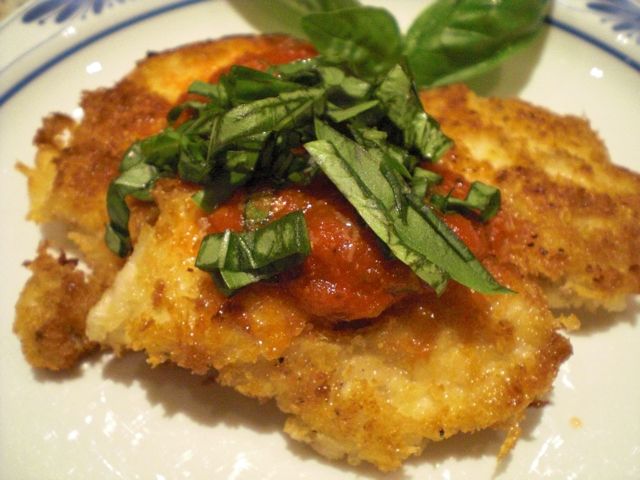
This is another small nothing dish but is very good nonetheless. I had an extra chicken breast after making other dishes. I just sliced the chicken breast into bite sized pieces across the grain of the meat obliquely ("sogigiri" そぎ切り). I added salt and pepper to the pieces, dredged with flour, egg wash and finally coated with Japanese bread crumbs "panko". I fried them with a bit of olive oil (more than for sautéing, not more than 1/4 inch deep) until both sides become crispy golden and meat is cooked through. I just put a leftover marianara sauce on top and garnished it with fresh basil. You could add Tabasco to the marinara sauce to make it spicy if you like.

It is a somewhat mundane dish but a nice dish to start. We had this with a red wine but I can not remember which one this was.

Monday, November 8, 2010

Poached egg, smoked salmon with crème fraîche ポーチドエッグとスモークサーモン

This can be a breakfast (for us) on weekends when it strikes our fancy or a mid-night snack after drinking (for younger fellow imbibers). I'm not sure how this got started but my wife came up with this one. It is a cross between bagels, lox and creme cheese (hold the bagel) and a variation of eggs benedict (hold the hollandaise). This variation may be (very) slightly, less deadly than the original because there is no hollandaise sauce and (hopefully) some benefit from the Omega 3 in the salmon.

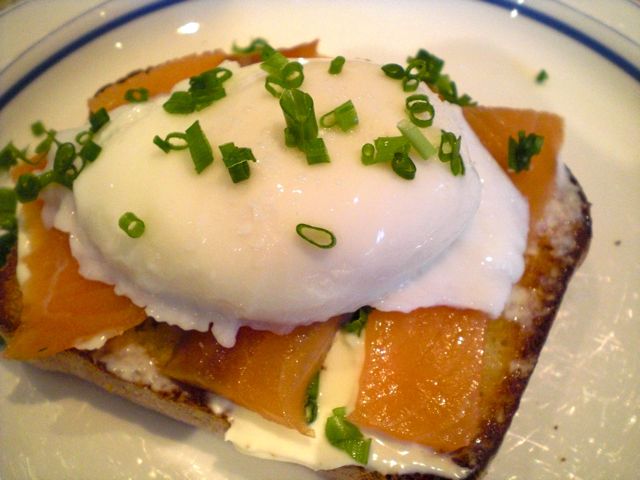
The recipe starts with a base of toasted and buttered English muffin bread (homemade, my wife promised me to post her recipe soon). On top of that goes a generous smear of crème fraîche (if not available, use sour cream or cream cheese). Next comes a sprinkle of chopped chives (my wife puts the chives on at this point so they are held in place by the next layers. Otherwise they just fall off the piece on the way to your mouth.  One layer of good cold smoked salmon follows the chives and the whole thing is topped with a poached egg. We sprinkled salt on top of the egg and more chopped chives as garnish. (It doesn't matter if these fall off the chive flavor is locked in the lower layer.)

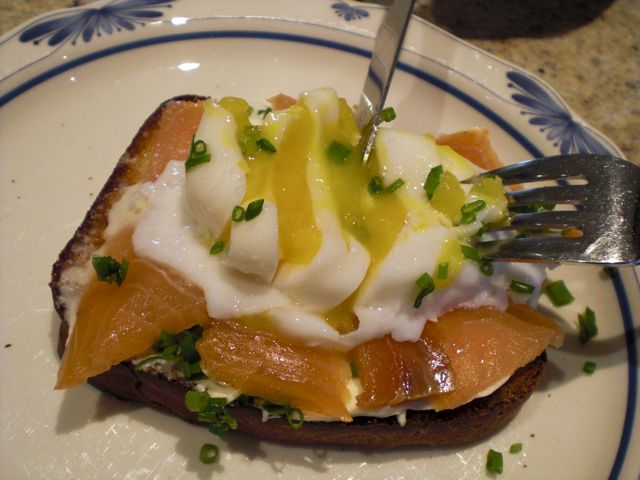
The poached egg should have a runny egg yolk so that when you cut into it, the yolk makes a wonderful sauce. The combination of all these ingredients work so well together. If you like smoked salmon, you will like this dish.

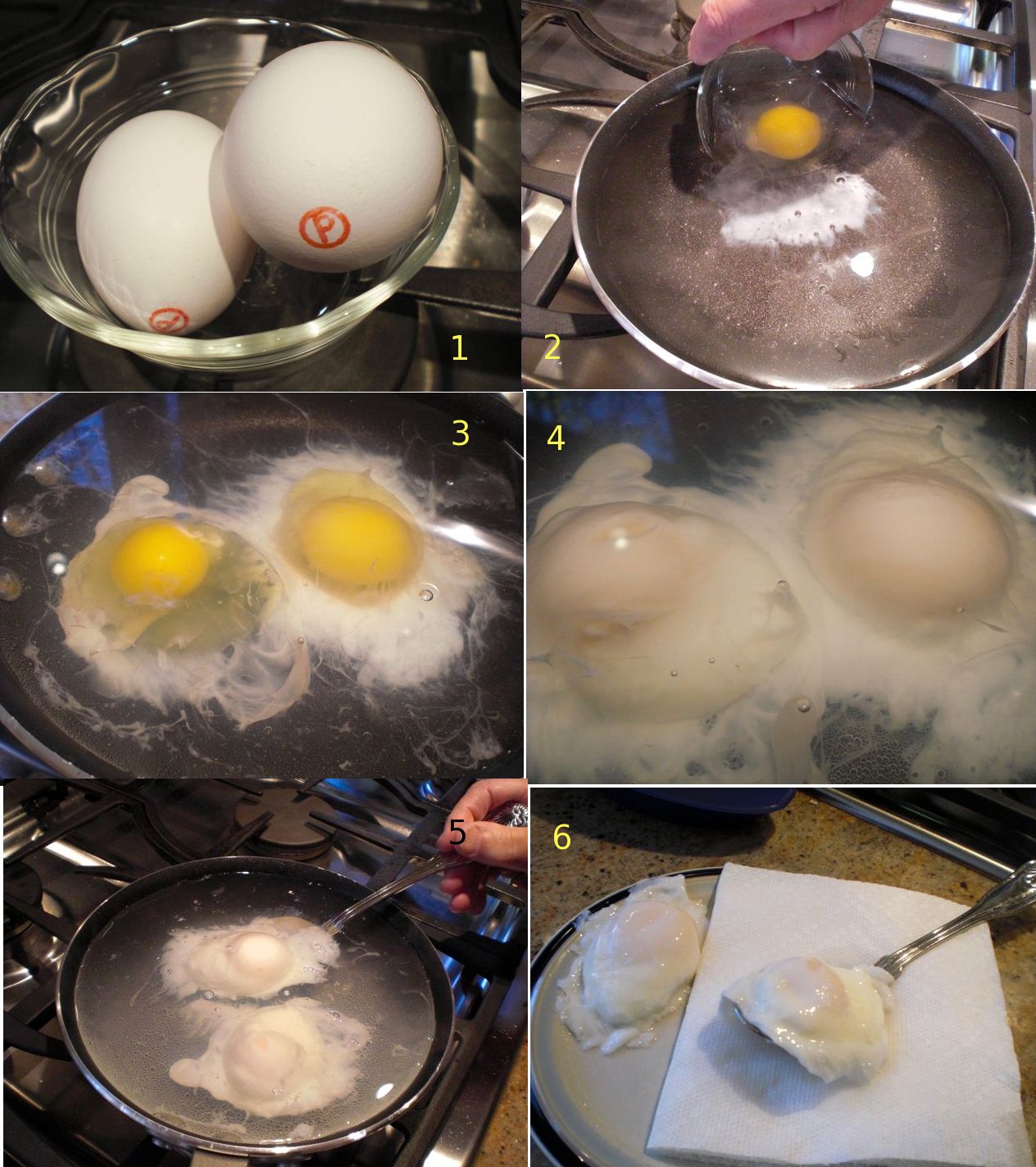
Since I mentioned several times how easy it is to make poached eggs but never really illustrated the steps, I decided to post some visual aids. We tried many methods including an egg poacher, a classic vinegar water method, Pepin's swirl-water-and-put-an-egg-in-the center-of-the-vortex method (it appears he is not advocating this silly method any longer) but our method always works, no fuss no muss.

1. Use pasteurized eggs (in the U.S., notice a red "P" in a circle).
2. Use a good non-stick frying pan with a high side wall and add enough water so that the eggs can be completely submerged. I also salt the water for subtle seasoning of the eggs (optional) but absolutely no vinegar. (We do not like vinegar tasting eggs). The water should be just barely simmering. Crack an egg into a small ramekin and slide the egg as seen here. 
3. Eggs will sink to the bottom. 
4. Eggs will stick to the bottom (Do not worry). Poach them until the surface of the yolks are opaque and set but the yolks are still runny (4-5 minutes).
5. Using a perforated (slotted) spoon, gently separate the eggs from the bottom. It should not be difficult if the pan is a good non-stick pan. If you encounter undue difficulty, use a silicon spatula to separate the eggs from the bottom of the pan, (if that happens you may want to throw out the pan and buy a new one).
6. Drain the water trapped by the spoon or dripping off the egg by touching the bottom of the perforated spoon to a paper towel and place it on the plate (Do not leave it on the paper towel. It will become very difficult to transfer without breaking the yolk). I usually keep one on the spoon as seen in the picture for easy transfer.

If you are into the looks, you could take off thin peripheral shaggy portions of the egg white to make it pretty.

Saturday, November 6, 2010

Julienned potatoes with spicy cod roe redux ジャガイモの明太子和え 再登場 (Mark's book p24)

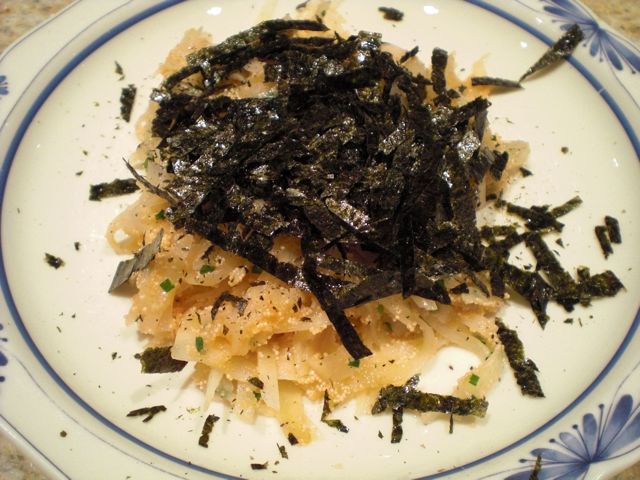
The dish I made according to the recipe in the Mark's book (p24) looked and tasted  elegant. But I could not help making it again with some modifications. As before I made a julienne of white potato, soaked in water and then patted dry using paper towels. I removed the "tarako" or cod roe from one large sac and mixed with a small mount of Tabasco, sake and lemon juice. I then sauteed the potatoes in butter for several minutes until done but still crunchy, I mixed  the tarako mixture, chopped chives and seasoned it with a bit more salt and ground black pepper. I served it with nori strips in a manner simialr to  tarako spagetti.

We liked the nori taste with tarako and potatoes. Either way (the original or this version), this is an excellent dish. We really like both versions.

Thursday, November 4, 2010

Monkfish medallion sautéed with garlic and olive oil アンコウのニンニクオリーブオイル焼き

After making the monkfish karaage 唐揚げ, I made the remaining monkfish fillet into this dish the next day.

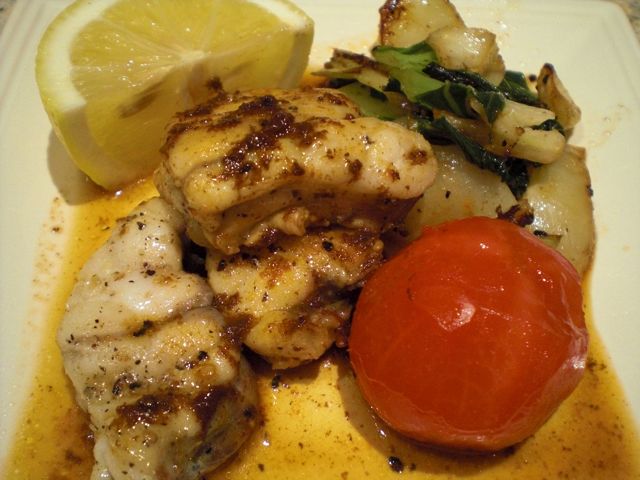
I made medallions of fish a bit less than 1 inch thick. I then marinated them in olive oil, lemon juice and 3-4 fat cloves of crushed garlic for 24 hours. Just before cooking, I removed the excess moisture from the surface of the medallions and lightly seasoned them with salt and pepper. In a frying pan on a medium flame, I added olive oil, and crushed garlic from the marinade and fried it until it became fragrant and slightly brown. I took the garlic out and set aside. I added the medallions of monkfish and cook them for 3-4 minutes and flipped them over. At this point, I added previously blanched Bok Choy which was cut into a bite sized pieces to the center of the pan, moving the medallions to the periphery to make room for the Bok Choy. I then put two thin pats of cold butter on the top of the Bok Choy and cooked it for another 3-4 minutes. The butter will melt very slowly. As the fish was about to finish cooking, I mixed the Bok Choy and butter and added just a small amount (1 tsp) of soy sauce and also add skinned Campari tomatoes to the pan for another minute or so and, at the very last moment, added back the garlic.

This is a sort of fusion dish and almost tastes like lobster tail. The rather assertive garlic flavor goes well with this fish. The tomatoes also exude some juice to form a small amount of sauce/liquid in the bottom of the pan. The flavors of soy sauce, butter, garlic and tomato add to the dish.