Tuesday, June 14, 2011

Fresh corn pudding 新鮮コーンのプディング

My wife made this dish. It's a very simple dish but extremely good to make when fresh corn on the cob is available. Fresh corn has been available in the local grocery store for a few weeks (Late April and May). We are not sure where it comes from--we surmised Florida, certainly not locally grown.

Freshly picked corn is very sweet but it is my understanding that soon after harvest, the sugar  in the corn converts back to starch resulting in a far less pleasant product referred to as "starchy" corn. I had a friend who loved corn and used to have "corn parties". He would plant a patch of corn so that it ripened in sections over the course of a season. When a section was ready to harvest he invited some friends over and had a party. The purpose of the party was to eat the corn at the height of its perfection. After some libations and socializing, the guests retreated to the corn patch where they harvested their own dinner. Everyone came back to the house where a large pot of boiling, salted water was ready and waiting. The rest was simple--shuck, boil, eat and enjoy. The time between harvest and cooking was a max of 5 minutes. He was right; the corn was perfection. While we can't have such "corn parties", this corn pudding is next best thing.

My wife used a box grater to grate the corn kernels off the cob (They have to be grated. Cutting them off does not have the same effect). She then scraped the bare cobs with the back of a knife to make sure she captured any corn "milk" left behind. She then poured the grated mixture into a small ramekin like the one seen above. She did not add any seasoning or additional ingredients--it's all just corn. Believe it or not, the corn from two ears went into one small ramekin. She then simply baked this in a 350F toaster oven for 30 minutes.

Before serving she sprinkled some Kosher salt on top (the salt enhances the sweetness). This was so sweet and creamy--the essence of summer corn. Somehow grating the corn makes it sweeter. My wife tasted a kernel from this batch before grating it to see how it tasted and she said it was so-so. But then we tasted the grated mixture and it was suddenly much sweeter. Corn pudding is also much easier to eat than boiled corn on the cob; no kernels to stick between your teeth. This could be served as a vegetable side dish but we like it as a drinking snack. (You know our priorities). This will go with any drink; beer, wine, sake. My wife suggested it was sweet enough to be served as a dessert...but I'm not going there. 

Sunday, June 12, 2011

Miso grilled Spanish mackerel サバの味噌焼き

This is another dish I made from the Spanish mackerel I bought the other day. This is based on the recipe in a cook book called "the Japanese Grill" but it is a rather standard recipe.

Mackerel fillet: After removing the pin bones as before, I salted both sides of the fillet with Kosher salt. I wrapped it in kitchen parchment paper and then with a paper towel and placed it in a Ziploc bag overnight in the refrigerator. This process removes excess moisture. You could use a special wrapping sheet popular in Japan called "Picchito" ピッチト 食品脱水シート. Wrapping the fillet with this sheet will produce a similar effect without using salt. After 24 hours, the paper wrappings were moist indicating excess water indeed had been extracted. I wiped any remaining moisture from the surface of the fillet with a paper towel.

Miso marinade: As suggested in the recipe, I used sweet "saikyou" miso 西京味噌 (1/4 cup) but if you use regular white or red miso, you could add sugar. I added mirin (2-3 tbs) to the miso until a thick sauce consistency was reached. After I smeared the miso marinade on both sides of the fillet, I wrapped it with plastic wrap and put it back in the Ziploc bag. I marinaded it for 6 hours before grilling. The original recipe calls for 3 days of marination.

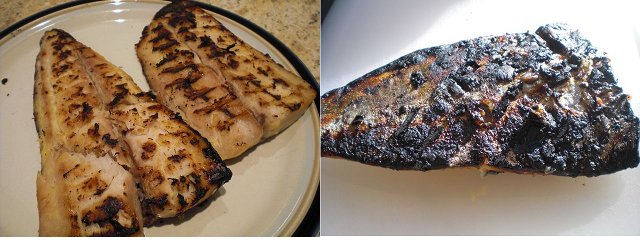
Grilling: I used a Weber grill with lump charcoal. As usual, I started the fire using a Charcoal starter chimney. I spread hot coals over only half of the grill to make hot and cool areas. After cleaning the grill, I sprayed Weber-brand grilling spray (this does not flare up even with hot coals underneath). I started the meat side down on the hot area of the grill for 2 minutes or so and flipped it over to grill the skin side for one to two more minutes. Because of the sugar content of the miso marinade, it is very easy to char the fish like I did here (image below right, but it still tasted good).  I moved the fillet to the cool side of the grill and put the lid on and finished cooking for 2-3 more minutes.

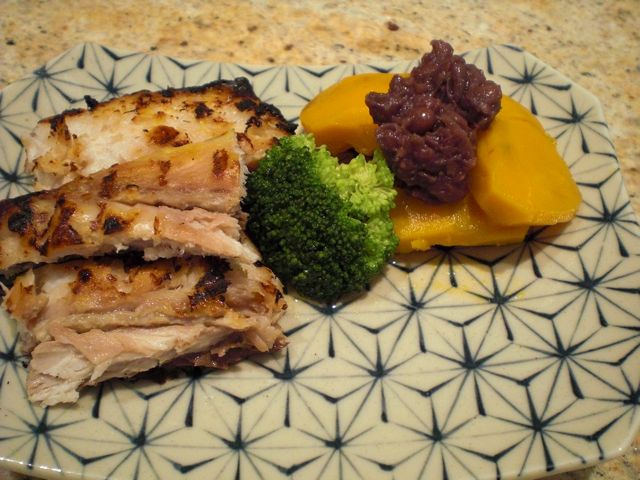
This is a rather classic but excellent preparation of mackerel. If has been a long time since we have had this kind of fish and taste, so we really savored it. The fish has a nice firm texture with a miso flavor. The charcoal grilling added to the flavor and it tasted even better the next day served cold. We'll be doing this one, again. I served it as a drinking snack with stewed sweet potato and azuki. For a drink, we are partial to sake for this dish and had "turbid" sake called Momokawa Organic Nigori from Sake One. This is not too sweet with a smooth rice residue (you do not have to chew the sake) and went well with this rustic grilled mackerel.

Friday, June 10, 2011

"Sekihan", red rice 赤飯

As mentioned before,  I found Japanese red beans or azuki at a newly opened neighborhood gourmet grocery store. Despite the fact that I do not particularly care for it, I ended up making a rice dish called "sekihan" meaning "red rice". Japanese consider red an auspicious color especially in combination with white. Sekihan 赤飯 is the traditional celebratory food especially when served with a grilled whole Japanese red snapper or "tai" 鯛. In the old days, when you had something to celebrate in your family, you made sekihan in large quantity and distributed it to the neighbors and your friends. I do not remember my mother making sekihan when I was a kid. Maybe my family didn't follow this tradition (or perhaps, we did not have much to cerebrate). I do remember, however, we were often the recipient of sekihan.

For most of Japan, un-sweetened azuki is used to make sekihan.  In Hokkadio, where I originally came from (also reportedly in Yamanashi 山梨 and a part of Aomori 青森 prefectures), sekihan is often made with "ama-nattou" 甘納豆 which is types of beans cooked in and coated with sugar. Although it contains the word "nattou", this has nothing to do with natto that fermented, sticky and smelly soy bean every(no)body likes. These sweetened beans are usually eaten as "sweets" rather than used in cooking. It appears the inventor of this recipe is known and her recipe was popularized by the local Hokkaido Newspaper. (This was discussed in detail in a digital food column of Nippon Keizai Shinbun, in Japanese). People in the Kanto 関東 area (Tokyo area) supposedly prefer to use another kind of bean called "sasage" ささげ in leu of azuki. This is apparently a type of cowpea. I am only familiar with black-eyed pea in this category of beans/peas in the U.S. but I assume there must be red or brown colored varieties in Japan used in sekihan. I read that the reason Kantoites prefer not to use azuki is because azuki tends to rupture while cooking and for those who may have been samuri descendants, the  rupturing beans reminded them of "seppuku" or "harakiri" (they are so sensitive!). It is also common to use red food coloring especially for commercially prepared sekihan or the kind made using "ama-nattou"--to heighten the color of the commercial product and because ama-nattou does not color the rice. Anyhow, I decided to make the dish in the traditional way (for most of Japan) with azuki beans.

Azuki: I prepared azuki as posted before and set aside the cooking liquid and cooked beans before I sweetened the rest. I had about 1/2 cup each of cooked azuki and the cooking liquid. I separated the azuki and the cooking liquid and set aside. 

Rice: I used sweet or glutenous rice (1 and half cup) and regular Japanese short grain rice (half cup). I washed both together until the water became clear. I drained it and set it aside.

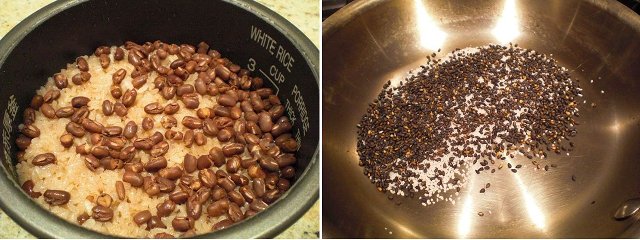
In an electric rice cooker, I added the washed rice and the azuki cooking liquid. I added water to the 2 cup mark. I added the cooked azuki. After the rice was cooked (image below left), I mixed the azuki and rice with a wood spatula called "hera" へら trying not to break the azuki.

I also made a traditional seasoning for sekihan called "gomashio" ごま塩.To enhance the flavor, I dry roasted black sesame seeds (2 tbs) with Kosher salt (1 tbs) in a dry flying pan (right image below).

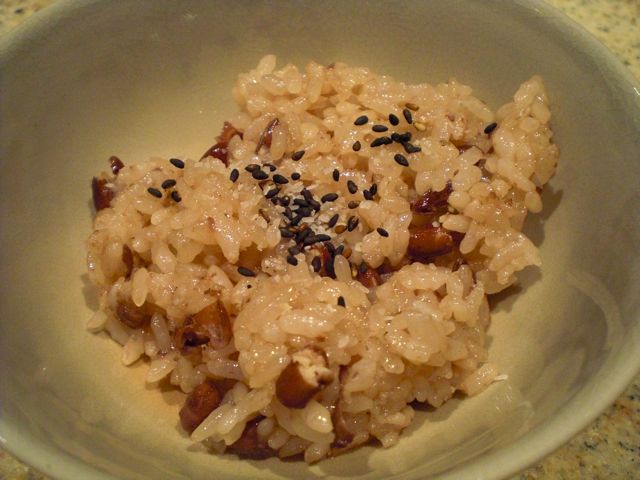
I sprinkled gomashio over the sekihan and served. I do not think this is worth the effort but the roasted sesame and salt indeed added a lot.  The nutty and salty flavors were definitely needed here.  After making sekihan, I felt like, at least, I paid adequate respect to azuki beans and this is the last of my azuki dishes.

Wednesday, June 8, 2011

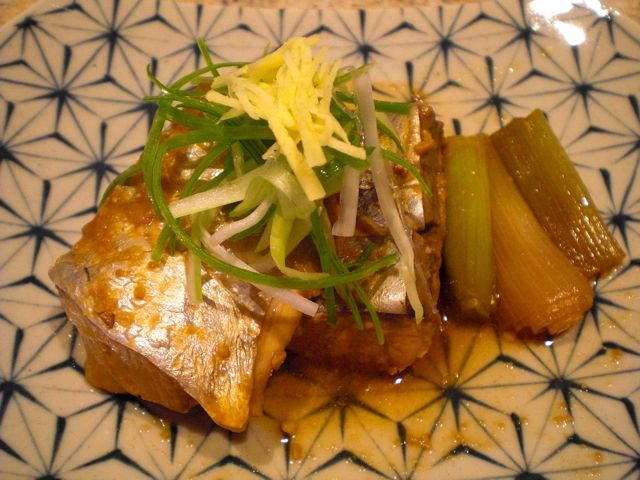
Spanish mackerel stewed in miso さばの味噌煮

Appropriate ingredients are the most important factor in making new and interesting dishes. At the newly opened gourmet grocery store, today's catch (whole fish selection) included some large Spanish mackerel and sardines. Although I was tempted to get the sardines or "iwashi" イワシ because I had some recipes I wanted to try, they looked like they had been in a bar fight the night before, and were much the worse for wear. So we got the Spanish mackerel. Again, it is difficult to compare the type of mackerel available in Japan vs. the ones available here.  The Spanish Mackerel we got was a bit over 4 lbs and was much larger than Japanese mackerel or まさば. The type of mackerel we call "Boston mackerel" here appears to be closer to Japanese mackerel. Size aside, these mackerels have characteristics similar to oily blue fish; nice firm reddish flesh and shiny silver blue-gray skin. They also have a rather strong taste and spoil very quickly. The classic Japanese preparation is to use miso when cooking mackerel.

Preparing mackerel: I had our Spanish mackerel filleted. I had to remove the small pin bones in the center line of the head portion of the fillet using a Japanese fish bone puller (I have one that I got from Global or you could use a needle nose pliers). Since the fish we got was rather large, I used one fillet for this miso stewed dish and the other for a miso grilled dish. I cut the fillet into half lengthwise and then cut crosswise into 2 inch wide pieces. I made shallow scores in the skin surface as well.

Simmering liquid: I combined dashi (200ml), mirin (4 tbs), sake (4 tbs), red miso (3 tbs) and sugar (2 tbs) in a frying pan. I also added ginger root (4 thin slices). After coming to the boil, I turned the heat down tasted it. I thought it was too strong and added more water and sake but, in retrospect, I should have left it alone.

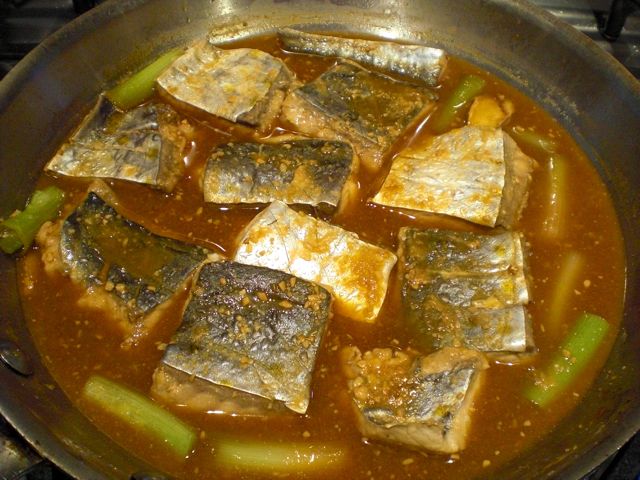
I placed the prepared mackerel in the pan skin side up and also added segments of scallion all around. After coming back to boil, I turned the heat down to simmer, I put an otoshi-buta and a regular lid (askew) and simmered it for 15-20 minutes (see image below).

Since the miso mixture was still a bit runny, after I removed the fish, I reduced it a bit to make a thicker consistency.

To serve, I garnished it with thin threads of ginger ("hari-shouga" 針ショウガ) and scallion cut thinly along the long axis called "shiraga-negi" しらが葱 or white hair scallion. Since I do not have naganegi 長ネギ or Tokyo scallion, this was the best I could manage.

This is a classic and very comforting dish--perfect as an accompaniment for sake. Miso and mackerel are indeed a winning combination.

Monday, June 6, 2011

Stewed kabocha and red bean カボチャのいとこ煮

This is a variation on the theme of azuki dishes. Instead of sweet potatoes, Japanese squash or kabocha is used. This is sometimes called "Itoko-ni" いとこ煮 meaning "cousin stew" but why it is called that is not clear to me or if any stewed dishes with azuki would be called "Itoko-ni".

In any case, I do not think this is one of our favorite dishes. I cooked the kabocha exactly same as before. Toward the end of the cooking, I added cooked and unsweetened red beans and dissolved a small mount of miso paste to taste. This dish needs something more. Somehow unsweetened azuki does not work well here for us.

So I made another version few days later (image below). I added my version of slightly sweetened azuki instead. I also added a bit more miso at the end than before.  This tasted much better. The sweetness was contrasted with some nutty salty tastes. We liked this much better than the original version.