Saturday, January 14, 2023

“Hoshigaki” Dried Persimmon “ Daikon-namasu 干し柿入り大根なます

Last year, we got “Hoshigaki” 干し柿 or dried persimmon from “Japanese taste”.  Since “kaki” 柿 persimmon is harvested in the fall and processed during the cold winter to make “Hoshigaki”, it usually becomes available in January. I requested that they notify me when it became available and they did recently. I ordered it immediately and (surprisingly) it came directly from Japan within only 4-5 days. This is again one of the best quality hishigaki called “Ichidagaki” 市田柿 from Nagano 長野 or “Shinshu” 信州 (old name of Nagano). It came in a nice box containing 24 or 2 dozen.


The surface is all coated with what appears to be powdered sugar but I am sure this is a natural sugar from the hoshigaki.


You can pull the fruit apart by hand revealing the pudding-like very sweet inside with concentrated persimmon flavors. Some have almost no seeds but others have large seeds like this one below. (See arrow). We enjoyed them straight out of the box at first then my wife suggested it may make them even better to warm them up a little bit. She microwaved one for 10 seconds. I agree it was much better. It got a bit softer and the flavors were enhanced.


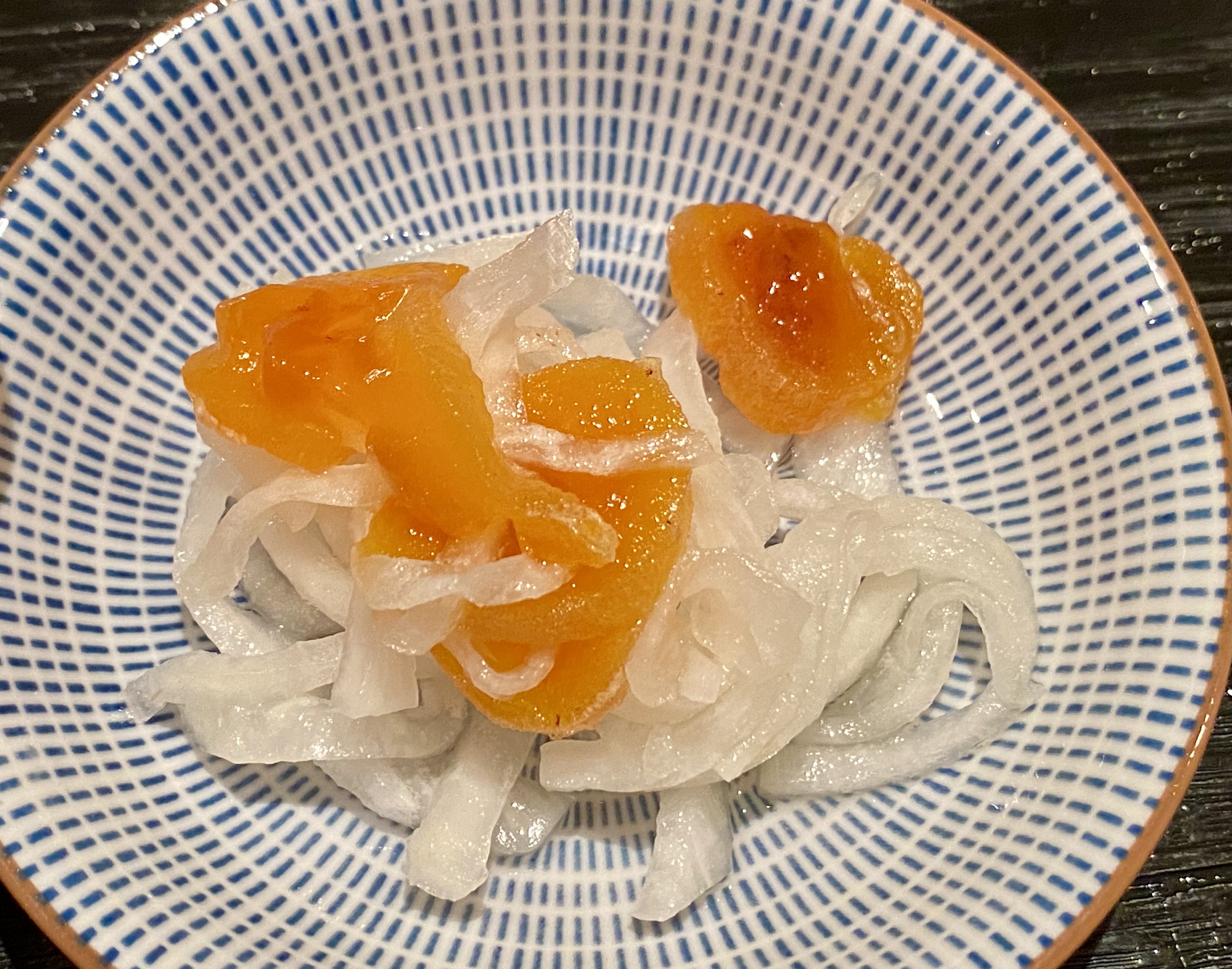
I made “daikon-namsu” 大根なます with hoshigaki. I was thinking of using the left-over daikon-namsu from the new year’s dishes I made but by the time, I got around to it, we had finished all the daikon-namasu. So, I made a small new batch with finely cut strips of hoshigaki. I did not add any carrots. The sweet hoshigaki and crunchy daikon with sweet vinegar all worked well.


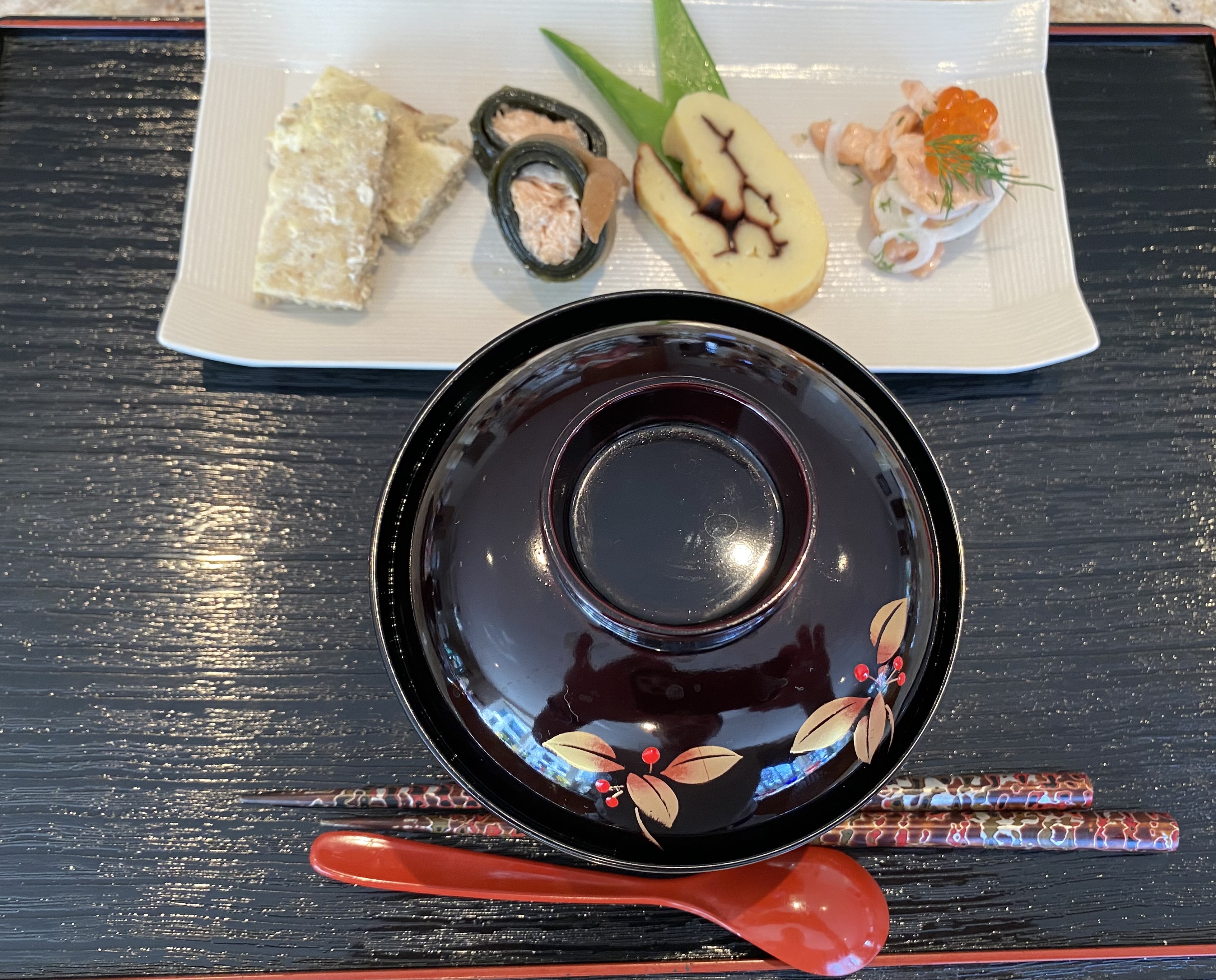
I served this dish with two other dishes to start the evening. The left side is dashi-maki だし巻きomelet I made. As an innovation I added small pieces of pre-seasoned herring roe or kazunoko 数の子 which I got from our Japanese grocery store for the new year. It happened to be rather too spicy to eat “as-is”. So I added some to the omelet which really toned it down and made it much more gentle and palatable. The center is left-over Russian salmon marinade 鮭のロシアずけ topped with ikura.


Although “hoshigaki” is excellent as is as a snack or dessert, I may explore other ways to incorporate it into other dishes. (That is if any are left by that time.)


Wednesday, January 11, 2023

Tomato and Egg Stir-fry on Rice トマトと卵炒め丼

 This is a variation of tomato and egg stirfly I posted previously. I learned that this is based on a Chinese dish called “番茄炒蛋” and there appears to be many variations. The main difference between this version and the recipe I posted previously, is the addition of caramelized catsup which adds a slightly sweet dimension. I made this one day for a lunch from my memory since we had skinned Campari tomatoes which needed to be used fairly soon. I made it as a type of “donburi”. Since I just made “simmered” pork or “nibuta” 煮豚 using InstantPot, I included a slice and also broccoli rabe (rapini) which I blanched earlier.


I may have overcooked the tomato a bit, but it was juicy and flavorful and very nice over the rice.


Ingredients:
4 skinned Campari tomatoes, cut into quarter pieces
2 eggs
Vegetable oil and dark sesame oil for stir frying
Salt and peper to tast
1tbs Ketchup
A dash or more of Sriracha sauce (to taste, optional)

Directions:
Add the tomatoes, ketchup and Suriracha into a small bowl and coat the tomato pieces.
Add the vegetable oil and a splash of sesame oil into a frying pan on midum high flame. Quickly stir fry and season with salt and pepper.
Add beaten eggs and let it sit until the bottom is set.
Gradually mix until the eggs are cooked (for 1-2 minutes).

Heat up the slices of simmered pork and chopped up blanched rapini in a separate frying pan with a small amount of oil. Season the rapini with salt and pepper (optional).

Pour over the bowl of rice and place the pork and rapini on top.

In general, we like “donburi” dishes. This one is no exception. The caramelized Catsup adds a nice complex slightly sweet dimension. Also the slow heat from the Sriracha is nice and enough juice came out of the tomatoes to make a nice sauce for the rice.

Saturday, January 7, 2023

Small Rice Bowl using the last of Osechi お節残り物丼

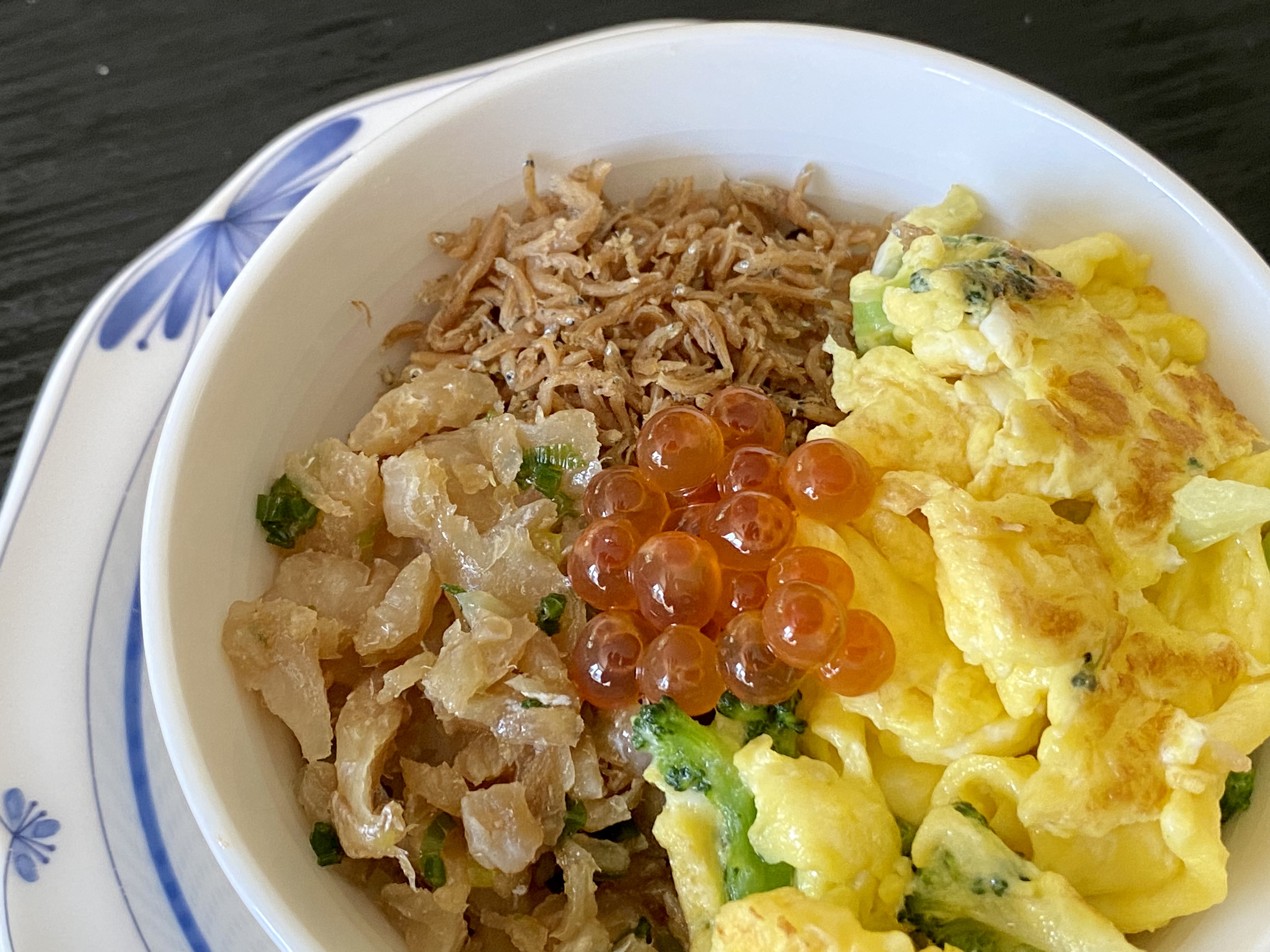
We had a lunch yesterday of mochi rice cake and cheese 焼きチーズ餅 and some side dishes. Today is the end of the first week of the new year called “Matusno-uchi” 松の内, I made a small “donburi” rice bowl topped with three of the last items from Sushi taro osechi box. (It would appear that I make a similar dish almost every new year). This time, I added a scrambled  egg with blanched broccoli florets. This was just a perfect size dish for us.


The small fish shown at 12 O’Clock is “Jako-no-arima-ni” 雑魚の有馬煮.  At 9 O’Clock is “soboro” そぼろ which I made using  the meat removed from a grilled small “tai” snapper 小鯛の姿焼き included in the osechi box and cooked in “mirin” sweet Japanese cooking wine and soy sauce until almost dry. I also garnished with ““ikura-no-shouyu-zuke いくらの醤油漬けor marinated “ikura” salmon roe.


With a side of  salted cucumber and nappa cabbage  胡瓜と白菜の浅漬け, this was a perfect lunch.

Wednesday, January 4, 2023

New Year’s day Evening 元旦の夕べ

So finally, we busted into the osechi box for the New Year’s day evening feast. Like we did before, I decided to use “Tsugaru-muri” 津軽塗り lacquerware two-tier lunch box (one tier for each of us) to serve the goodies. As a side, I also served the diakon-namasu 大根なます I made topped with slices of boiled Spanish octopus leg we got from D’Artagnan  and Ikura salmon roe.


I picked up most of the key items here including our favorites like “kazunoko” herring roe marinated in miso かずのこの味噌漬け, “karasumi” 唐墨 botargo and “ankimo tofu” あん肝豆腐 monkfish liver terrine. I lightly toasted karasumi, duck breast and “sawara saikyo-yaki” 鰆の西京焼き before serving.


These small items were such a treat. We enjoyed every bite along with a sip of our house sake “Tengumai daiginjo” 天狗舞大吟醸.

Sunday, January 1, 2023

Happy New Year 2023 新年おめでとう御座います2023

It is morning of the first day of 2023. The past year was marked by many events; not the least of which is the still lingering COVID-19. In any case, here is the “Kagami-mochi” 鏡餅 New Year’s decoration. It is  accompanied by various rabbit figurines because this is the year of the rabbit according to the Chinese zodiac. We usually place the new year’s decoration in the tokonoma 床間 alcove  of  our “tearoom” in the basement but this year, we decided to place it in the room where we spend most of our time to maximize our enjoyment of the collection.


As usual, the highlight of our new year is the Sushi taro osechi box 寿司太郎お節箱. We drove down to Dupont circle and picked up the Osechi box and hand-cut soba noodles “toshikoshi soba” 年越しそば (which we usually enjoy the 2nd day of the new year). For many years, we traditionally have our regular breakfast of Cafe Latte with yogurt and breads and have the New Year’s “Ozouni” お雑煮 soup for lunch. I also served a few items I made. As always, we wheeled out the real Japanese laquer ware bowls my mother gave us a long time ago.


As usual, we encased the mochi in a fried tofu pouch or “abura-age” 油揚げ (in an effort to make the eating experience a bit more manageable). It is at the bottom of the bowl so you can’t see it in the picture. I cut the carrot into a flower-shape and the daikon into a ginko leaf-shape. I also added burdock root ごぼう (the white rectangular object in the picture), shiitake mushroom, shrimp, flower-shape gluten cakes or “fu” 麩, snow pea, scallion and yuzu zest (frozen). I made the broth from dashi packs, a bit of mirin and x4 Japanese noodle sauce.


The accompanying dishes (from left to right) are all listed in “Norio’s New year dishes”. They are: chicken squares with gorgonzola cheese and dried fig, salmon kelp roll 鮭の昆布巻き, datemaki omelet 伊達巻, and salmon Russian marinade. (This year I made some modifications to the marinade by adding Dijon mustard and dill). Of course it wouldn’t be an adequate celebration of the first day of the New Year without at least a token glass of sake. This year it was our house favorite Tengumai Daiginjo 天狗舞大吟醸. The soup and these items were pretty good if I do say so myself.


Although we did not tap into the osechi box, here is a preview of what to expect when we eagerly dive in this evening. The picture below shows the first tier. Although many goodies are hidden below the items we can see, we can spot our favorites like “karasumi” 唐墨,  “mushi uni” 蒸し雲丹 and “Kazunoko” 数の子.


The second tier also has our favorites such as “Ankimo tofu”, “Ikura” and duck breast.


We are repeating ourselves but it is so wonderful that we are able to get this incredible osechi from Sushi Taro. We will be enjoying these delicacies over the next few days.