Sunday, September 17, 2023

Cold Thin Udon Noodle with Home-made Ponzu 自家製ポン酢、冷やし糸うどん

Cold noodle dishes using somen 素麺, soba 蕎麦 and ramen noodle “Hiyashi chuka” 冷やし中華 or “Hiyashi ramen” 冷やしラーメン are common especially on hot summer days in Japan. Cold udon うどん dishes are less common, except, as I understand it, in Osaka where you can have many combinations of cold/hot soup and cold/hot udon noodles. I made this cold udon dish just like cold ramen or “hiyashi ra-men” just substituting the ramen noodles with thin udon.


Since I made two kinds of pork a few days ago; Simmered pork and Barbecued pork, I cut some julienne pieces off of both kinds. We have a profusion of perilla in our herb garden and I added a chiffonade of perilla. My wife just harvested myouga 茗荷 and I made myouga picked in sweet vinegar. I included both fresh and pickled myouga as a topping (in the center). Other toppings included “Gari” ガリ pickled shouga ginger, cucumber and golden thread omelet or “Kinshi-ran” 金糸卵. For the sauce, I used my home-made ponzu-shouyu mixed with dark sesame oil (just a few splashes). I also added Japanese hot mustard and yuzu kosho shown on the rim of the plate (upper right).


Our myouga patch was doing well in terms of the foliage but the underground buds were slow to mature this year. But finally we had a good harvest. Myouga is such a unique herb/vegetable. We like to enjoy fresh as a topping or type of salad but pickled in sweet vinegar is also a very good way to prepare the myouga. At least for one or two weeks, the color of myouga becomes very red and sweet vinegar adds to the flavor. Then eventually the color fades to white.


I did not post about the home-made ponzu. This is just for my convenience. Since it is difficult to get fresh yuzu, I used bottled yuzu juice plus lime juice.

Ingredients:
100 ml yuzu juice (Either freshly squeezed or bottled) plus freshly squeezed lime of lemon juice to make 100ml
150 ml soy sauce
I small square of “konbu” kelp
I small package of bonito flakes

Directions:
Just mix the yuzu juice and soy sauce. In a clean sealable container (I used a clean and empty rakyo pickles plastic container) and added the kelp and bonito flakes.
Place in the refrigerator for 1-2 weeks (I kept it for 2 weeks)
Strain the kelp and bonito flakes and transfer the ponzu in clear sealable container and keep it in the refrigerator.

I think my home-made ponzu is slightly better but not much better than the commercial one since I could not use freshly squeezed Japanese citrus such as yuzu. This was a cool refreshing dish for a hot day. 

Thursday, September 14, 2023

Soft Boiled Duck Eggs 半熟アヒルの卵

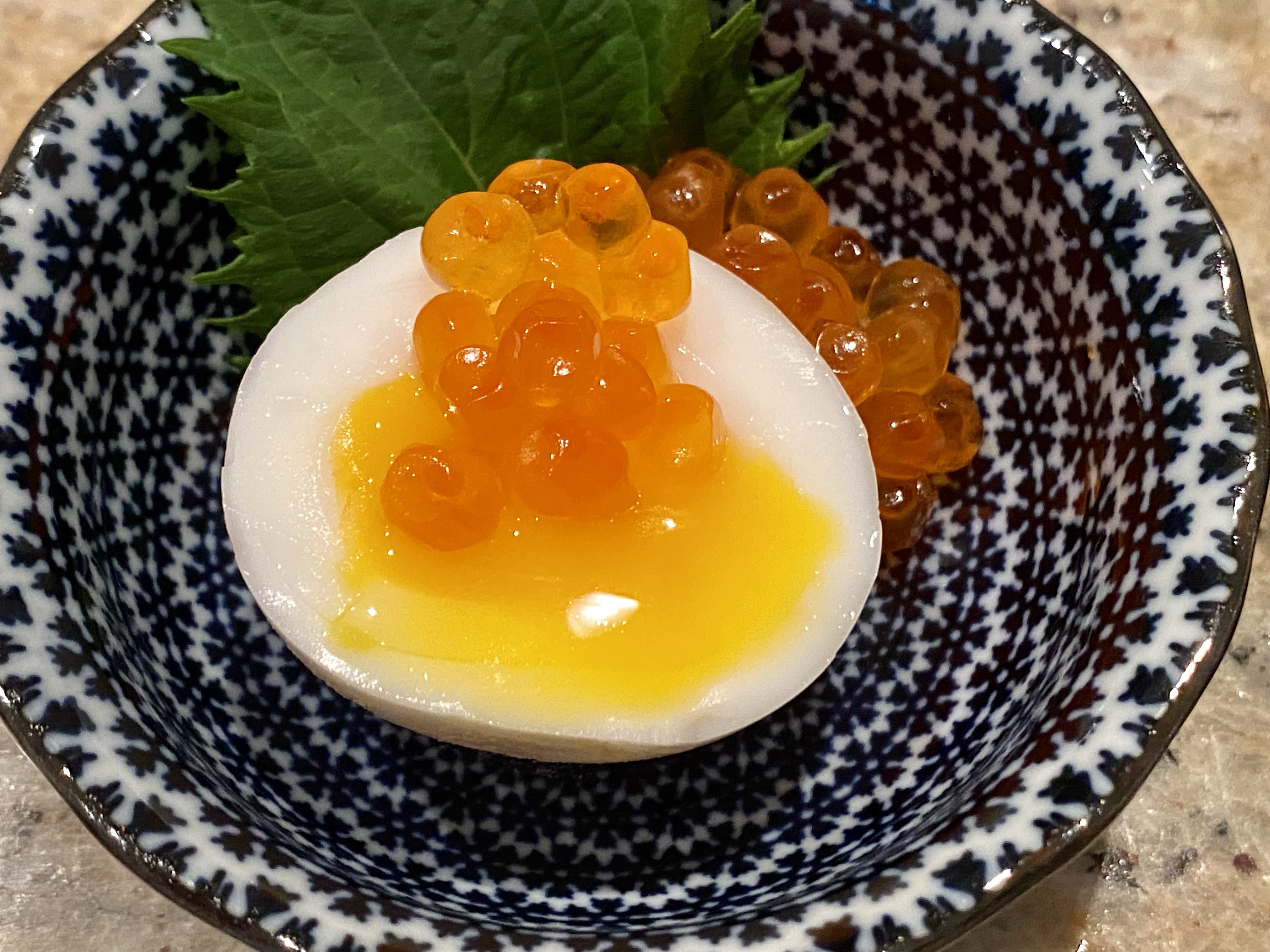
This is continuation of the duck eggs we got from Weee. Since we do not want to worry about a potential Salmonella problem, I pasteurized the duck eggs. I managed to make soft boiled duck eggs with runny yolk (see below). I somehow cut across the egg rather than usual halving the egg length-wise. In any case, the yolk was very rich and creamy. Interestingly, egg white clearly (more pronounced as compared to hen egg) showed two layers; an inner layer that did not congeal as firmly as the outer layer egg white.


I topped this with “ikura” salmon roe and a bit of soy sauce. This is a very luxurious appetizer.


Actually, this was part of the evening offerings. I made “bo-zushi” 棒鮨 of pickled mackerel with kelp. a very small sashimi assortment.


1. How to pasteurize duck eggs: Since duck eggs are larger than hen eggs (in our case no more than 30%), I used 57C for 2 hours instead of 75 minutes for hen’s eggs. As before, when the 2 hours were up, I immediately soaked the eggs in ice water for 30 minutes or more and placed them in the refrigerator.

2. How to make soft-boiled duck eggs with runny yolk: According to the on-line instructions I found, place the duck eggs in cold water and when the water starts simmering, cook another 6-7 minutes. I was not sure if I should pierce the shell on the air cell side (bland end) to prevent the egg from cracking. In the end, I did. One of the eggs extruded a thin thread of yolk. Next time, I will not pierce the shell and see what happens. After 7 minutes, I soaked the eggs in ice cold water. We peeled the shell after 30 minutes and the eggs were cooled down. It was difficult to peel. My wife did a better job.

We are quite satisfied with the soft-boiled duck eggs only if we can peel it more easily.

Saturday, September 9, 2023

Eggplant “Kabayaki” 茄子の蒲焼

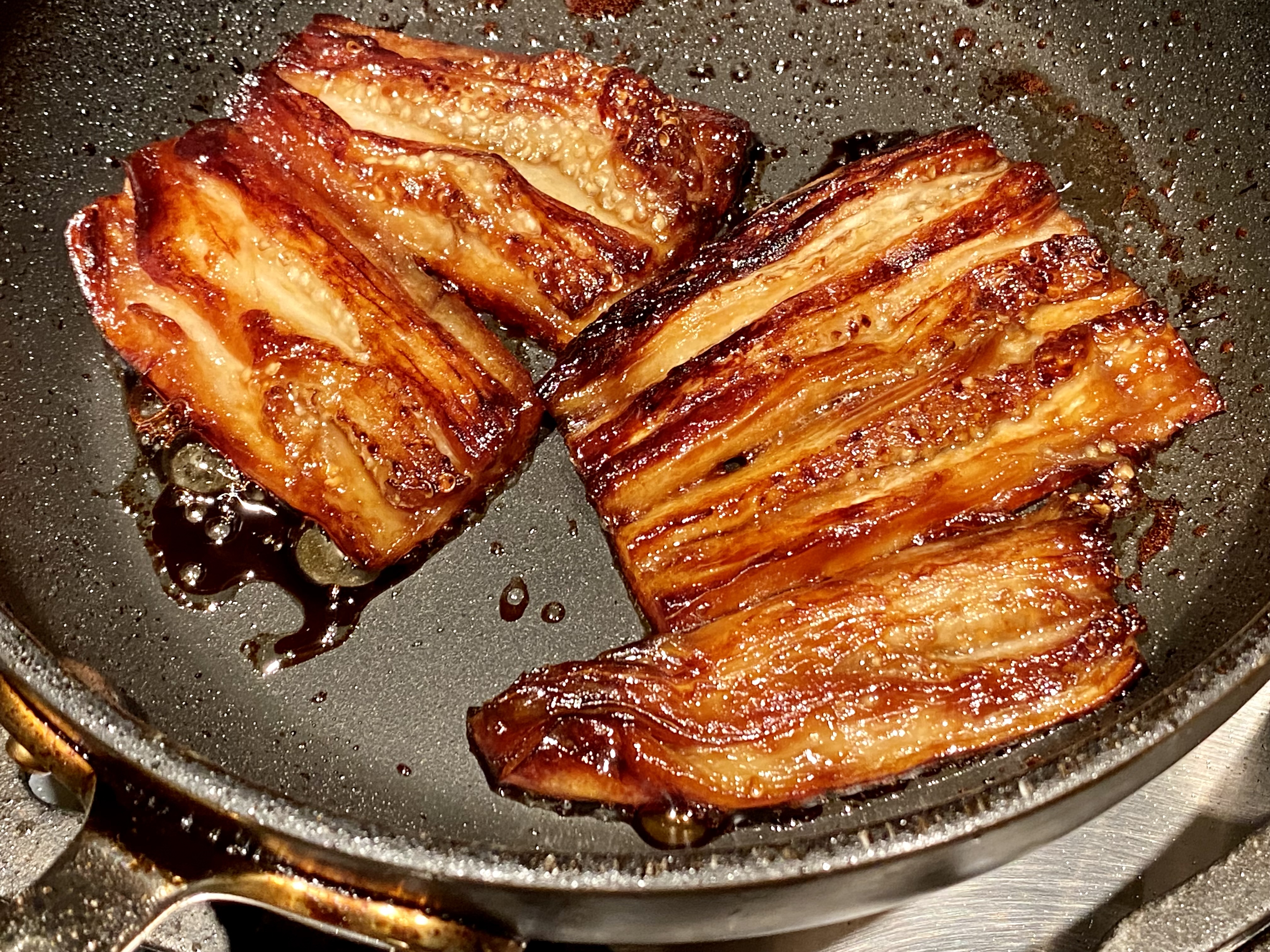
This was the dish I made from the last remaining eggplant I got from Weee. With this dish I finished all the eggplants. I saw this recipe on YouTube. This is easy to make since the initial cooking is done by microwave. Visually it resembles eel kabayaki うなぎの蒲焼. I served this over fresh rice as a small donburi 丼 for “shime” 〆 ending dish one evening. This is quite unique and and a good way to serve eggplant.


Ingredients: (for two small servings)
1 Asian eggplant, stem end removed, peeled, cut into two equal pieces (This was a quite long slender eggplant)
2 tbs light olive oil

For the Kabayaki sauce
2 tbs sake
2 tbs mirin
2 tbs soy sauce
1 tbs sugar

Directions:
Prepare the kabayaki sauce by mixing all the ingredients in a small pan on medium heat and dissolving the sugar.
Cook the eggplant in the microwave using a silicon container for 2 minutes or until cooked through
When cool enough, cut the eggplant lengthwise but do not cut all the way through. Then open it up. You may need to add more parallel cuts (again not all the way through the eggplant) so that it makes flat rectangular pieces.
Add the oil in a frying pan on medium heat and put in the eggplant pieces (see below)


Once one side is nicely browned (2-3 minutes), carefully turn it over without breaking the pieces.


When both sides are nicely browned add the kabayaki sauce to coat the eggplant pieces and the sauce reduces a bit.


Drizzle some of the sauce on the rice and place the eggplant pieces over the rice. I sprinkled powdered “sansho” 粉山椒 Japanese pepper as though this was an eel kabayaki (optional).

Visually it is easy to believe this is really eel. The flavor of the sauce further supports the impression this is eel. Even the texture is very similar. The one thing that is missing, which gives away the fact this is not eel is the unctuous fattiness that is the characteristic essence of eel. Otherwise it is a very good facsimile.

Wednesday, September 6, 2023

Eggplant Prosciutto and Ham Rolls 茄子の生ハム巻き

I was trying to come up some new eggplant recipes since we still had two large eggplants we got from Weee. I saw two recipes on-line using thinly sliced pork or prosciutto wrapped around a baton shaped piece of eggplant. Actually, these types of roll-ups are very popular in Japan. The most common ones use vegetables such as scallion or asparagus in the center rolled up in various kinds of thinly slices meat. Since we had slices of prosciutto and honey-baked ham, these two recipes inspired me to make roll-ups using batons of eggplant with one kind wrapped in prosciutto and the other with ham. I did not add any sauce as suggested in one of the recipes. This is a good snack-y dish. Salted “umeboshi” plum paste gave a nice salty sour flavor that went well with the eggplant. We definitely liked the prosciutto one best.


Ingredients (made 12 roll-ups):
For salted plum sauce (“bainiku” 梅肉)
Two “umeboshi” 梅干し salted plums, meat removed from the stone, chopped.
1/2 tsp mirin

One asian/Japanese eggplant (long slender one which is not quite a Japanese eggplant), quartered length-wise, then cut across about 2 inch long or the width of the ham and prosciutto.
10 perilla “aojiso” 青紫蘇 leaves
12 slices total of prosciutto and ham.
1 tbs potato starch or “katakuriko”片栗粉
2-3 tbs light olive oil or vegetable oil

Directions:
Place the meat of the salted plum in a Japanese “suribachi” mortar. Add the mirin and grind into a smooth paste (#1)
Spread out a slice of the prosciutto or ham on a cutting board, place the perilla leaf on the ham, smear the plum sauce, place a baton of the eggplant and roll to make 12 roll-ups (#2 and #3).
Thinly coat the surface with potato starch
Seam-side down, fry in a non-stick frying pan with the olive oil in medium heat, turning occasionally to brown all sides (#4). Once all sides are brown, turn the heat down put the lid on, to complete cooking of the eggplant (about 5 more minutes).
Serve hot or re-heated in the toaster oven before serving.


As mentioned before, the ones made with prosciutto were much better largely because the ham didn’t have any flavor. The outside was crispy with some saltiness. The eggplant was creamy, soft and permeated with the major flavors that came from the salted plum paste and the perilla leaves. Very good combination of the textures and flavors. Perfect snack for either sake or wine.

Sunday, September 3, 2023

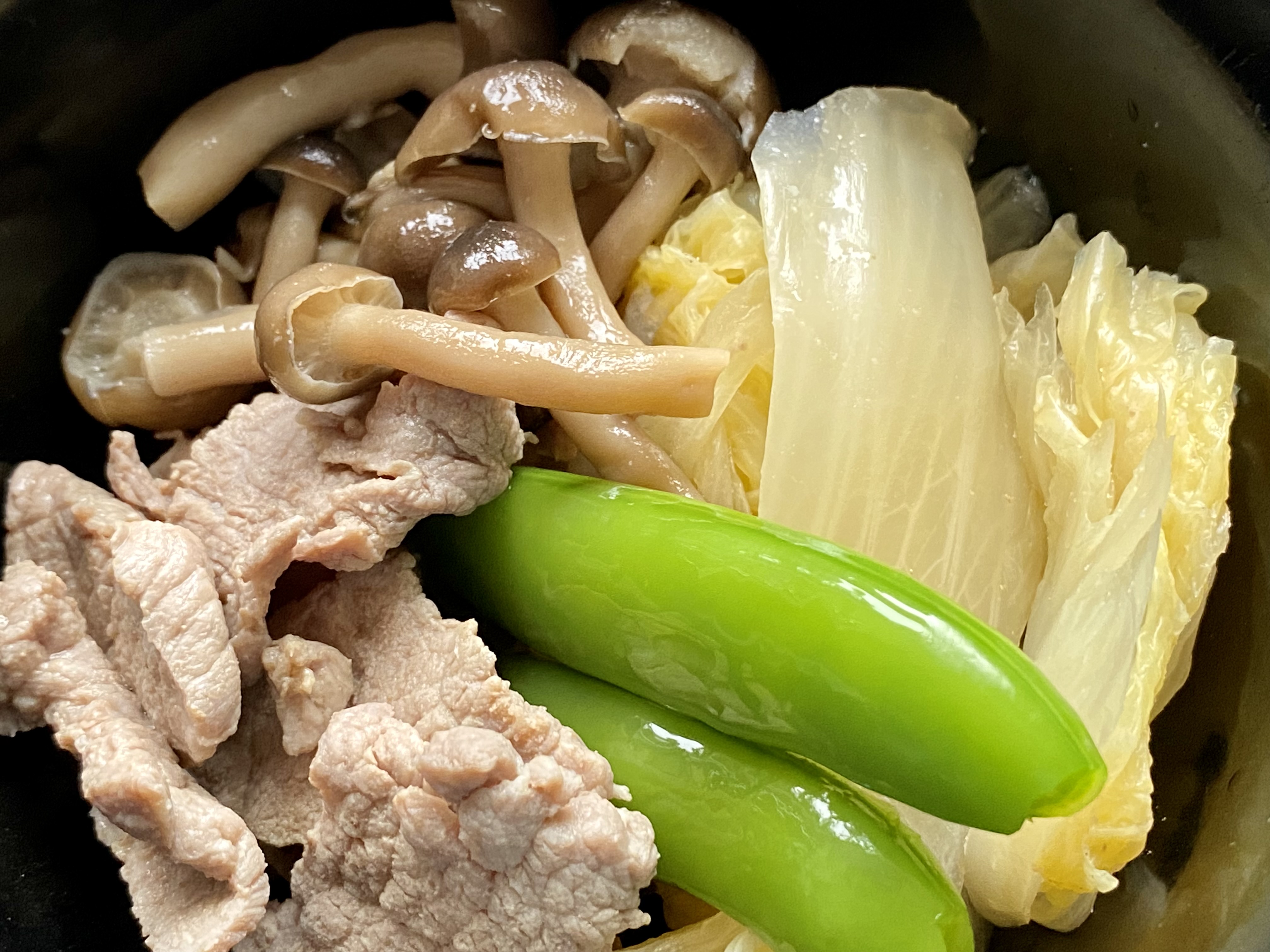
Simmered Pork and Nappa Cabbage 豚肉と白菜の煮物

When we get a large bone-in skin-on piece of pork (either fore- or hind-quarter), I do secondary butchering to remove the skin and bone. With the meat I usually make one large roast for barbecuing in our Weber grill, and one smaller roast for making simmered pork or “Nibuta” 煮豚 in the Instant pot. I usually hand-chop the remaining trimmings into ground pork which I use to make “mapo tofu” 麻婆豆腐, “niku-miso” 肉味噌 or other dishes.  This time the pork came from the fore-quarter and after I did all my usual preparations additional small blocks of pork remained. So I sliced them very thinly and made two dishes; one was a classic homey dish of meat and potato stew or “nikujaga” 肉じゃが and the other was this nappa cabbage dish. I made this dish since I had quite a good amount of left-over nappa cabbage or “hakusai” 白菜 and also brown shimeji mushroom or “bunashimeji” ぶなしめじ.


I added sugar snaps スナップ豌豆の塩びたし for color.


This is based on a recipe I saw on-line but because of the ingredients I had (or didn’t have), I had to make some modifications.

Ingredients:
4 leaves of nappa cabbage, bottom trimmed, cut in half lengthwise. I cut the bottom half thick portion on a slant (45 degree against the cutting board surface) 1 inch long (called “sogi-giri” 削ぎ切). This makes a slightly thin segment). The leafy tops were cut into 1 inch long pieces.
120 grams of thinly sliced pork (the amount is arbitrary. More the better?)
1 package (150 grams) of brown shimeji mushroom, bottoms removed and separated
400ml Japanese dashi broth
1 tbs each of sake and soy sauce (to marinade the pork)

Seasoning
2 tbs sake
2 tbs x4 Japanese noodle sauce (or 1 tbs each of mirin and soy sauce)
1/2 tsp ginger juice (from grated ginger root)

Direction:
Marinate the pork in the mixture of sake and soy sauce for 5-10 minutes.
Put the dashi broth in a pan on medium heat. When it boils add the marinated pork. When the meat changes color, add the nappa cabbage and mushrooms. Cook for a few minutes and add the seasoning. Cook for 10-15 minutes or until the hard part of the nappa cabbage is cooked through.
Serve warm with topping of blanched green beans or sugar snap or chopped scallion (optional).

Although this dish uses the combination of seasoning similar to “niku-jaga”, this dish came out much more mildly flavored and gentle. This is a good dish for drinking snack or the accompaniment for rice.