Showing posts sorted by date for query persimmon. Sort by relevance Show all posts

Friday, November 27, 2026

Persimmon and Daikon Layered Pickles 柿と大根の重ね漬け

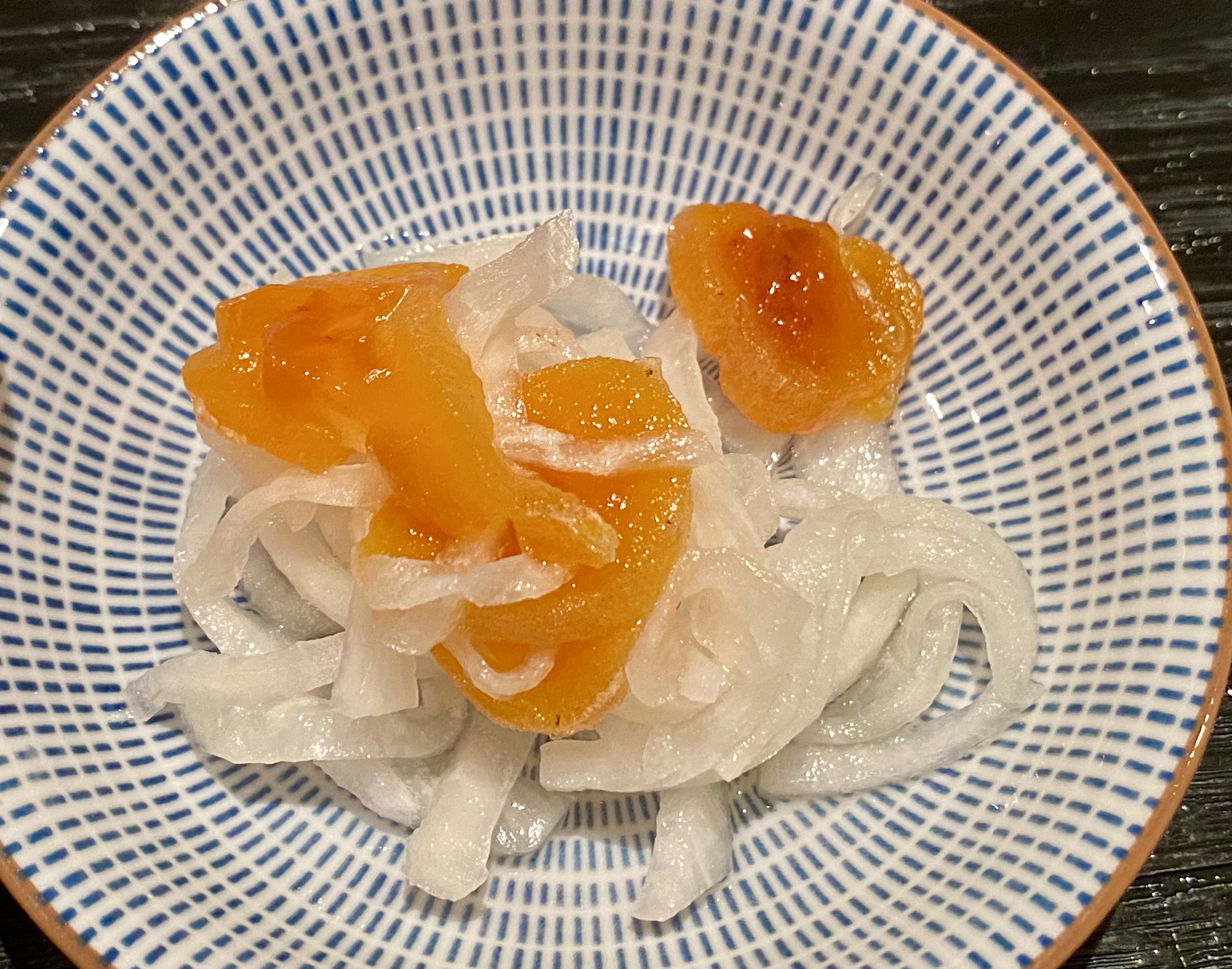
Among the autumnal delights we like is persimmon. This time, we got “Fuyu” persimmon 富有柿 in a box (about 4lb or 15 persimmon) from Weee. They were from California; mostly seed-less and very good. We did not have to wait for them to ripen and become sweet rather than puckering. I pontificated about differences in types of persimmon previously.  Although we started eating some of the ripe ones for dessert, we still had lots to go. We have made and posted quite a few dishes using persimmon. I wanted to make something we have not tried before. As I was looking for new recipes, I came across several versions of layered slices of persimmon and daikon or 柿と大根の重ね漬け (picture #1).  This turned out to be very good, refreshing and goes well with many dishes as an accompaniment.


After seeing and reading several recipes, I made this dish as described below.

Ingredients:
2 fuyu kaki, stem-end removed, peeled, halved and sliced 2-3mm thick
3 inch segment of medium-sized daikon. peeled, halved lengthwise and then sliced 2-3mm thick
3 tbs lemon juice (I used Meyer lemon)
1 tbs mirin
salt (3% weight of the daikon)

Directions:
Add salt weighing about 3% of the weight of the daikon and knead to coat all slices. Let it stand for 10 minutes and ring out the excess moisture. Make alternate layers of the daikon and persimmon slices and place in a container that can hold them snuggly (picture #2). Pour the lemon juice and mirin mixture over the daikon/persimmon and tightly cover with a plastic wrap. Let it marinate in the refrigerator for at least several hours before serving. The resulting pickles should last for at least few days or more in the refrigerator.


These pickles are a very refreshing combination of sweet soft texture from the persimmon and crunchy slightly bitter texture from the daikon. The taste, however, was tame enough that the pickles were a nice accompaniment for a number of other dishes.

Tuesday, November 10, 2026

Matsutake Lunch 松茸の昼食

It is autumn and time to enjoy the seasonal dishes featuring Matsutake. In the past we have gotten fresh matsutake in the US from various sources. In recent years, we have gotten some very good ones from Weee but this year, they didn’t carry it. So, we got one pound from “Oregon Mushrooms”; one of the other sources we have used. I posted many times about  Matsutake 松茸 dishes.  This post is a summary of the various dishes I made this year. Each dish will appear in greater detail in subsequent posts. One of the major changes I made this year, was using “Nagatani-en” Matsutake-flavored clear soup 永谷園松茸風味お吸い物 in the dishes. The idea of using this flavored soup was presented to us many years ago by our Japanese friends. They mentioned that the advantage of using this matsutake seasoned broth was that it would enhance the matsutake flavor in the dish. This flavor enhancement would be especially helpful because North American matsutake has less prominent flavor compared to Japanese ones. Nonetheless we never followed up on this suggestion until this year and we have to say their observation was 100 percent correct. It really added to the overall matsutake experience.


The pic shows the matsutake dishes we had as a lunch (Picture #1). These were our usual matsutake rice 松茸ご飯, matsutake clear soup 松茸のお吸い物 and daikon and persimmon layered pickles 大根と柿の重ね漬け (this is new). Since I used “matsutake-flavored”  soup base for the matsutake rice and soup, they will be the subject of individual new posts. I also added a post about the new daikon and persimmon pickles for extra good measure. (I also used the soup base in chawamushi 茶碗蒸し, but did not take any pics so that dish will not be posted.)

Sunday, April 5, 2026

Hanami 2026 #2 and #3 花見2026、二回目、三回目

This year, two of our cherry trees (shown in the picture) kept their blossoms for several days, which gave us an opportunity to have multiple “Hanami 花見” cherry blossom gazing celebrations. The weather was a bit too cold to stay outside in the evening but we had a some time during the day to sit under the cherry trees. In the evening, we moved inside but still had a great view of the cherry blossoms. We served several small hanami dishes in the red and gold “jubako 重箱” (stackable boxes) which we have. These boxes were was just the right size and an elegant way to serve the small hanami feasts. 


The picture below shows the various dishes we served in the jubako. In picture #1, the dish in the upper left is a small “chirashi-sushi* ちらし寿司” scattered sushi with “ikura いくら” salmon roe, “uni ウニ” (not fresh uni but “Uni shuto うにの酒盗 from Maruhide 丸秀 which is the next best thing to fresh uni), and slices of avocado and cucumber.

*Since I had hydrated dried shiitake mushrooms left over from making vegetarian broth and “Kanpyo 干瓢” gourd peel from making salmon kelp rolls, I cooked and seasoned them with sugar and soy sauce (sweet and salty “ama-kara 甘辛” ). I chopped them up and mixed it into the sushi rice (this is the classic way of preparing rice for  “chirashi-zushi ちらし寿司” scattered sushi).


The upper right is simmered mackerel in miso sauce 鯖の味噌煮 with small pieces of two kinds of dashi-maki omelettes だし巻き卵, left-over from the first hanami. The left lower is Russian marinated salmon サーモンのロシア漬け topped with ikura. Finally the lower right is an assortment of what I made mostly for the first hanami, all vegetalian including mock tofu 擬制豆腐, persimmon in tofu dressing 柿のしら和え, braised burdock 金平牛蒡, nappa and cucumber asa-zuke 白菜とキュウリの浅漬け,
and marinated qual eggs うずらの味玉.

The next day, I served similar items including scattered sushi. A notable addition were the fire-fly squid ホタルイカ we got from Regalis foods. We ate half of the quantity of squid soon after we received them. For the other half,  I re-boiled, then removed the tough rock-like eyes and beaks and froze them. I thought they would be a perfect addition to the hanami feast. After thawing them, I briefly sautéed them in butter and seasoned them with a small amount of soy sauce. I also added karashi-sumiso 辛子酢味噌 miso and vinegar dressing with Japanese hot mustard (picture #2).


This has been our cherished once-a-year event. The only problem is that when the blooms are over, we have to wait a whole year before we can enjoy them again. As an aside, the Easter (and late blooming Christmas) amaryllis are also adding to the show.  


Thursday, April 2, 2026

Hanami 2026 花見2026

Since the past winter was brutally cold, it was estimated that the cherry trees in the Washington area would not bloom until early April; much later than usual.  But somebody forgot to inform the cherry trees of the proposed schedule. After just a few warm days the cherry trees in our backyard snapped to attention and before we knew it, they were in spectacular full bloom. And when did this occur? At the end of March; the time they usually put on their performance. With the cherry trees in full bloom it was time for us to snap to attention and seriously celebrate the coming of spring. As we may have mentioned before we have 3 cherry trees in our back yard. They are of different ages and different vintages. They generally bloom in sequence, one after the other, with the one we called the smallest (which is now the tallest) so named because I rescued it as a small twig, going first. Next is the newest member of the “family” which we planted in 2018 to replace the cherry tree we planted soon after we moved into the house but was destroyed by a large branch that flew off the neighbors pine tree during a Nor'Easter in 2018. Last to bloom is the oldest cherry tree (the Grand Dame) which was well established in our backyard when we moved in. (We would like to think it may be around 70 years old). This year all three were blooming in succession but almost simultaneously.  So, celebration was mandatory. We invited our friends over and had our Hanami 花見. One of our guests is a vegetarian. We made a special “sashimi” plate of assorted vegetarian appetizers for them to enjoy while we had a plate of actual sashimi. The vegetarian plate shown in the picture was an assortment of  dishes we have previously posted.


1. Persimmon  and green beans dressed in tofu dressing 柿とインゲンの白和, 2. Japanese omelet with dried “aonori” sea weed 青のり入りのだし巻き, 3. roasted red pepper sauce omelet 赤パプリカソースのだし巻き, 4.  pan-fried oyster mushroom 平茸の洋風ソテー, 5. mock tofu 擬制豆腐, 6. braised crunchy cauliflower モンパルナスのカリフラワー炒め, 7. Braised baby artichokes 8. marinated quail eggs うずらの味玉, 9.eggplant caviar ナスのキャビア. I was very careful to make sure I did not use any classic Japanese “dashi” broth which contains bonito flakes and other fish derived flavors. Instead, I used a broth made from kelp and dried shiitake mushrooms.


After this, we had assorted nigiri-sushi, rolls (vegetarian sushi and rolls for our vegetarian friend). Although it was rainy when we had our friends over, our main cherry tree was in full bloom shown in this picture.


In addition, our Easter amaryllis (and even some tardy Christmas ones) were also in full bloom.


What’s not to like about this after the harsh winter we had? Although this lasts only a short time we should still be able to have several more hanami.

Saturday, February 28, 2026

Persimmon and “Kabu” turnip salad 柿と蕪のマリネ

This is a quick impromptu dish I made one evening. This dish came about since I had a small fresh Japanese “kabu 蕪” turnip from Suzuki Farm, and “Fuyu” persimmon 富有柿 from Weee. In addition, I had leftover “Kabosu miso カボスみそ”. So I made a quick marinated kabu and persimmon with added  wakame わかめ dressed in “Kabosu miso”. This was a refreshing small dish with interesting texture and flavor. The raw kabu turnip has a nice crunch with distinctive flavor (pungent in a good way) combined with the sweetness of persimmon in a dressing made of mixture of home-made sweet vinegar and olive oil. All worked well together. Although wakame is usually dressed with “Sumiso 酢味噌”, “Kabosu miso” worked as well or even better.


Ingredients (2 servings or 4 small servings like the one in the picture).
One small Japanese “kabu” turnip, top removed, skinned, halved and sliced thinly (depending on your preference; the thicker the crunchier)

One “Fuyu” persimmon, (firm one), peeled, halved and sliced similar to the “kabu”
1/2 tsp salt

Marinade/dressing:
1 tbs “amazu” sweet vinegar*
1 tbs extra virgin olive oil
salt and pepper to taste

*Amazu 甘酢: there are a few variation (see “daikon namasu” section of Norio’s New year dishes”). The one I had was made some time ago and kept in a jar. It was made of equal parts rice vinegar and water as well as sugar equal to half the amount of vinegar used and a pinch of salt.

Directions
Add the salt to the kabu, knead and let stand for 5 minutes and squeeze out any excess moisture.
In a small bowl, add the kabu and persimmon. Add the dressing and mix.
Refrigerate for 5 minutes before serving.

Because of the acidity in the dish, sake is the libation of choice.

Sunday, February 1, 2026

Warm sake on a cold night 寒夜の燗酒

At the end of January, it was brutally cold due to an Arctic vortex which swept over the continent. Lows were in the single digits, wind chills in the negative range and daily highs never got above freezing for many days. In addition, there was a winter storm that produced a significant snow accumulation. The snow was then coated with sleet and freezing rain becoming a solid block of ice which stayed for days due to the Arctic weather.

This was a perfect time to have hot pot “nabe 鍋” dishes and “kanzake 燗酒” warm sake. One day, we had “Ishikari-nabe 石狩鍋” with our favorite warm sake (Tengumai yamahai-jikomi junmai 天狗舞山廃仕込純米). Another night,  we had a special sake “Kiku-masamune junmai taruzake 菊正宗純米樽酒” warm. This is the sake we had when we visited an Izakaya in Tokyo called “Fukube ふくべ”. They had a large wooded cask or “taru 樽” of Kiku-masamune. We had it at room temperature but later we learned that the regulars have this “nuru-kan ぬる燗” or warmed even in summer. Taking heed of what we learned at the Izakayae in Tokyo, we took out our handy-dandy electric sake warmer (Picture #2) and enjoyed it warm as recommended. This sake is quite a character; its flavor changes based on the temperature at which it is served. When served warm the cedar flavor characteristic of its cooler state becomes a bit muted and integrates more subtly into the base taste of the sake.

No sake, no matter how good, can shine at its best if not accompanied by a some tasty small dishes. I served this sake with some “tsumami つまみ” appetizers. None of them were new to our repertoire but served the purpose well. Since we got “hoshigaki 干し柿” dried persimmon from Japanese taste, I made “daikon namasu 大根なます” and topped it with dried persimmon (lower right). Others included “Russian marinated salmon 鮭のロシア漬け” (upper left), pickled herring (from a jar) with sour cream dill sauce (upper middle), salmon kelp roll 鮭の昆布巻き and spicy tofu ピリ辛豆腐 (lower left).


Historic note: Placing sake in a Japanese cedar “taru” cask may have started before pasteurization. It was done to preserve sake as well as cover up unwanted flavors which may have developed in unpasteurized and non-refrigerated sake. In modern times, due to refrigeration, there is no need to place sake in a cedar cask but people developed a taste for the distinctive cedar aroma/flavor. This is a situation similar to the Greek wine “Retsina” which was flavored with the pine resin used to seal the amphora in which it was stored. Now even though those type of amphora are no longer needed, pine resin flavor is added to the wine.

In any case, this sake comes in a blue tinted bottle shaped like a traditional “tokkuri とっくり” which was used to buy/store/carry sake or other liquids in the old days. The rope on the neck of the bottle is for easy carrying or (in the old days) securing the tokkuri bottle to your sash (for handy access to a drink). One other sake we like served warm “Gekkeikan 月桂冠Black and Gold” also comes in a similarly shaped bottle.

For heating and maintaining the warm sake, we have been using the electric sake warmer shown in picture #2 for some time. It is a “must have” even if you drink warm sake only occasionally. I sure beats the old fashioned methods we used to use such as partially immersing the sake filled container in hot water or microwaving it. This little warmer heats up and maintains the sake at the specified temperature—no fuss no muss.


Although we have not tried many sakes warm, our rankings are #1 Tengumai Junmai, #2. Kiku-masamune Junmai Taruzake and #3 Gekkeikan Junmai “Black and Gold”.

Tuesday, January 20, 2026

Persimmon in Tofu Dressing 柿の白和え

“Shira-ae 白和え” meaning “white dressing”  refers to dishes in which the dressing consists mainly of tofu. The dishes usually use vegetables or fruit (persimmon being the most common fruit used). But protein such as chicken can also be added. There are variations of how to season the tofu but one ingredient consistently used is sesame; either sesame paste and/or coarsely ground sesame seeds. White miso or light colored soy sauce is often used. You can use either silken (Kinugoshi tofu 絹ごし豆腐 or firm Momen tofu 木綿豆腐). This time I used left-over medium firm tofu, ground re-roasted sesame seeds and hummus which I made a few days ago. For saltiness, I used “Shiro-dashi 白だし*” from the bottle. I used blanched green beans and persimmon (picture #1) which is rather classic.

* Shiro-dashi is a versatile light colored Japanese seasoning made of  light-colored soy sauce and Japanese  dashi-broth which is available in a bottle. 


I served this as a part of the appetizers (picture #2) one evening. The left is “Russian” marinated salmon 鮭のロシア漬け with “ikura いくら” salmon roe.
>


Substituting sesame paste with hummus worked very well. This is a good “healthy” appetizer.

Wednesday, December 31, 2025

Table of Contents 2026

January 2026
January 1     Happy New Year 2026 明けましておめでとうございます
January 2    “Ozoni” New Year’s Soup お雑煮 2026
January 5    Osechi from Sushi Taro 2026 すし太郎のお節
January 8    Chocolate Brownie Pudding チョコレートブラウニープディング
January 11    Japanese “Kabu” Turnip Simmered in Broth 蕪の煮物
January 14    Japanese Sweet potato Blini さつまいもビィリニ
January 17    Simmered “Satoimo” taro with squid 里芋とイカの煮物
January 19    Grilled Beef Tongue 牛タンの焼肉
January 20    Persimmon in Tofu Dressing 柿の白和え
January 23    Cauliflower-puree Blini カリフラワーピュレー ビィリニ
January 25    Gingerbread Pancakes with Date Sauce ジンジャーブレッドパンケーキ
January 26    “Bento” Lunch Box 弁当
January 29    Chestnuts and Apple Blini 栗とリンゴ味のビリニ

February 2026
February 1    Warm sake on a cold night 寒夜の燗酒
February 4    Cranberry sauce muffins クランベリーソースマフィン
February 7    Appetizers; one with Shad Roe 酒のつまみ
February 10    Custardy Apple Cake カスタードアップルケーキ
February 13    Salted “Kabocha” 塩かぼちゃ
February 16    Fried “Renkon” Lotus Root with “Aonori” dried seaw...
February 19    Valentine‘s day sashimi dinner バレンタインデイ刺身ディナー
February 22    Valentine’s day cake バレンタインデイケーキ
February 25    Crispy Cheese Rice Puffs チーズライスパフ
February 28    Persimmon and “Kabu” turnip salad 柿と蕪のマリネ

March 2026
March 3    Peanut butter pancake ピーナッツバターパンケーキ
March 6    Cold Jade Eggplant in broth 茄子の翡翠煮
March 9    Cream Cheese Biscuits クリームチーズビスケット
March 12    Roasted Red Pepper Sauce V2 赤パプリカのソース
March 15    Pan-fried Oyster Mushroom 平茸の洋風ソテー
March 18    English Muffin Loaves イングリシュマフィンローフパン
March 21    Honey Oatmeal Roll 蜂蜜とオートミールのロールパン
March 24    Shrimp and Grits with Poached Egg 温玉のせ海老とグリィツ
March 27    Sweet potato gnocchi さつまいものニョキ
March 30    Japanese Fluffy “Soufflé” Pancake (version 2) 日本風フ...

April 2026
April 2    Hanami 2026 花見2026
April 5    Hanami 2026 #2 and #3 花見2026、二回目、三回目
April 8    Baked Spaghetti (angle hair) Cup with meatballs オー...
April 11   “Atsu-age “ Fried Tofu 厚揚げ
April 14    Mango Crumb Bars マンゴークラムバー
April 17    Vegetarian Buttermilk Cotta ベジタリアンバターミルクパナコタ
April 20    Strawberry Cream Cheese Cupcakes 苺とクリームチーズのカップケーキ
April 23    Stir-steamed “Kimpira gobo” Burdock-root 蒸し炒め金平牛蒡
April 26    Mini Cheese Grits Casserole ミニグリッツキャセロール
April 29    Duck Leg Confit アヒルのもも肉のコンフィ

May 2026
May 2    Pan-fried Grits Cake フライパンで焼いたグリッツケーキ
May 5    Lemon Ricotta Cake レモン、リッコタチーズケーキ
May 8    Roasted Carrot Soup にんじんスープ
May 11    Shrimp and Scallop Rice Krispies Bites エビとホタテのライスク...
May 14    Rice Krispies Pancake ライスクリスピーパンケーキ
May 17    Walnut Cheddar Loaf くるみとチェダーチーズのローフ
May 20    Norwegian Lefse Flatbread ノルウェイのレフシイ フラットブレッド
May 23    Grape-puree Muffin ブドウのピューレのマフィン
May 26    Pork Vindaloo served in Soup Curry-style スープカレー風豚肉...
May 29    Honey Curry Bread 蜂蜜カレーパン

June 2026
June 1    Morning Glory Muffin 朝顔マフィン
June 4    Three Eel Dishes うなぎの蒲焼料理3種類
June 7    Meatloaf ミートローフ
June 10    Air Fried stuffed Chicken Wings エアーフライ手羽餃子
June 13    Air Fried Chicken Wings エアーフライ手羽
June 17    Air Fried Eggplant エアーフライ茄子
June 20    Grilled Tofu-puff with Egg Yolk Miso 柚子胡椒入り玉味噌の焼き油揚げ
June 23    Goat Cheese Popover ゴートチーズ ポップオーバー

June 26    Sausage Encased in Cookie Dough (Full Moon Pastries)
June 29    Raspberry Muffin Bites ラズベリーマッフィンバイツ

July 2026
July 1    Raspberry Muffin Bites ラズベリーマッフィンバイツ
July 4    Salmon Pate サーモンパテ
July 7    Chicken Liver Cooked in Ketchup and Worcestershire...
July 10    Air Fried Zucchini エアーフライズッキニ
July 13    Garlic Chive and Cucumber Salad ニラとキュウリの和え物
July 16    Blueberry Cream Cheese on Blueberry Muffin ブルーベリーチ...
July 19    Neapolitan-ish pizza ナポリ風ピザ
July 22    Tomato-Spinach Roulade Bread トマトとほうれん草のルラード
July 25    Pork and Potato and Goat Cheese Bites ローストポーク、ポテト、...
July 28    Mashed Potato, Roasted Pork and Cheese Bites versi...
July 31    Spinach Feta Cheese Frittata Bites ほうれん草とフェタチーズのフリ...

August 2026
August 3    Sour Cream Blueberry Muffins サワークリーム、ブルーベリー、マッフィン
August 6    Strawberry, Pretzel Cheese Cake いちごチーズケーキ
August 9     Blueberry Pudding Cake ブルーベリープディングケーキ
August 12    Air Fried Pork Tenderloin with Panko Crust エアーフライ...
August 25    Air-fried Spicy Tofu エアーフライピリ辛豆腐
August 28    Air-Fried Pork Tenderloin without Panko Crust エアー...

September 2026
September 1    Okonomi-yaki Vegetarian Version ベジタリアンお好み焼き
September 4    Seafood Okonomi-yaki 海鮮お好み焼き
September 7    Pork Okonomi-yaki 豚バラお好み焼き
September 10    Blueberry Yogurt Popsicle ブルーベリー ヨーグルト アイスキャンディー
September 14    Okonomi-yaki, Osaka-style Summary 大阪風お好み焼き総括
September 17    Okonomi-yaki, Hiroshima style 広島風お好み焼き
September 25    Take-out Sashimi 刺身テイクアウト
September 27    Condensed Sweet Milk Bread with mistake バターミルク、コンデ...
September 30    Ricotta Rolls リコッタチーズ入りディナーロール

Sunday, November 12, 2023

“Name-take” as a part of 9 Appetizers 自家製なめたけ

This is another installment of 9 appetizers served on 9 divided plate. There are a few repeats but no store-bought items.  Among these 9 items, the new ones are home-made “name-take” なめ茸* (in the center) and seasoned and grilled quail eggs 味付けうずらの卵 (in the bottom row, center). 

The top row from left to right are fig and edible chrysanthemum イチジクと春菊の和物 (I added sesame dressing this time), sugar snaps in salt broth スナップ豌豆の塩びたし,  simmered mushrooms “tsukudda-ni” キノコの佃煮.  The he middle row left to right are “hoshigaki” dried persimmon with daikon namasu 干し柿大根なます, nametake なめ茸, “kinpira gobo” burdock root 金平牛蒡.  The bottom row left to right are grilled “ginnan” ginko-nuts with salt 銀杏**, grilled seasoned quail eggs 味付けうずらの卵   lilly bulb with ikura salmon roe 百合根のイクラ載せ.


*I thought I have not posted home-made Name-take but when I searched my blog I found two enoki mushroom dishes one is home-made name-take in 2011. I will list the recipe again for my own convenience. Nametake is most commonly available as a rice condiment in a jar.

** It may be spelled as “gingko”. We used to be able to get a small can of boiled ginko nuts but in recent years, it has disappeared. This may be due to the fact that ginko nuts contain a small amount of toxin called MPN, or 4'-methoxypyridoxin. If consumed in a large quantity, especially among children, could produce intoxication. We could harvest ginko nuts since ginko trees are around, the preparation (to remove the meat of the fruit) is messy and smelly which I am hesitant to do). Very recently, however, we could get boiled and packaged ginko nuts (China product) from Weee.

Nametake:

Ingredients: (the seasoning can be more stringer/salty (more soy sauce)
I package (200 gram) Enoki mushroom
2 tbs sake
1 tbs mirin
2 tbs soy sauce (or x4 concentrated Japanese “mentsuyu” noodle sauce

Directions:
Cut off the end of the enoki, cut in half, separate the bottom parts
Place it in a small pot and add sake on low heat with a lid on. After 5 minutes, stir to mix. The consistency changes and thickens. Add the seasoning and increase the heat, stir until no free liquid remains.

Imitating the commercial products, I put  the home-made nametake in a jar (below) after sterilizing the inside of the jar with 50 proof Vodka.

The way this is cooked and seasoned are identical to mushroom tsukuda-ni but the difference is that “Enoki mushroom” cooked this way produced unique texture on the surface of the mushroom (somewhat slippery coating).


Seasoned quail eggs: (I think we figured out how to boil and peel)

How to boil and peel the quail eggs
I
n a pan add enough water and boil. When the water started boiling, add small mount of cold water to stop rapid boiling and add the cold (refrigerated) quail eggs using a slotted spoon. Gently stir in first 1-2 minutes so that the egg yolks center. Cook in gentle boil for 4 minutes then soak the eggs in ice water (mixture of ice cubes and cold water).
After 10-15 minutes, make multiple cracks on the shell (I used the back of the knife) and put them back to the ice water for 10-15 more minutes.
Peel the shells using a thin stream of cold water could help peel the shells.

Marinading the eggs:
I simple marinate the eggs in x4 Japanese concentrated “Mentsuyu” 麺つゆ noodle soup. Alternetively mix equal amount of mirin and soy sauce as a marinade.

Before serving, I toaster oven for 5-6 minutes.

We like these small dishes. The quail eggs have delicate seasoning from the marinade and creamy yolk. The grilled ginko nuts with salt is unique texture and taste for autumn and a quintessential drinking snack in Japan.

Wednesday, October 25, 2023

Marinated “Tsukemono” Daikon 大根漬物

We got 2 medium size daikon from Weee. From half of one daikon I made two dishes; tuna and daikon ツナ大根 and dried persimmon and daikon in sweet vinegar 干し柿の大根なます. I made this dish from the other half. This is a type of tsukemono 漬物 (salted/pickled vegetable) but it uses quite a large amount of sugar besides salt and vinegar. When I saw this recipe on-line, I was a bit skeptical about the result but this is surprisingly good and we finished half a daikon in two sittings. I used frozen Yuzu citrus zest as well (see below).


I have seen similar recipes in which both salt and sugar were used but this one appears simplest.

I converted the Japanese tbs=15ml and tsp=5ml to grams but this may have increased both the sugar and salt amount as compared with the original recipe but it still came out OK.

Ingredients:
1/2 medium-size daikon radish, peeled, cut in half,

Marinade
25ml rice vinegar
15grams salt
120grams sugar
10 ml sake
Yuzu zest

Directions:
Mix the marinade. The amount of sugar is quite large and the marinade is slush rather than liquid
Add the marinade and the daikon into a Ziploc bag, remove the air as much as possible
Put it in the refrigerator, turning once or twice a day. After a few hours, the moisture from the daikon made the marinade completely liquid and clear (see below)


This dish was subtly very appealing; slowly growing on you. The daikon had a very pleasing crunch; not the hard not too soft. The slight sweetness of the sugar contrasted with the slight sourness of the vinegar and completely permeated the daikon. The original daikon spicy flavor peeked through at the very end of the bite. The added Yuzu zest was like icing on the cake adding yet another dimension of citrus. No wonder we consumed the whole thing in only 2 sittings.

Thursday, October 19, 2023

Chestnut Flour Cake with Persimmons and Buttermilk チェストナッツフラワーと柿のケーキ

This is an another cake my wife made from the new chestnut flour.   She came across the recipe using chestnut flour, persimmons, and buttermilk. Since we happened to have all these ingredients, she went for it. The cake was very moist and had nice chestnut flavor but the persimmon flavor is very subtle (i.e. not discernible at all). It was not too sweet and perfect for breakfast.


Ingredients:
172 grams chestnut flour
148 grams or 5.2 ounces of persimmon puree. *
1/2 cup buttermilk (we used my wife favorite buttermilk from Harrisburg dairies.)
3 eggs, at room temperature
1/4 cup melted unsalted  butter
1 tsp vanilla extract
generous pinch of salt
1 tsp baking powder

* The persimmon came from Weee (#1 below). They are “Fuyu” 富有柿 (which is pronounced “fuyuu” meaning “wealthy”) variety and are called chocolate fuyuu because of the dark brown color of the fruit. They were not expensive but they were small with seeds. (Most commercially grown Fuyu persimmons are seed-less). They were irregular in shape with dark blemishes which made them look like they came from somebody’s backyard tree. But when ripened they are very good with pudding-like consistency and sweet. Only problem was that it was very difficult to remove all the seeds/stones.

Directions:
Preheat oven to 350°F (177°C). Butter 9" cake pan. (Having learned from our previous experience with the chestnut flour cake we added a buttered piece of parchment paper to the bottom of the pan and the cake came out of the pan with no problem) 
Puree the persimmon and set aside (#2). Sift chestnut flour to remove any larger bits/chunks.
Mix dry ingredients in bowl and set aside. Using either an electric mixer or a bowl whisk and beat the eggs. Add other wet ingredients. Fold dry ingredients into wet ingredients until fully incorporated (#3).
Pour batter into buttered pan and put into pre-heated oven for about 30 minutes, until the cake is firm in the middle and a toothpick pulls out clean. Remove from oven and cool on baking rack for at least 30 minutes before serving (#4). We reheated in the microwave for 15 seconds (First picture).


This cake was very moist, slightly sweet with a dense texture. The nutty chestnut flavor came through but we couldn’t identify any persimmon taste. This was a very good addition to breakfast.

Friday, February 10, 2023

New Induction Cooker Compatible Do-nabe IH 対応、銀宝花三島万古焼土鍋

Japanese “Nabe” 鍋 hot pot is a dish that is cooked at the table while you eat.  Classically, a portable butane-canister gas cooker is used with a “Do-nabe”  土鍋 earthen-ware pot. We used to have a butane table top cooker for nabe and sukiyaki すき焼き but because of safety concerns, which mainly stemmed from the age of our canisters and cooker, we looked for an alternative which turned out to be a table-top induction cooker (or the Japanese term is “IH”, short  for induction heater). For this to work, you have to use IH compatible pots and pans. Traditional Japanese nabe earthen-ware pots are certainly not IH compatible. We eventually found an IH compatible nabe from Kinto which worked great. Only complaint (which may not be important to many) is that while the pot worked well it is a very modern-appearing ceramic and does not have the traditional look of nabe. (I missed the homey nostalgic feel of a nabe which just the sight of the traditional design pot can evoke for me.)

Recently, I found an IH compatible nabe which is made of traditional “Banko-ware” 万古焼 pot called “Gipo Hanamishima Banko-yaki pot” 銀宝花三島万古焼土鍋 in an on-line store called “Japanese taste”. This is where we got dried persimmon or “hoshigaki” 干し柿. The “Japanese taste” ships items directly from Japan but it comes relatively quickly*. In any case, we got this “IH compatible do-nabe” pot last year but did not have a chance to use it until now. In the picture below, the left is “Kakomi” IH donabe from Kinto and the right is new Ginpo IH compatible donabe.

*We later learned that this pot is available at Amazon USA.


To make a donabe IH compatible, a magnetic metal disk needs to be present between the induction cooker surface and donabe.  Both these induction compatible donabes took a bit of a different approach.

Kinto donabe has a metal disk embedded into the bottom of pot as seen below. It can be used on gas, induction, and or halogen (electric heating element) cook tops. But not in a microwave oven.


Gipo comes with a stainless steel perforated disk which snaps into the inside bottom of the pot (apparently Ginpo has a patent). There are metal hooks and the inside bottom of the pot is formed to accept and secure this disk. It can be removed for cleaning and using the pot in a microwave. We initially tried it on our old induction cooktop (at least 18 years old which works with our cast iron sukiyaki pot and  Kinto donabe). The Gipo donabe, however, did not work with the old induction cooker. The cooker issued an error message which essentially read “NO-CAN-DO”. I read the instructions that came with the Gipo donabe and found out that it may not be compatible with older IH cookers. Great. Which meant we would be getting a new table top induction cooker to complete the set. It was not too expensive.


The new one is much better; the surface is completely covered with glass and easy to clean and the controls are more advanced. The new cooker worked with the Ginpo donabe. Actually, it boiled the liquid inside much quicker. I assume that because the metal disk is in contact with the liquid.


We enjoyed our nabe dish.  The main protein was cod and oyster. The cod was great. The oysters, however, were a different story. Digression alert: We are having a difficult time getting good oysters, especially Pacific oysters. For this dish we got small (eastern) frozen oyster but they tasted terrible. Luckily they did not ruin the flavor of the rest of the nabe. We ended up throwing out the remainder of the oysters in the package.

The other items in the nabe included nappa cabbage, tofu, diakon, mushrooms (enoki, oyster, shiitake and shimeji). I also added “fu” 麩 gluten cake. I made a broth with dried kelp and a dashi pack and, and for a change, seasoned the simmering liquid with miso (miso, mirin and sake).


Somehow, this new do-nabe is esthetically more pleasing (at least for me) and works great. Since this is a genuine earthen ware pot, you should not keep the contents in the pot over night.

Saturday, February 4, 2023

New Fitz and Floyd Japanese Crane Plates 鶴と松模様のお皿

My wife has been getting decorative figurines and china from a Fitz and Floyd overstock website (I call it Frick and Frack) for some time. In addition, since both our china and flatware patterns have been discontinued, she discovered that she could fill in missing pieces from a place called “Replacments, Ltd”. She really hit the “jackpot” when she learned that old discontinued Fitz and Floyd pieces are also available at Replacements. The convergence of these two sites materialized in the form of the beautiful Japanese plates with a crane pattern which were originally produced by Fitz and Floyd, have since been discontinued but were available at Replacements (shown in the picture below.) Since we are particularly fond of the crane motif and have several plates with crane pattern, she got them. We got “bread and butter” size since we tend to use smaller plates more often. They are beautiful; with a crane and pine pattern (both of which are auspicious symbols in Japan).

Immediately after we received them we used them for a lunch (as shown in the picture below). We made Mozzarella cheese mochiマツレラチーズ餅 served on this plate with side of couscous salad クスクスサラダ and “hoshigaki” persimmon daikon namasu 干し柿入り大根なます.


This is close up of this plate. They are labeled “made in Japan” but the exact manufacturer was not specified. They are very well made and we are delighted with them.


My wife found out that Replacements. Ltd also had three larger salad plates available (quantities at Replacements tend to be limited) in the same crane pattern. She bought them out. They are heading our way.

Saturday, January 14, 2023

“Hoshigaki” Dried Persimmon “ Daikon-namasu 干し柿入り大根なます

Last year, we got “Hoshigaki” 干し柿 or dried persimmon from “Japanese taste”.  Since “kaki” 柿 persimmon is harvested in the fall and processed during the cold winter to make “Hoshigaki”, it usually becomes available in January. I requested that they notify me when it became available and they did recently. I ordered it immediately and (surprisingly) it came directly from Japan within only 4-5 days. This is again one of the best quality hishigaki called “Ichidagaki” 市田柿 from Nagano 長野 or “Shinshu” 信州 (old name of Nagano). It came in a nice box containing 24 or 2 dozen.


The surface is all coated with what appears to be powdered sugar but I am sure this is a natural sugar from the hoshigaki.


You can pull the fruit apart by hand revealing the pudding-like very sweet inside with concentrated persimmon flavors. Some have almost no seeds but others have large seeds like this one below. (See arrow). We enjoyed them straight out of the box at first then my wife suggested it may make them even better to warm them up a little bit. She microwaved one for 10 seconds. I agree it was much better. It got a bit softer and the flavors were enhanced.


I made “daikon-namsu” 大根なます with hoshigaki. I was thinking of using the left-over daikon-namsu from the new year’s dishes I made but by the time, I got around to it, we had finished all the daikon-namasu. So, I made a small new batch with finely cut strips of hoshigaki. I did not add any carrots. The sweet hoshigaki and crunchy daikon with sweet vinegar all worked well.


I served this dish with two other dishes to start the evening. The left side is dashi-maki だし巻きomelet I made. As an innovation I added small pieces of pre-seasoned herring roe or kazunoko 数の子 which I got from our Japanese grocery store for the new year. It happened to be rather too spicy to eat “as-is”. So I added some to the omelet which really toned it down and made it much more gentle and palatable. The center is left-over Russian salmon marinade 鮭のロシアずけ topped with ikura.


Although “hoshigaki” is excellent as is as a snack or dessert, I may explore other ways to incorporate it into other dishes. (That is if any are left by that time.)